
präsentiert von

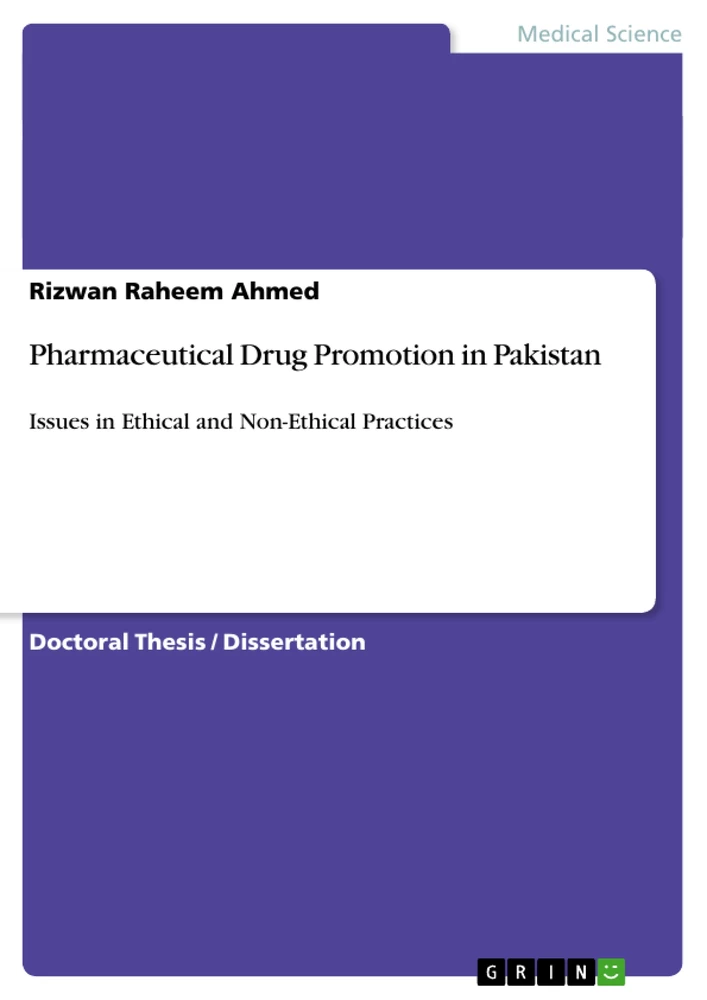
Table of Contents
Chapter I: INTRODUCTION
1.1 Background of the Study
1.2 An Overview of Pakistani Pharmaceutical Industry
1.3 Statement of the Problem
1.4 Research Hypotheses
1.5 Purpose of the Study
1.5.1 General Purpose
1.5.2 Specific Purpose
1.6 Scope of the Study
1.7 Justification
1.8 Definition of Key Words & Phrases
Chapter II: REVIEW OF THE LITERATURE
Chapter III: RESEARCH METHODOLOGY
3.1 Data, Sample and Methodology
3.2 Total Population
3.3 Targeted Population
3.4 Sample Size
3.5 Pharmaceutical Sales & Marketing Personnel
3.5.1 Multinational/National Pharmaceutical Personnel
3.6 Doctors Community
3.6.1 General Practitioners (Both Rural & Urban)
3.6.2 MOs & RMOs of Public & Private Hospitals
3.6.3 Consultants of All Specialties
3.7 Hospitals
3.7.1 Public Hospitals
3.7.2 Private Hospitals
3.8 Pharmacies
3.8.1 Retail Pharmacies
3.8.2 Whole Sales Pharmacies
3.9 Government Officials
3.9.1 Federal/Provincial Government Officials
3.10 Patients or their attendants’
3.10.1 Outdoor Patients & their attendants’
3.10.2 Indoor Patients & their attendants’
3.11 Plan of Data Analysis
Chapter IV: DATA ANALYSIS
4.1 Survey Findings
4.1.1 Gender
4.1.2 Age
4.1.3 Experience
4.1.4 Education
4.1.5 Respondents
4.1.6 Pharmaceutical Personnel
4.1.7 Consultants
4.1.8 General Practitioners
4.1.9 RMO / MO
4.1.10 Government & Private Hospitals Officials
4.1.11 Retail Pharmacies
4.1.12 Whole Sales Pharmacies
4.1.13 Outdoor Patients
4.1.14 Indoor Patients
4.1.15 Government Officials (Federal & Provincial)
4.2 Hypotheses Testing
4.2.1 Hypothesis No. 1
4.2.2 Hypothesis No. 2
4.2.3 Hypothesis No. 3
4.2.4 Hypothesis No. 4
4.3 Qualitative Analysis
4.3.1 Tools of Unethical Drug Practices
4.3.2 Drug Promotion to Non-qualified Doctors
4.3.3 Legislation for Unethical Drug Promotion
4.3.4 Eradication of Unethical Drug Promotion
Chapter V: SUMMARY, CONCLUSIONS AND RECOMMENDATIONS
5.1 Summary & Conclusions
5.2 Recommendations
5.3 Suggested Areas of Further Research
Objectives and Key Research Themes
The primary objective of this study is to analyze unethical pharmaceutical drug promotion practices in Pakistan and evaluate their impact on the general public. The research aims to identify which stakeholders are most responsible for these practices, the trends behind them, and whether current regulatory frameworks require further legislative intervention.
- Identification of intensity and trends of unethical drug promotion in Pakistan.
- Evaluation of roles played by pharmaceutical companies, doctors, and healthcare institutions.
- Statistical testing of hypotheses regarding unethical practices across urban and rural settings.
- Assessment of the effectiveness of existing regulatory mechanisms and the need for new legislation.
Extract from the Book
1.1 BACKGROUND OF THE STUDY
Unethical marketing practices have become an essential part of the pharmaceutical industry in Pakistan and roots are so strong that it may not be possible to reverse the same (Parmar & Jalees, 2004). However the previous study has a limitation. It was a case study on pharmaceutically industry in Hyderabad. In view of the findings of that study there was a need to carry out the same on larger basis. Thus this research has been undertaken with this objective in mind.
The phenomenon of the unethical drug practices is common worldwide but its severity is deep rooted in developing countries. Unethical drug practices have two dimensions. One is drug related, and other is drug promotion related. Extensive research on drug related unethical practices has been carried out internationally. However, the author was not able to find any empirical study on unethical drug promotion practices except the one that was carried out by (Parmar, Jalees, 2004) in Pakistan. Parmar and Jalees (2004) in their study observed that pharmaceutical industry spends a substantial portion of its budget on market research but do not carry out the research on unethical drug promotion practices. One of the reasons is that the industry itself is indulged in this practice therefore it does not find any need to carry out the research on this issue.
Summary of Chapters
Chapter I: INTRODUCTION: Provides the background of unethical drug promotion practices in Pakistan, outlines the research problem, hypotheses, and states the core objectives of the study.
Chapter II: REVIEW OF THE LITERATURE: Examines existing academic and industry reports on unethical pharmaceutical marketing practices globally and in developing countries, highlighting the roles of various stakeholders.
Chapter III: RESEARCH METHODOLOGY: Details the research design, including the population, sampling techniques, and the six variables analyzed to test the study's hypotheses.
Chapter IV: DATA ANALYSIS: Presents the findings from the survey, including demographic information of the respondents and the results of hypothesis testing using Z-tests and ANOVA.
Chapter V: SUMMARY, CONCLUSIONS AND RECOMMENDATIONS: Synthesizes the empirical findings, draws final conclusions about the responsibility of pharmaceutical companies and doctors, and offers recommendations for policy reform.
Keywords
Pharmaceutical, Pakistan, Unethical Promotion, Marketing, Drug Promotion, Healthcare Professionals, Doctors, Corruption, Legislation, Ethics, Clinical Trials, Generic Drugs, Multinational Companies, Medical Representatives, Public Health.
Frequently Asked Questions
What is the core focus of this research?
This study examines the unethical marketing and promotion practices within the pharmaceutical industry in Pakistan, focusing on how these practices persist and which stakeholders are primarily responsible.
What are the primary variables analyzed?
The researcher focuses on six key variables: pharmaceutical sales and marketing personnel, the doctors' community, retail and wholesale pharmacies, government and private hospital personnel, government officials, and patients or their attendants.
What is the main research question?
The central questions are: How common are unethical drug promotion practices in Pakistan? Who initiated these practices? Who is responsible for their continuation?
What scientific methods were employed?
The study utilizes both descriptive and inferential statistics. Hypotheses were tested using Z-tests and F-tests (ANOVA) to analyze gathered survey data from a sample of 300 participants.
What does the main body cover?
The main body investigates the transition of unethical practices from being industry-driven to being fueled by the demands of the medical community, alongside qualitative analysis of tools like monetary rewards and foreign trips.
What are the key descriptive characteristics of the study?
The work is characterized by its empirical approach to quantifying corruption in the pharmaceutical sector, specifically focusing on the Karachi case study to represent the broader Pakistani market.
How do pharmaceutical companies influence doctors in Pakistan according to the study?
The study concludes that companies influence prescribing habits through "monetary rewards," "local and foreign visits," "personalized gifts," and "chamber decoration," often disguising these as educational conferences.
What is the conclusion regarding the primary initiator of these practices?
The study concludes that while pharmaceutical companies were initially responsible for introducing these unethical norms, the doctor community is currently more responsible for their continuation due to increased and unreasonable demands.
Ende der Leseprobe aus 208 Seiten
- nach oben
- Arbeit zitieren
- Rizwan Raheem Ahmed (Autor:in), 2012, Pharmaceutical Drug Promotion in Pakistan, München, Page::Imprint:: GRINVerlagOHG, https://www.diplomarbeiten24.de/document/276715


neugierig - aktuell - relevant
Entdecken Sie hilfreiche Tipps und Tricks rund ums Studium!

Entdecken Sie hilfreiche Tipps und Tricks rund ums Studium!
Ihre Hausarbeit / Abschlussarbeit:

- - Publikation als E-Book und Buch
- - Hohes Honorar auf die Verkäufe
- - Für Sie komplett kostenlos - mit ISBN
- - Es dauert nur 5 Minuten
- - Jede Arbeit findet Leser

- © GRIN Publishing GmbH.
- Alle Inhalte urheberrechtlich geschützt. Kopieren und verbreiten untersagt.
- info@grin.com
- AGB
- Open Publishing
Der GRIN Verlag hat sich seit 1998 auf die Veröffentlichung akademischer eBooks und Bücher spezialisiert. Der GRIN Verlag steht damit als erstes Unternehmen für User Generated Quality Content. Die Verlagsseiten GRIN.com, Hausarbeiten.de und Diplomarbeiten24 bieten für Hochschullehrer, Absolventen und Studenten die ideale Plattform, wissenschaftliche Texte wie Hausarbeiten, Referate, Bachelorarbeiten, Masterarbeiten, Diplomarbeiten, Dissertationen und wissenschaftliche Aufsätze einem breiten Publikum zu präsentieren.
Kostenfreie Veröffentlichung: Hausarbeit, Bachelorarbeit, Diplomarbeit, Dissertation, Masterarbeit, Interpretation oder Referat jetzt veröffentlichen!
Folgen Sie GRIN auf


- GRIN Verlag GmbH
-
- Nymphenburger Str. 86
- 80636
- Munich, Deutschland
- +49 89-550559-0
- +49 89-550559-10
- info@grin.com
-
