
präsentiert von

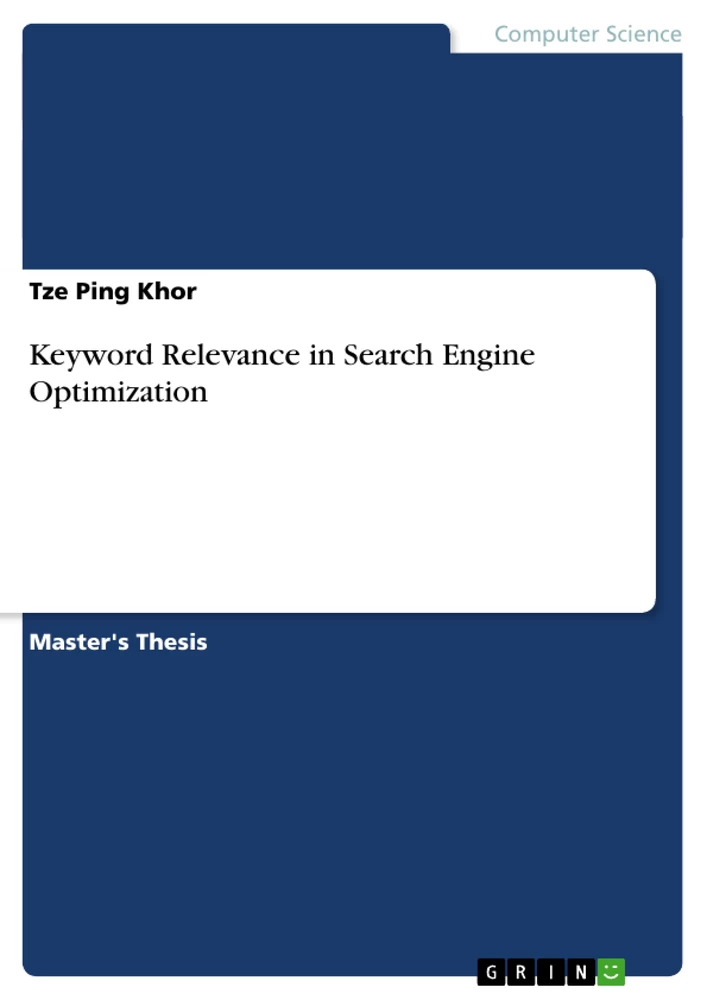
Table of Contents
CHAPTER 1 INTRODUCTION
1.1. Background of Study
1.2. Objective of Study
1.3. Challenges
CHAPTER 2 LITERATURE REVIEW
2.1. Search Engine History
2.2. Popularity vs. Relevancy
2.3. How Does a Web Search Works
2.4. Accuracy of Search Engines
2.5. Calculating PageRank
2.6. Importance of Keywords
2.7. How Search Engines Remain Viable
2.8. What is Search Engine Optimization (SEO)
2.9. How Does Google Work
2.10. Related Research
2.11. Research Questions
2.12. Research Limitations
CHAPTER 3 RESEARCH METHODOLOGY
3.1. Test Platform
3.2. Benchmark Website Creation
3.3. Keywords Creation
3.4. Keywords Counting
3.5. Search Engine Ranking Check
3.6. Inbound Links Check
3.7. Analysis of Domain Age
3.8. Analysis of Recent Updates
3.9. Analysis of Social Interest
3.10. Overall Analysis
CHAPTER 4 DATA ANALYSIS AND RESULTS
4.1. Evaluation of analytic tools
4.1.1. Keyword Count Analysis Using Keyword Density Analyzer
4.1.2. Analysis of Inbound Links Using ahrefs
4.1.3. Analysis of Domain Age Using Domain Age Checker from SEOChat
4.1.4. Analysis of Site Freshness from SiteBeam
4.1.5. Analysis of Site Ranking Using Rank Checking Tool from SEOCentro
4.1.6. Summary of Tools Analysis
4.2. Keyword Analysis Test 1
4.3. Keyword Analysis Test 2
4.4. Keyword Analysis Test 3
4.5. Social Interest Test on Google
4.6. Social Interest Test on Bing and Yahoo
4.7. Backlinks Check on Bing and Yahoo
4.8. Keyword vs. Backlinks Test on Bing and Yahoo
4.9. Social Interest vs. Backlinks Test on Google
4.10. Analysis of Results
4.11. Comparison of Results
CHAPTER 5 DISCUSSION AND CONCLUSION
5.1. Discussion
5.2. Summary of Findings
5.3. Limitations
5.4. Conclusion
5.5. Future Research Recommendations
Research Objectives and Themes
The primary objective of this research is to evaluate the influence of keyword relevance on search engine rankings in modern search technology. By conducting comparative tests across major search engines, the study examines whether keyword count remains a critical determinant for ranking or if other metrics, such as social interest, domain age, and backlinks, have become more influential in determining search results.
- Analysis of keyword relevance and search engine ranking algorithms.
- Evaluation of secondary ranking factors, including backlinks and domain age.
- Investigation of social interest as a modern ranking metric on Google.
- Comparative analysis of Google, Bing, and Yahoo performance.
- Examination of geo-targeting effects on search result accuracy.
Auszug aus dem Buch
2.2. Popularity vs. Relevancy
In the world of search engines popularity and relevancy of a website are two different things. A site may be popular but may not be relevant for a search. Conversely, a site may be relevant for a search but may not be that popular.
Popularity is determined by the number of links pointing towards a site. The more links pointing towards a site the more popular it is (Dover & Dafforn, 2011). Since popularity of a site does not mean it is relevant to a search, another metric to gauge relevancy has to be determined. Think of it as a site like Facebook. Facebook is a site which is very popular and may turn up in your searches but it does not mean a search like “buy Christmas stockings” should end up in Facebook as Facebook does not sell Christmas stockings.
In the world of search engines, relevancy is determined by the theoretical distance between two corresponding items with regards to relationship (Dover & Dafforn, 2011). Search engines therefore need to determine relevancy by analyzing the content of a webpage, website or document. A webpage with more relevant content would be ranked higher than a webpage with less relevant content. This would enable the search engine to use a list based on the rankings to present the search results to the searcher with the highest ranked webpage being shown first and followed by the other webpages with lower ranks in succession.
Summary of Chapters
CHAPTER 1 INTRODUCTION: This chapter provides an overview of how search engines operate and outlines the research objective regarding the effectiveness of keywords in determining search rankings.
CHAPTER 2 LITERATURE REVIEW: This section covers the history of search engines, the evolution of ranking algorithms like PageRank, and previous research concerning SEO, popularity versus relevancy, and ranking factors.
CHAPTER 3 RESEARCH METHODOLOGY: This chapter details the technical framework for the study, including the selection of a benchmark website and the various tools used to monitor keywords, backlinks, and social signals.
CHAPTER 4 DATA ANALYSIS AND RESULTS: This section presents the findings from eight distinct tests conducted to measure the impact of keywords, backlinks, and social interest on ranking across different engines.
CHAPTER 5 DISCUSSION AND CONCLUSION: This chapter synthesizes the experimental data to conclude that while keywords remain relevant, other metrics like social interest have become significant, particularly for Google.
Keywords
Search engines, search engine optimization, keyword research, keyword relevance, search engine ranking, PageRank, backlinks, social interest, algorithm, SEO, Google, Yahoo, Bing, web indexing, geo-targeting.
Frequently Asked Questions
What is the core focus of this research?
The research explores the shifting importance of keyword relevance within search engine ranking algorithms compared to other modern factors.
What are the central thematic areas?
The study centers on search technology, specifically analyzing keywords, site freshness, social media engagement, and backlink authority.
What is the primary research goal?
The aim is to determine how significantly keywords affect search engine results compared to secondary metrics in today's demanding search landscape.
Which scientific method is utilized?
The researcher uses an empirical, experimental approach, creating a controlled benchmark website and utilizing various analytic tools to perform comparative ranking tests across Google, Bing, and Yahoo.
What is covered in the main section of the work?
The main body focuses on a comparative analysis of search engine performance, documenting eight specific tests to isolate the impact of different variables on search rankings.
Which keywords characterize this paper?
Key terms include search engine optimization (SEO), PageRank, keyword relevance, social interest, and search algorithms.
How does Google differ from Bing and Yahoo in terms of ranking factors?
The research concludes that while Bing and Yahoo lean heavily on backlink counts, Google places a higher degree of importance on social interest factors.
What role does geo-targeting play in this study?
The study identifies geo-targeting as a challenging variable that can skew results, necessitating local search engine access to ensure a fair comparison of data.
Ende der Leseprobe aus 96 Seiten
- nach oben
- Arbeit zitieren
- Tze Ping Khor (Autor:in), 2014, Keyword Relevance in Search Engine Optimization, München, Page::Imprint:: GRINVerlagOHG, https://www.diplomarbeiten24.de/document/278141

neugierig - aktuell - relevant
Entdecken Sie hilfreiche Tipps und Tricks rund ums Studium!

Entdecken Sie hilfreiche Tipps und Tricks rund ums Studium!
Ihre Hausarbeit / Abschlussarbeit:

- - Publikation als E-Book und Buch
- - Hohes Honorar auf die Verkäufe
- - Für Sie komplett kostenlos - mit ISBN
- - Es dauert nur 5 Minuten
- - Jede Arbeit findet Leser

- © GRIN Publishing GmbH.
- Alle Inhalte urheberrechtlich geschützt. Kopieren und verbreiten untersagt.
- info@grin.com
- AGB
- Open Publishing
Der GRIN Verlag hat sich seit 1998 auf die Veröffentlichung akademischer eBooks und Bücher spezialisiert. Der GRIN Verlag steht damit als erstes Unternehmen für User Generated Quality Content. Die Verlagsseiten GRIN.com, Hausarbeiten.de und Diplomarbeiten24 bieten für Hochschullehrer, Absolventen und Studenten die ideale Plattform, wissenschaftliche Texte wie Hausarbeiten, Referate, Bachelorarbeiten, Masterarbeiten, Diplomarbeiten, Dissertationen und wissenschaftliche Aufsätze einem breiten Publikum zu präsentieren.
Kostenfreie Veröffentlichung: Hausarbeit, Bachelorarbeit, Diplomarbeit, Dissertation, Masterarbeit, Interpretation oder Referat jetzt veröffentlichen!
Folgen Sie GRIN auf


- GRIN Verlag GmbH
-
- Nymphenburger Str. 86
- 80636
- Munich, Deutschland
- +49 89-550559-0
- +49 89-550559-10
- info@grin.com
-
