
präsentiert von

Contents
Chapter 1 Introduction
1.1. Historical Retrospect – The Advent of the Electric Vehicle in 1900
1.2. Electric Vehicles within the Context of Sustainability
1.3. Objective of Thesis and Methodical Approach
1.4. Present State of Knowledge
Chapter 2 The Zero-Emission Vehicle Fleet Simulation Model – ZEVS
2.1. Theory on the Prerequisites of Energy Demand Comparisons
2.2. Selected Electric Vehicle Technologies
2.3. Applied Driving Cycles
2.4. Modelling the Development of the Future Kerb Weight of Vehicles
2.5. Modelling the Power Demand for Heating and Cooling Electric Vehicles
2.6. Methodology for Calculating the Total Electric Vehicle Fleet of a Country
2.7. The Implications of Mobility Habits
2.8. The Resulting Consumption Curves Specific to Electric Vehicles
Chapter 3 The Energy System Simulation & Optimisation Model – URBS-EU
3.1. Model Genesis
3.2. Model Methodology
3.3. Model Input Data
Chapter 4 Integration & Evaluation Principals of Electric Vehicles
4.1. Theory on the Integration of Electric Vehicles in Energy Systems
4.2. Allocation and Evaluation Methods for Analysing Electric Vehicles
Chapter 5 The System of Reference – ICVs
5.1. The Technological Basis of ICVs
5.2. CO2 Emission Goals for ICVs until 2050
5.3. The Growing Link between the Transport and the Energy Sectors: EVs
Chapter 6 Simulation Results & Analyses
6.1. The Sustainability of Electric Vehicles Today (2015)
6.2. The Sustainability of Electric Vehicles in the Future (2015 – 2050)
Chapter 7 Summary & Conclusion
Thesis Objectives and Key Topics
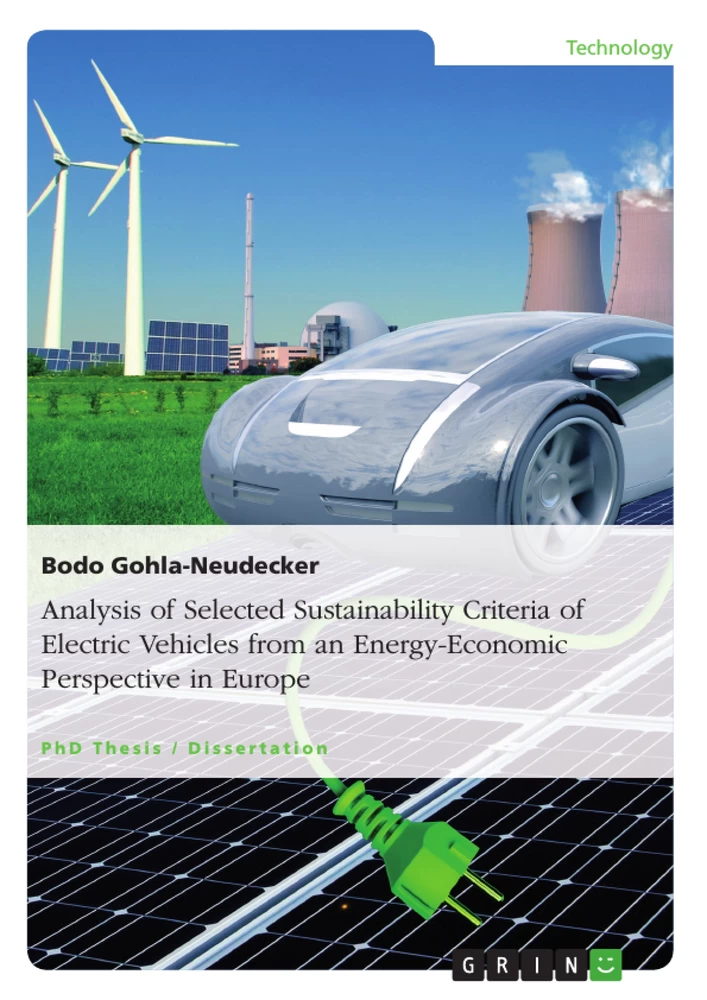
This dissertation aims to evaluate the sustainability of electric vehicles by assessing their energy-economic impact compared to internal combustion engine vehicles (ICVs) in Europe from 2015 to 2050. The central research question focuses on whether electric vehicles offer a more sustainable mobility alternative when evaluated against well-to-wheel efficiencies, CO2 emissions, and energy costs.
- Development of the Zero-Emission Vehicle Fleet Simulation Model (ZEVS) to model hourly energy demand.
- Integration of ZEVS with the URBS-EU energy system model to optimize power plant portfolios.
- Comparative analysis of allocation methodologies: Mix, Delta, and Parallel Market methods.
- Long-term evaluation of sustainability indicators in 27 European countries under EU climate targets.
- Assessment of the economic impact of vehicle electrification on energy markets and emission certificate prices.
Excerpt from the Book
1.1. Historical Retrospect – The Advent of the Electric Vehicle in 1900
Over a hundred years ago, at the turn of the last century, a techno-economic development rolled up an entire industry, which was dedicated to satisfying the need for individual travel. The ubiquitously found horse-and-carriage was to become technically and economically obsolete in comparison to the breakthrough development of coupling an engine to the axel of a carriage. The years around 1900 went down in history as a tipping point for individual travel – away from horse-powered carriages towards electrified and mechanised auto-mobility.
As an unforeseen side effect specifically in large urban centres, the technical evolution of the horse-and-carriage also proved to be a step towards cleaner, more sustainable mobility. This might be misconceived in today’s terms if the high traffic pollution in cities comes to mind. However, a closer examination of individual travel in 1900 shows why the horse-and-carriage provides an even greater contribution to urban pollution than automobiles.
The common mode of individual travel in those days involved the equipping of horses in conjunction with their required harnessing gear to the designated carriage, which accommodated the driver with the steering reins and other passengers (Figure 1-1). In today’s terms, the preparation of the horse-and-carriage for a trip entailed quite an elaborate procedure: It involved stabling, feeding and grooming the horses adequately (high additional expenditures of time and money) and yoking them into their harnessing position in front of the carriage. These labour and time intensive arrangements were often the part time of a number of employees, provided the owner was able to afford the whole financial extent of this mode of individual travel.
With increased population concentrations in ever larger American and European cities and their considerable numbers of people entering and exiting from rural outskirts on a daily basis, individual travel by horse-and-carriage became increasingly popular and also affordable. It was the first materialisation of mass mobility on an individual basis.
Summary of Chapters
Chapter 1 Introduction: Provides a historical perspective on individual mobility, defines the concept of sustainability, and outlines the objectives and methodological approach of the thesis.
Chapter 2 The Zero-Emission Vehicle Fleet Simulation Model – ZEVS: Describes the development of the simulation model, detailing drive train technologies, driving cycles, kerb weight modelling, and electricity demand estimation for electric vehicle fleets.
Chapter 3 The Energy System Simulation & Optimisation Model – URBS-EU: Explains the methodology of the European energy system model, including its optimization logic, input parameters, and how it incorporates electric vehicle demand.
Chapter 4 Integration & Evaluation Principals of Electric Vehicles: Discusses the theoretical framework for integrating electric vehicles into energy systems and presents three allocation methods (Mix, Delta, Parallel Market) to assess their sustainability.
Chapter 5 The System of Reference – ICVs: Defines the internal combustion engine vehicle as the technological benchmark, detailing future efficiency potential, emission targets, and economic constraints.
Chapter 6 Simulation Results & Analyses: Interprets and evaluates the simulation results for both 2015 and the period up to 2050, focusing on well-to-wheel efficiency, CO2 emissions, and energy costs.
Chapter 7 Summary & Conclusion: Summarizes the key findings of the research and provides an outlook on potential model improvements and the long-term role of electric vehicles in the energy system.
Keywords
Electric Vehicles, Sustainability, Energy Economics, Simulation Modelling, ZEVS, URBS-EU, Well-to-Wheel, CO2 Emissions, Energy Efficiency, Power System Optimization, Merit Order, Charging Infrastructure, Renewable Energy, Future Mobility, Transport Sector.
Frequently Asked Questions
What is the core focus of this dissertation?
The research examines the environmental and economic sustainability of large-scale electric vehicle (EV) adoption in Europe from 2015 to 2050, specifically evaluating how EVs interact with the European energy system.
What are the primary thematic areas covered?
The thesis covers energy system modelling, electric vehicle fleet simulation, allocation methodologies for sustainability criteria (efficiency, emissions, costs), and a comparative analysis against internal combustion engine vehicles.
What is the main objective of the thesis?
The primary goal is to quantitatively assess whether electric vehicles represent a more sustainable mobility option than internal combustion engine vehicles by applying energy-economic indicators to future development scenarios.
Which scientific methods are utilized?
The author developed the ZEVS model for vehicle fleet simulation and utilized the URBS-EU model for energy system optimization. Three specific allocation methods—Mix, Delta, and Parallel Market—are used to attribute energy-economic impacts to EVs.
What is the focus of the main body?
The main body details the methodology for simulating future vehicle mass (kerb weight) and HVAC demand in the ZEVS model, explains the cost-optimal power plant dispatch in the URBS-EU model, and provides a comparative evaluation of sustainability criteria across different European energy policies.
Which keywords characterize this work?
Key terms include Electric Vehicles, Well-to-Wheel, Sustainability, Energy System Optimization, CO2 Emissions, and Energy Economics.
How does the author model future vehicle weights?
The author utilizes an iterative methodology called the "degressive weight spiral," which accounts for technological advancements in light-weighting and lithium-ion battery energy density to simulate vehicle mass reduction potential through 2050.
Why is the "Delta Method" important?
The Delta method is used to isolate the specific impact of the additional electricity demand of an electric vehicle fleet on the energy system, allowing for a more focused allocation of marginal emissions and costs compared to the aggregate average provided by the Mix method.
Ende der Leseprobe aus 208 Seiten
- nach oben
- Arbeit zitieren
- Bodo Gohla-Neudecker (Autor:in), 2014, Analysis of Selected Sustainability Criteria of Electric Vehicles from an Energy-Economic Perspective in Europe, München, Page::Imprint:: GRINVerlagOHG, https://www.diplomarbeiten24.de/document/279160

neugierig - aktuell - relevant
Entdecken Sie hilfreiche Tipps und Tricks rund ums Studium!

Entdecken Sie hilfreiche Tipps und Tricks rund ums Studium!
Ihre Hausarbeit / Abschlussarbeit:

- - Publikation als E-Book und Buch
- - Hohes Honorar auf die Verkäufe
- - Für Sie komplett kostenlos - mit ISBN
- - Es dauert nur 5 Minuten
- - Jede Arbeit findet Leser

- © GRIN Publishing GmbH.
- Alle Inhalte urheberrechtlich geschützt. Kopieren und verbreiten untersagt.
- info@grin.com
- AGB
- Open Publishing
Der GRIN Verlag hat sich seit 1998 auf die Veröffentlichung akademischer eBooks und Bücher spezialisiert. Der GRIN Verlag steht damit als erstes Unternehmen für User Generated Quality Content. Die Verlagsseiten GRIN.com, Hausarbeiten.de und Diplomarbeiten24 bieten für Hochschullehrer, Absolventen und Studenten die ideale Plattform, wissenschaftliche Texte wie Hausarbeiten, Referate, Bachelorarbeiten, Masterarbeiten, Diplomarbeiten, Dissertationen und wissenschaftliche Aufsätze einem breiten Publikum zu präsentieren.
Kostenfreie Veröffentlichung: Hausarbeit, Bachelorarbeit, Diplomarbeit, Dissertation, Masterarbeit, Interpretation oder Referat jetzt veröffentlichen!
Folgen Sie GRIN auf


- GRIN Verlag GmbH
-
- Nymphenburger Str. 86
- 80636
- Munich, Deutschland
- +49 89-550559-0
- +49 89-550559-10
- info@grin.com
-
