
präsentiert von

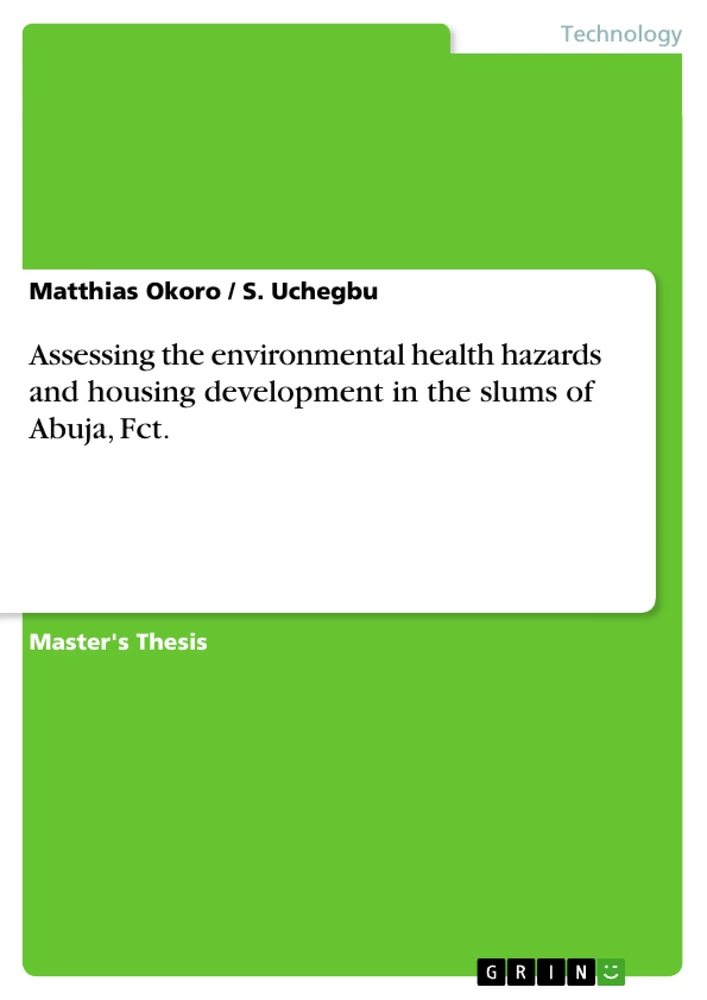
Table of Contents
1. Introduction
1.2 Statement of the Problem
1.3 The Aim/Objectives
1.3.1 Objectives
1.4 Research Question
1.5 Hypotheses Formulation
1.6 Significance of the Study
1.7 Scope
1.8 Limitations
2. Theoretical Framework
2.1 Human Settlement Theory
2.1.1 Locational Theory
2.1.2 Central Place Theory
2.1.3 Housing Development in a Slum
2.2 Urbanization Theory
2.2.1 Environmental Hazard and Slum House Development
2.2.2 Nature of Developed Houses in Slums
2.3 Sector Theory
2.3.1 Waste and Pollution in a Slum
2.4 Population Theory
2.4.1 Principle of Population
2.4.2 Slum and Overpopulation
2.5 Primacy Theory
2.5.1 Cumulative Causation
2.5.2 The Devastating Environmental Hazards in Slum
2.6 Definition of Terms
3. Literature Review
3.1 Slum Development in 3rd World Countries, Causes, Effect and Way Out
3.2 The Improvement of Slums and Informal Settlements
3.3 Reducing the Environmental Health Risk of Slum Dwellers in a Developing Country
3.4 The Nature of a Slum
3.5 Environmental Impact in a Slum
3.6 Environmental Sanitation in a Slum
3.7 Research Gap
4. Study Area
4.1 Historical Background
4.2 Location
4.3 Population
4.4 Physiographic Characteristic
4.4.1 Climate
4.4.2 Topographic and Geological Classification
4.4.3 Flora and Fauna
4.4.4 Socio-Economic Activities
5. Method of Study
5.1 Sampling Procedure
5.2 Source of Data Collection
5.2.1 Secondary Source of Data Collection
5.2.2 Primary Source of Data Collection
5.3 Data Treatment Technique
6. Data Presentation, Analysis and Finding
6.1 Data Presentation
6.1.1 Sex of the Respondent
6.1.2 Marital Status of the Respondents in the Study Area
6.1.3: Respondents Qualification in the Study Area
6.1.4: Categories of Worker in the Study Area
6.1.5 Activities of the Respondent in the Study Area
6.1.6 Waste Disposal Method of the Respondents in the Study Area
6.1.7 Types of Houses occupied by the Respondents in the Study Area
6.1.8 Types of Soak Away pit in Respondents House
6.1.9 Sources of Drinking Water in the Study Area
6.1.10: Indicators of Environmental Health Hazard and Housing Development
6.1.11: Health Devastating Diseases and Ramshackle Developed Houses
6.1.12 Laboratory Analysis
6.1.13 Soil Sample Test
6.2 Data Analysis
6.2.1 Result of the Indicator of Environmental Health Hazards and Housing Development
6.2.2 Result of the Occurrence of Health Devastating Diseases and Ramshackle Developed Houses
6.2.3 Result of the Differences in the Indicators of Environmental Health Hazards among the Slum Areas of Abuja
6.2.4 Test of Hypothesis
6.3 Discussion of Findings
7. Summary, Conclusion and Recommendation
7.1 Summary
7.2 Conclusion
7.3 Recommendation
7.3.1 Slum Upgrading Programmes
7.3.2 Main Actors
7.3.3 Scaling Up
Research Goals and Themes
The research aims to conduct a scholarly assessment of environmental health hazards and housing development in the slum areas of Abuja, Nigeria, in order to identify the causal links between uncontrolled urban expansion and the deterioration of public health, and to propose data-driven recommendations for sustainable improvement.
- Identification of slum dwellers' activities impacting the human environment.
- Analysis of environmental health indicators (pollution, waste disposal, water quality).
- Statistical correlation between housing quality (ramshackle structures) and disease prevalence.
- Assessment of slum upgrading strategies and institutional capacity.
- Examination of heavy metal concentrations in soil as an environmental hazard.
Excerpt from the Book
1.1 BACKGROUND OF STUDY
According to Sule (2004), one serious problem of over urbanization and environmental quality had been revealed by the index and chronic housing deficit to provide adequate accommodation for it’s over populated dwellers. Shortage of housing accommodation has become an enduring feature of the urbanization process generally on the globe and cities of the developing countries in particular. The earth, our spaceship is a habitat for 7 billion people with over one billion people around the world living in slums. Going by these anomalies, it is estimated that by 2030 the world’s slum population could rise to two billion if no action is taken. (United Nation Center for human settlement – UNIHABITAT, 2011). For the poor, this environmental challenge seems to pose no problem to them, this is because urban areas have, and will continue to provide a means of improving quality of life, as well as being in close proximity to better jobs and income more than the rural settings. Deteriorating condition for those who live a rural life style and the promise of a better life have prompted million of rural inhabitant the world over to migrate to the nearby cities. This development has given rise to one of the
Summary of Chapters
Chapter 1: Establishes the research foundation by identifying the global and local crises of over-urbanization, defining the objectives, and formulating hypotheses regarding the impact of slum housing on health.
Chapter 2: Outlines the theoretical foundations, including Human Settlement, Urbanization, Population, and Primacy theories, which explain the socio-economic and spatial drivers of slum formation.
Chapter 3: Reviews existing literature on slum development, environmental health risks in developing countries, and strategies for slum improvement and sanitation.
Chapter 4: Provides a detailed profile of Abuja, including its historical background, population dynamics, and physiographic characteristics such as climate and topography.
Chapter 5: Details the research methodology, including sampling procedures for ten selected slum areas, data collection instruments, and laboratory experiments for soil and water quality analysis.
Chapter 6: Presents the primary data collected, including detailed statistical analyses and hypothesis testing regarding environmental health hazards and their relationship to housing development.
Chapter 7: Concludes the research with a summary of findings and actionable recommendations for slum upgrading programmes, institutional roles, and scaling up initiatives.
Keywords
Abuja, Slums, Environmental Health Hazards, Housing Development, Urbanization, Overpopulation, Ramshackle Structures, Sanitation, Heavy Metals, Public Health, Sustainable Development, Slum Upgrading, Demographic Growth, Waste Management, Infrastructure.
Frequently Asked Questions
What is the core focus of this research?
The work primarily focuses on evaluating the nexus between environmental health hazards and the development of substandard housing within the slum settlements of Abuja, Nigeria.
What are the primary themes addressed?
The study centers on urbanization dynamics, housing quality, sanitation challenges, soil contamination, and the prevalence of water-borne and respiratory diseases among low-income urban dwellers.
What is the central research objective?
The main objective is to empirically assess the effect of environmental hazards on housing development, to identify differences in hazard distribution among various slums, and to suggest policy solutions.
Which scientific methodologies were employed?
The study utilizes a mixed-methods approach, including participant observation, household questionnaires, statistical analysis (PCA and ANOVA), and laboratory testing of soil and water samples.
What is examined in the core chapters?
The study moves from theoretical frameworks of urban growth to a detailed empirical analysis of specific slum areas, focusing on data presentation, laboratory results, and hypothesis validation.
What key terms define the work?
The research is defined by concepts such as slum emergence, urban primacy, environmental impact, bioaccumulation of heavy metals, and sustainable slum upgrading strategies.
How does this study contribute to environmental policy?
It provides empirical evidence that rapid, uncontrolled housing expansion is the primary driver of environmental degradation in Abuja, helping policymakers identify where intervention is most urgent.
What were the major findings regarding soil quality?
Laboratory analysis indicated that open dump sites in these slums are highly contaminated with heavy metals like lead, cadmium, and arsenic, which pose long-term neurotoxic and carcinogenic risks to the residents.
Ende der Leseprobe aus 210 Seiten
- nach oben
- Arbeit zitieren
- Matthias Okoro (Autor:in), Prof. S. Uchegbu (Autor:in), 2014, Assessing the environmental health hazards and housing development in the slums of Abuja, Fct., München, Page::Imprint:: GRINVerlagOHG, https://www.diplomarbeiten24.de/document/280701

neugierig - aktuell - relevant
Entdecken Sie hilfreiche Tipps und Tricks rund ums Studium!

Entdecken Sie hilfreiche Tipps und Tricks rund ums Studium!
Ihre Hausarbeit / Abschlussarbeit:

- - Publikation als E-Book und Buch
- - Hohes Honorar auf die Verkäufe
- - Für Sie komplett kostenlos - mit ISBN
- - Es dauert nur 5 Minuten
- - Jede Arbeit findet Leser

- © GRIN Publishing GmbH.
- Alle Inhalte urheberrechtlich geschützt. Kopieren und verbreiten untersagt.
- info@grin.com
- AGB
- Open Publishing
Der GRIN Verlag hat sich seit 1998 auf die Veröffentlichung akademischer eBooks und Bücher spezialisiert. Der GRIN Verlag steht damit als erstes Unternehmen für User Generated Quality Content. Die Verlagsseiten GRIN.com, Hausarbeiten.de und Diplomarbeiten24 bieten für Hochschullehrer, Absolventen und Studenten die ideale Plattform, wissenschaftliche Texte wie Hausarbeiten, Referate, Bachelorarbeiten, Masterarbeiten, Diplomarbeiten, Dissertationen und wissenschaftliche Aufsätze einem breiten Publikum zu präsentieren.
Kostenfreie Veröffentlichung: Hausarbeit, Bachelorarbeit, Diplomarbeit, Dissertation, Masterarbeit, Interpretation oder Referat jetzt veröffentlichen!
Folgen Sie GRIN auf


- GRIN Verlag GmbH
-
- Nymphenburger Str. 86
- 80636
- Munich, Deutschland
- +49 89-550559-0
- +49 89-550559-10
- info@grin.com
-
