
präsentiert von

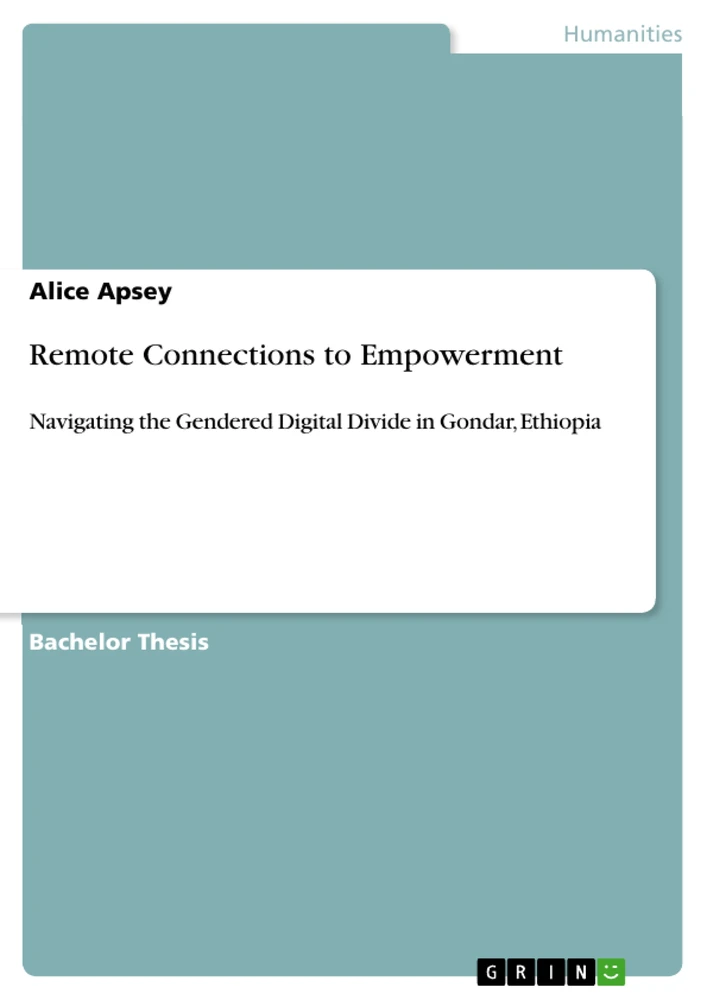
Table of Contents
Introduction
Chapter One: Conceptual Field
The ‘D’ in ICT4D: Tied to technological determinism and economic growth
Gender in ICT4D: “Add women and stir”
Diluted Empowerment
Identifying and Bridging the gap in ICT4D
Reconceptualising Empowerment in ICT4D: Incorporating choice and ‘jugaad’
Chapter Two: Research Location
Context of gender and ICT in Ethiopia
Gondar
Chapter Three: Methodologies
Sampling: Representativeness and limitations of chain-referral methods
Ethnography: Reflexivity and practice
Interviews and Focus Groups
Researching the Youth: triangulating PRA methodologies
Voicing the Silent Women
Chapter Four: An Uneven Landscape of Access
Telecommunications Infrastructure: A monopoly market
Education in Gondar: Stretched resources and unequal provision
Urban-Rural Digital Divide
Chapter Five: The Gendered Digital Divide
Cultural Constraints to ICT access: “The man, he controls the mouse”
Heterogeneity of Women’s Experiences: Tsega and Tadila
Chapter Six: Navigating the Digital Divide
Conclusion
Research Objectives and Topics
This research investigates the complex, gendered dimensions of the digital divide in Gondar, Ethiopia, by analyzing how structural factors and local realities influence access to and usage of Information and Communication Technologies (ICTs). It moves beyond binary views of the digital divide to explore how individuals navigate infrastructural and cultural constraints within their specific socio-economic contexts.
- Analysis of structural barriers to ICT access including telecommunications monopolies and educational resource limitations.
- Examination of the gendered nature of ICT access and the role of cultural norms in shaping technological participation.
- Exploration of individual agency and 'jugaad' (frugal innovation) as strategies for navigating technological exclusion.
- Assessment of the applicability of global ICT4D empowerment discourse within the specific local reality of Gondar.
Excerpt from the Book
Cultural Constraints to ICT access: “The man, he controls the mouse”
“I want to tell a story from when I was younger. My cousin is a boy, and we are of a similar age. When we were younger, we would go to school, and then afterwards, I would have work in the home and would have time to play, but also have time to study. This got me so angry! But, I was strong, and I would try and study as well as doing my work at home. When we were in Grade 10, we did a national exam, and I got a better mark than him. But our family, they still said, he should do the Natural Sciences, and me to do the Social Sciences. […] This got me so frustrated, and I would complain and ask my parents “Why?!” I would even cry because of it, I would say "Why do you decide this for myself?”. Even though I scored a good result, they did not think I would be able to do the Maths and Sciences, they thought it would be too difficult for me”.
Science and technology are traditionally perceived as male domains that are incongruous with the socially constructed image of what it is to be a woman (Litho, 2005; Dlodlo, 2009). In Gondar, many women remained burdened with traditional expectations of their roles as mothers and housewives. In some interviews, men proclaimed: “technology isn’t the business of women”, and that women had an “obligation to their children and serving their husbands”. For example, in my ICT class, the women’s attendance would fluctuate during religious holidays as they were expected to prepare food and clean their homes, whereas the male students within the class were able to attend every lesson.
Summary of Chapters
Chapter One: Conceptual Field: Examines the theoretical foundations of ICT4D, critiquing technological determinism and advocating for a more people-centered approach that considers both individual and structural factors.
Chapter Two: Research Location: Describes the specific context of Gondar, Ethiopia, highlighting the country's status regarding global connectivity and gender equality indicators.
Chapter Three: Methodologies: Details the ethnographic research design, including chain-referral sampling and participatory methods used to collect qualitative data from various stakeholders.
Chapter Four: An Uneven Landscape of Access: Analyzes the structural barriers to ICTs, focusing on the monopoly market of the telecommunications sector and the educational challenges within Gondar.
Chapter Five: The Gendered Digital Divide: Investigates the cultural and social processes that constrain women's engagement with technology, contrasting the experiences of different women.
Chapter Six: Navigating the Digital Divide: Explores how individuals use resilience and frugal innovation to overcome infrastructural and social barriers to ICT usage.
Conclusion: Synthesizes the findings, arguing that ICT4D success is highly contingent on local contexts and that technology alone is insufficient for meaningful development.
Keywords
ICT4D, Ethiopia, Gondar, Digital Divide, Empowerment, Gender, Ethnography, Technological Determinism, Education, Infrastructure, Jugaad, Agency, Social Construction, Inequality, Capabilities Approach.
Frequently Asked Questions
What is the core focus of this dissertation?
The research explores the gendered digital divide in Gondar, Ethiopia, and analyzes how local structural and cultural contexts mediate the potential for ICTs to bring about empowerment.
What are the primary themes discussed?
Key themes include the impact of telecommunications monopolies, the role of gendered expectations in technology access, educational disparities, and the strategies individuals use to negotiate limited access.
What is the main objective of the study?
The study aims to provide a nuanced, ethnographic perspective on ICT4D, moving beyond the homogenized "Western" development discourse to understand local realities and agency.
Which scientific methods were employed?
The author utilized an ethnographic approach, including thirty-nine semi-structured interviews, youth-adapted participatory rural appraisal (PRA) methods, and participant observation in educational settings.
What does the main body address?
The main body covers theoretical conceptualizations of ICT4D, the specific research location, methodological approaches, an analysis of infrastructural and educational barriers, and a detailed look at gendered cultural constraints.
Which keywords define this work?
The work is defined by concepts such as ICT4D, Ethiopia, gendered digital divide, agency, ethnography, and structural inequality.
How does the author view the concept of 'jugaad'?
The author relates 'jugaad' (frugal innovation) to the inventiveness of individuals in Gondar who find creative, low-cost ways to navigate the digital divide despite minimal infrastructure.
Why did the author include the 'voices' of silent women?
The author argues that silences in interviews are not merely data gaps but are significant findings that reveal deep-seated gendered social exclusions and the complexities of power dynamics.
How does this research challenge the traditional 'ICT4D' model?
It challenges the technologically deterministic view that the mere presence of ICTs automatically leads to development and empowerment, emphasizing instead the importance of social, economic, and political contexts.
Ende der Leseprobe aus 56 Seiten
- nach oben
- Arbeit zitieren
- Alice Apsey (Autor:in), 2014, Remote Connections to Empowerment, München, Page::Imprint:: GRINVerlagOHG, https://www.diplomarbeiten24.de/document/281113

neugierig - aktuell - relevant
Entdecken Sie hilfreiche Tipps und Tricks rund ums Studium!

Entdecken Sie hilfreiche Tipps und Tricks rund ums Studium!
Ihre Hausarbeit / Abschlussarbeit:

- - Publikation als E-Book und Buch
- - Hohes Honorar auf die Verkäufe
- - Für Sie komplett kostenlos - mit ISBN
- - Es dauert nur 5 Minuten
- - Jede Arbeit findet Leser

- © GRIN Publishing GmbH.
- Alle Inhalte urheberrechtlich geschützt. Kopieren und verbreiten untersagt.
- info@grin.com
- AGB
- Open Publishing
Der GRIN Verlag hat sich seit 1998 auf die Veröffentlichung akademischer eBooks und Bücher spezialisiert. Der GRIN Verlag steht damit als erstes Unternehmen für User Generated Quality Content. Die Verlagsseiten GRIN.com, Hausarbeiten.de und Diplomarbeiten24 bieten für Hochschullehrer, Absolventen und Studenten die ideale Plattform, wissenschaftliche Texte wie Hausarbeiten, Referate, Bachelorarbeiten, Masterarbeiten, Diplomarbeiten, Dissertationen und wissenschaftliche Aufsätze einem breiten Publikum zu präsentieren.
Kostenfreie Veröffentlichung: Hausarbeit, Bachelorarbeit, Diplomarbeit, Dissertation, Masterarbeit, Interpretation oder Referat jetzt veröffentlichen!
Folgen Sie GRIN auf


- GRIN Verlag GmbH
-
- Nymphenburger Str. 86
- 80636
- Munich, Deutschland
- +49 89-550559-0
- +49 89-550559-10
- info@grin.com
-
