
präsentiert von

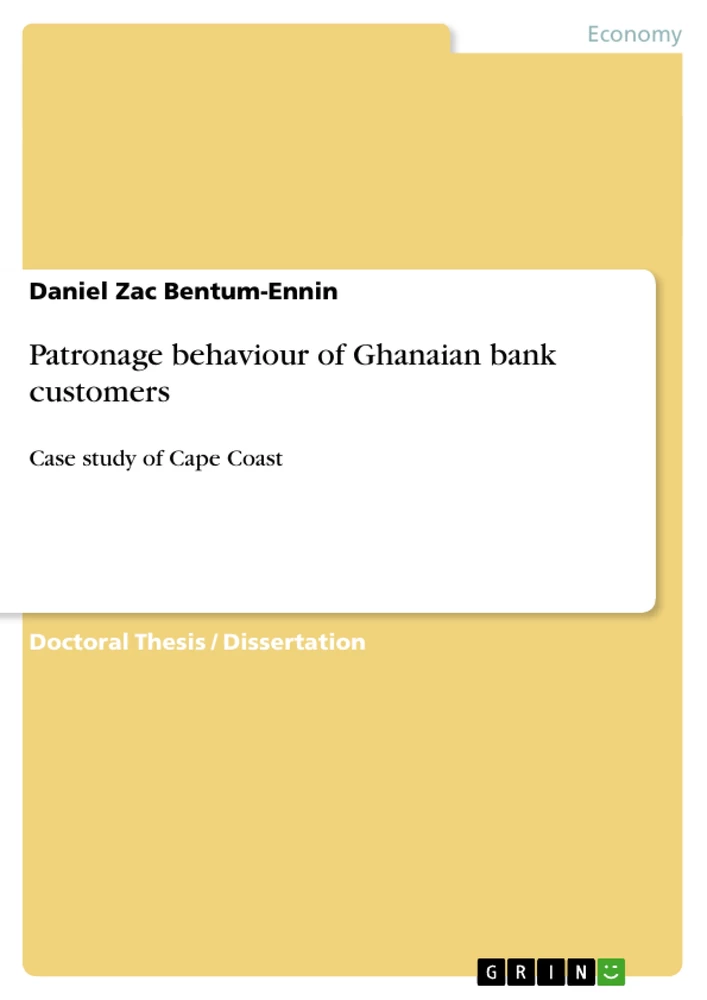
Table of Contents
1. Introduction
1.1 Country profile
1.2 History of Banking in Ghana
1.3 Current Banking system in Ghana
1.4 Aims
1.5 Objectives
1.6 Hypothesis
1.7 Dissertation structure
1.8 Chapter Summary
2. Literature Review
2.1 Introduction
2.2 Service quality
2.3 Interest rate
2.3.1 Interest rate on savings
2.4 Image and reputation of banks
2.4.1 Image of banks
2.4.2 Reputation of banks
2.5 Chapter summary
3. Methodology
3.1 Research philosophy
3.2 Research Approach
3.3 Research Strategy
3.3.1 Survey
3.3.2 Case Study
3.3.2.1 Single case verses Multiple
3.3.2.2 Holistic case verses embedded case
3.3.3 Action Research
3.3.4 Archival Research
3.4 Research Choices
3.5 Time horizons
3.6 Types of data
3.6.1 Secondary Data
3.6.2 Primary Data
3.6.2.1 Semi-structured interview
3.6.2.2 Questionnaire
3.6.2.3 Sample frame and Sample size
3.6.2.4 Sampling method
3.7 Access and Resources
3.7.1 Access
3.7.2 Resources
3.8 Limitations of sources and methodology
3.9 Ethics of the research
3.9.1 Definition of Research Ethics
3.9.2 Gaining access and Research Ethics
3.9.3 Semi structure interview and Research Ethics
3.9.4 Questionnaire and Research Ethics
3.9.5 Data Collection and Research Ethics
3.9.6 Chapter summary
4. Findings, Analysis and Presentation of Results
4.1 Questionnaire
4.1.1 Ratings of reasons for choice of bank
4.1.1.1 Gender and rating of interest rate as a reason for choice of bank
4.1.1.2 Gender and rating of service quality as a reason for choice of bank.
4.1.1.3 Bankers and rating of service quality as a reason for choice of bank.
4.1.1.4 Employment status and rating of interest rate as a reason for choice of bank.
4.1.1.5 Employment status and accessibility to loans as a reason for choice of bank
4.1.1.6 Bankers and rating of entire service quality
4.2 Semi structured interview
4.3 Chapter summary
5. Conclusion and Recommendation
5.1 Conclusion on hypothesis
5.1.1 Efficient quality service delivery of banks enhances patronage behaviour of Ghanaian bank customers.
5.1.2 Ghanaian banks understand customer behaviour.
5.1.3 Ghanaian banks know customer needs and preferences.
5.1.4 Issues of financial services of banks are best communicated through family and friends.
5.1.5 Issuance of loans attracts customers to banks in Ghana.
5.1.6 High interest rate on savings attracts customers to banks in Ghana
5.1.7 Proximity or accessibility of bank is the reason for a customer’s choice of a bank.
5.1.8 Good Image of banks attract Ghanaian bank customers to the bank
5.1.9 Good Reputation of banks attracts Ghanaian bank customers.
5.2 Recommendation
5.3 Areas for further study
Research Objectives and Focus
The primary aim of this dissertation is to investigate the patronage behavior of bank customers in Ghana, with a specific focus on the Cape Coast region, in order to assist bank management in developing efficient, quality-driven service models that satisfy existing clients while attracting new ones.
- Analysis of factors influencing customer bank selection, including service quality, corporate image, and reputation.
- Evaluation of the impact of demographic variables (gender, employment status, education) on customer preferences.
- Examination of the effectiveness of different bank advertising and communication strategies.
- Assessment of the role of interest rates and loan accessibility in customer patronage behavior.
- Comparison of customer perception between government-owned banks and private banking institutions.
Excerpt from the Book
1.1 Country profile
Ghana is located on the West African Coast with a population of 24,223,431 and has a growth rate of 28%. The population consists of 48.7% males and 51.3% females (Census 2010). Cape Coast is the capital of the central region as well as the capital city of the Fante people (Mfantsefo). “It is the historical city of Ghana, the centre of British Administration and was the capital of the Gold Coast (Ghana) by 1700 until 1877 when the capital was moved to Accra. Most of the oldest and best schools in Ghana are in Cape Coast” Ghana web (2011). Cape Coast (Cabo Corso) is situated 165 km west of Accra, the capital of Ghana and has a population of 1,593,823 (census 2010).
Summary of Chapters
1. Introduction: This chapter provides the research background, country profile, history of Ghanaian banking, and defines the aims, objectives, and hypotheses of the study.
2. Literature Review: The chapter explores theoretical and empirical literature concerning perceived service quality, bank reputation, corporate image, and factors influencing customer patronage.
3. Methodology: This section details the research design, including the philosophy, strategies (survey and case study), data collection methods (questionnaires and interviews), and ethical considerations.
4. Findings, Analysis and Presentation of Results: This chapter presents the data gathered from the survey and interviews, analyzing the impact of demographics and bank characteristics on customer choice through SPSS and ANOVA.
5. Conclusion and Recommendation: The final chapter summarizes the research findings regarding the hypotheses, provides recommendations for banking management to improve service quality and competitiveness, and suggests areas for future study.
Keywords
Patronage behavior, Ghanaian banking, Service quality, Corporate image, Corporate reputation, Customer satisfaction, Interest rates, Loan accessibility, Cape Coast, Bank selection criteria, Financial services, Consumer behavior, Banking industry, Marketing strategy, Retail banking.
Frequently Asked Questions
What is the core focus of this research?
The research explores the patronage behavior of bank customers in Ghana, specifically identifying why customers choose certain banks over others within the Cape Coast region.
What are the primary themes discussed in the work?
Key themes include service quality, corporate image, corporate reputation, interest rates, and the accessibility of loans as determinants of consumer choice in the banking sector.
What is the overarching research goal?
The goal is to provide bank management with insights to improve service delivery and marketing effectiveness to better retain existing customers and attract new ones.
Which methodology was applied in this study?
The study uses a mixed approach, primarily relying on quantitative data from customer questionnaires analyzed via SPSS/ANOVA and qualitative insights from semi-structured interviews with bank management.
What does the main body of the research address?
The main body evaluates theories of service quality and reputation, presents the study's specific methodology, and performs a detailed analysis of findings regarding how customer demographics influence their banking choices.
How would you describe the key characteristics of this research?
The research is categorized as explanatory and deductive, focused on understanding consumer motivation and behavior through the lens of banking service delivery.
How do gender differences affect bank selection according to the findings?
The study found significant differences; for example, male bank customers tend to prioritize higher interest rates and value service quality more strongly, whereas female customers place greater emphasis on social interactions and reliability.
How does the size or type of bank impact its customer base in Cape Coast?
Larger, government-owned banks like GCB maintain a large customer base due to established trust, while private banks like UT Bank have successfully targeted niche markets by offering faster loan processing and specialized services.
Ende der Leseprobe aus 113 Seiten
- nach oben
- Arbeit zitieren
- Daniel Zac Bentum-Ennin (Autor:in), 2012, Patronage behaviour of Ghanaian bank customers, München, Page::Imprint:: GRINVerlagOHG, https://www.diplomarbeiten24.de/document/281765

neugierig - aktuell - relevant
Entdecken Sie hilfreiche Tipps und Tricks rund ums Studium!

Entdecken Sie hilfreiche Tipps und Tricks rund ums Studium!
Ihre Hausarbeit / Abschlussarbeit:

- - Publikation als E-Book und Buch
- - Hohes Honorar auf die Verkäufe
- - Für Sie komplett kostenlos - mit ISBN
- - Es dauert nur 5 Minuten
- - Jede Arbeit findet Leser

- © GRIN Publishing GmbH.
- Alle Inhalte urheberrechtlich geschützt. Kopieren und verbreiten untersagt.
- info@grin.com
- AGB
- Open Publishing
Der GRIN Verlag hat sich seit 1998 auf die Veröffentlichung akademischer eBooks und Bücher spezialisiert. Der GRIN Verlag steht damit als erstes Unternehmen für User Generated Quality Content. Die Verlagsseiten GRIN.com, Hausarbeiten.de und Diplomarbeiten24 bieten für Hochschullehrer, Absolventen und Studenten die ideale Plattform, wissenschaftliche Texte wie Hausarbeiten, Referate, Bachelorarbeiten, Masterarbeiten, Diplomarbeiten, Dissertationen und wissenschaftliche Aufsätze einem breiten Publikum zu präsentieren.
Kostenfreie Veröffentlichung: Hausarbeit, Bachelorarbeit, Diplomarbeit, Dissertation, Masterarbeit, Interpretation oder Referat jetzt veröffentlichen!
Folgen Sie GRIN auf


- GRIN Verlag GmbH
-
- Nymphenburger Str. 86
- 80636
- Munich, Deutschland
- +49 89-550559-0
- +49 89-550559-10
- info@grin.com
-
