
präsentiert von

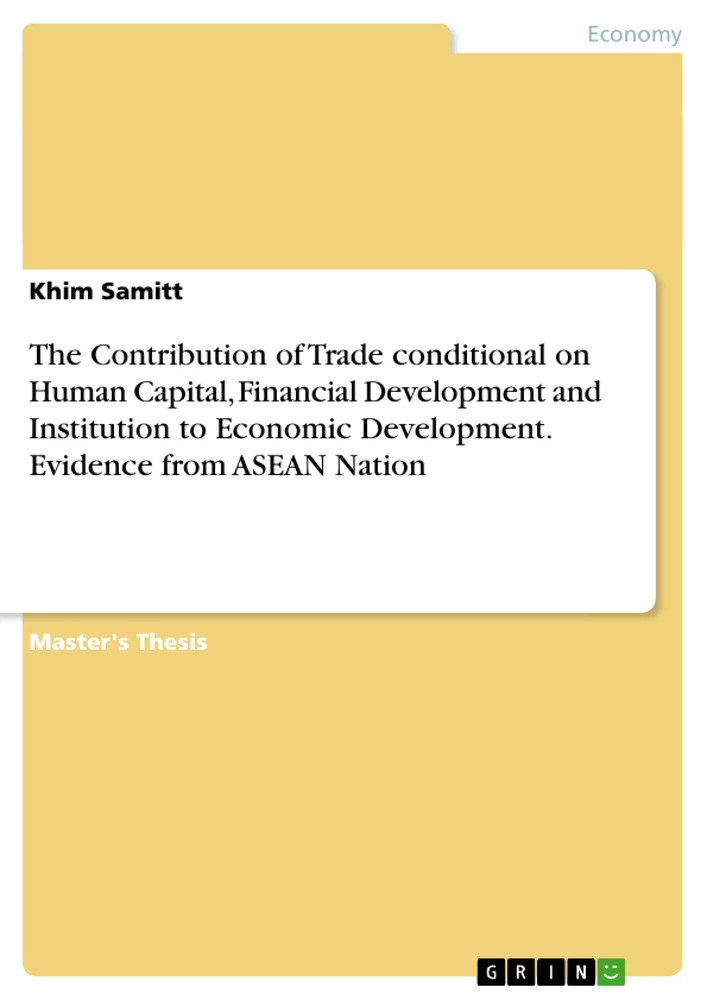
Table of Contents
CHAPTER ONE: INTRODUCTION
1.1. Research Backgrounds
1.1.1 Economic Cooperation in ASEAN
1.1.1.1. ASEAN Free Trade Area (AFTA)
1.1.1.2 The ASEAN Economic Community (AEC)
1.2. Research Motivations
1.3. Research Objectives and Intended Contribution
1.4. Thesis Structure
CHAPTER TWO: LITERATURE REVIEW
2.1. The Effects of Foreign trade on Economic Development
2.2. The Effects of Institutions on Foreign trade and Economic Development
2.3. The Effects of Financial Development on Trade and Economic Development
2.4. The Effects of Human Capital on Foreign trade and Economic Development
CHAPTER THREE: THEORETICAL FRAMEWORK
3.1. Foundations of Trade Theories
3.2. Why Do Nations Trade? Is trade good for a country?
3.3 Theories of complementary factors to trade openness and growth
3.4 Human Capital in the Theoretical Perspectives
3.5 Institutions in the Theoretical Perspectives
3.6 Financial Development in the Theoretical Debates
3.7 An Illustration of an Endogenous Growth Model
3.8 Proposed Research Hypothesis
CHAPTER FOUR: METHODOLOGY
4.1 Pooled OLS Estimation
4.2 Fixed-Effect Estimation
4.3 Random Effect Estimation
4.4 The Endogeneity problems and Instrumental Variable
4.5 Model Specifications
4.5.1 Pooled OLS Regression:
4.5.2 Fixed-effect Regression
4.5.3 The regressions of the roles of trade complementarities on GDP
CHAPTER 5: DATA
5.1 Data sources and Definition of selected variables
5.2 Descriptive Statistics
5.3 General Trends of some most important variables
5.3.1 Gross domestic product (GDP) trend across ASEAN members
5.3.2 The trend of trade openness across ASEAN countries
5.3.3 The trend of financial development across ASEAN countries
5.3.4 The trend of stock of institutions across ASEAN countries
5.3.5 The trend of human capital across ASEAN countries
CHAPTER SIX: RESEARCH ANALYSIS AND RESULTS
6.1 Panel Correlation and Baseline Regression Results
6.2 Results of Growth benefits from trade interacted with policy complementarities
6.2.1 Growth benefits from trade conditional on Human Capital and Financial Depth
6.2.2 Growth benefits from trade conditional on Quality of Institutions
CHAPTER 7: CONCLUSIONS
7.1 Summary of findings
7.2 Policy Implications of the Research Findings
7.3 Suggestions for Future Works
Objectives and Research Themes
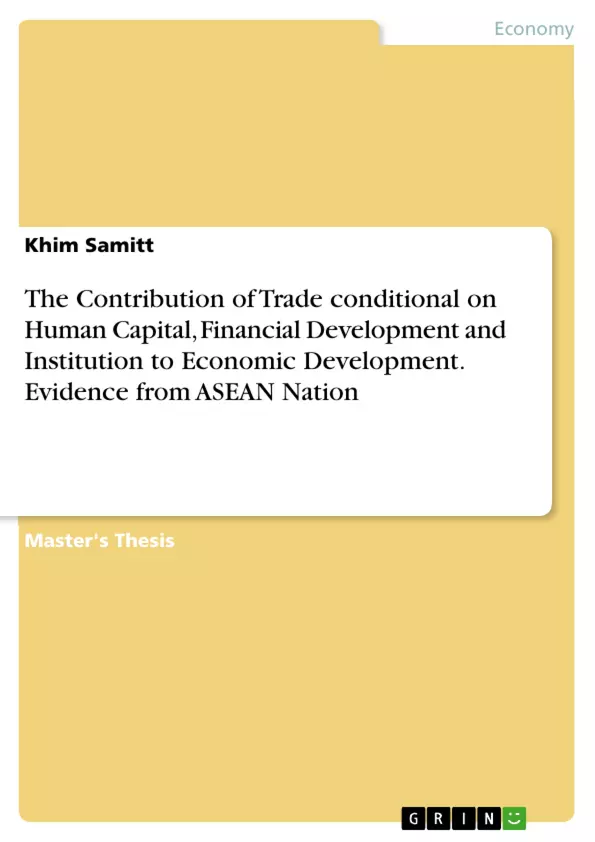
This thesis examines the nexus between economic development and trade openness within the ASEAN region, while accounting for structural factors such as human capital, financial development, and institutional quality. The research aims to empirically determine how these factors influence the economic impact of international trade for ASEAN member states.
- Analysis of ASEAN regional cooperation and its impact on trade.
- Quantitative assessment of the relationship between trade openness and economic growth.
- Investigation into how structural factors (human capital, institutions, and financial depth) mediate trade benefits.
- Use of panel data (1980-2010) with sophisticated estimation techniques like fixed-effects and instrumental variable (IV-GMM) models to address endogeneity.
Auszug aus dem Buch
1.1. Research Backgrounds
In the past several decades, more and more countries have considered international trade in an increasingly integrated world a necessary avenue to realize comparative advantages and to grow national economy. Recently there have been multiple free trade agreements and regional integration agreements. Calderon and Poggio (2010) found that the world trade has grown as fast as world output over the last two decades and as a result economic integration is accelerated. Regional economic integration in turn plays important role in many nations’ economic development and reform.
Many trading blocs have actively facilitated trade and economic welfare in the respective nations. For example, the European Union (EU) is a trading bloc in Europe which can be considered as the oldest one in the word. EU was historically formed after the World War II as the European Economic Community (EEC) by the six countries in 1958. In the American Hemisphere, there are several active regional trading blocs, namely, the North American Free Trade Area (NAFTA), the Southern Common Market (SCA), the Dominican Republic—Central American Free Trade Area (CAFTA) and the Caribbean Community, etc.
Summary of Chapters
CHAPTER ONE: INTRODUCTION: Outlines the rise of regionalism and international trade, defines the ASEAN context, and sets the research goals and thesis structure.
CHAPTER TWO: LITERATURE REVIEW: Examines existing academic discourse on how foreign trade, institutional quality, financial development, and human capital influence economic growth.
CHAPTER THREE: THEORETICAL FRAMEWORK: Discusses classical and modern trade theories, endogenous growth models, and the theoretical role of structural factors in economic development.
CHAPTER FOUR: METHODOLOGY: Details the panel data estimation techniques used, including Pooled OLS, Fixed-Effects, and Instrumental Variable models to control for endogeneity.
CHAPTER 5: DATA: Describes the sources and definitions of the variables used in the empirical analysis, including institutional indicators and macroeconomic datasets.
CHAPTER SIX: RESEARCH ANALYSIS AND RESULTS: Presents the empirical findings, including baseline regressions and the analysis of trade interaction with policy complementarities.
CHAPTER 7: CONCLUSIONS: Summarizes the study findings, draws policy implications for ASEAN nations, and provides suggestions for future research.
Keywords
International trade, human capital, financial development, institutional quality, ASEAN, economic growth, panel data, fixed-effects, instrumental variable, policy reforms, regional integration, trade openness, endogenous growth, economic development, governance.
Frequently Asked Questions
What is the primary focus of this research?
The research explores the impact of trade openness on the economic performance of ASEAN nations, specifically focusing on how this relationship is mediated by human capital, financial depth, and institutional quality.
What are the core research themes?
The core themes include regional economic integration, the role of structural constraints in trade-led growth, and the empirical validation of policy complementarities within developing economies.
What is the main research objective?
The objective is to empirically quantify the influence of trade on economic development in the ASEAN region and evaluate how variations in structural and institutional factors alter these effects.
Which scientific methodology is employed?
The author uses panel data estimation techniques, including Pooled OLS, Fixed-Effects, and Instrumental Variable models (IV-GMM), to address potential endogeneity and provide consistent estimates.
What topics are covered in the main body?
The body covers a comprehensive literature review, the establishment of a theoretical framework based on endogenous growth theory, detailed methodological procedures, data description, and a rigorous analysis of the regression results.
What are the key descriptive characteristics of this work?
The work is characterized by its empirical focus on ASEAN member nations, its use of the 1980-2010 panel dataset, and its focus on "trade complementarities."
How does human capital impact the findings regarding trade?
The thesis finds that trade openness has a more substantial and positive impact on economic growth in ASEAN members that possess higher levels of human capital and better educational attainment.
What is the role of institutional quality according to this study?
The study concludes that institutional quality—such as the rule of law and regulatory quality—is vital because it helps reduce transaction costs and uncertainty, thereby enabling economies to better benefit from trade integration.
What is the policy recommendation for less developed ASEAN countries?
The author suggests that less developed ASEAN countries need to prioritize building their banking sectors, improving capital utilization, and enhancing educational infrastructure to reach a competitive threshold for trade-led growth.
Ende der Leseprobe aus 82 Seiten
- nach oben
- Arbeit zitieren
- Khim Samitt (Autor:in), 2013, The Contribution of Trade conditional on Human Capital, Financial Development and Institution to Economic Development. Evidence from ASEAN Nation, München, Page::Imprint:: GRINVerlagOHG, https://www.diplomarbeiten24.de/document/281848

neugierig - aktuell - relevant
Entdecken Sie hilfreiche Tipps und Tricks rund ums Studium!

Entdecken Sie hilfreiche Tipps und Tricks rund ums Studium!
Ihre Hausarbeit / Abschlussarbeit:

- - Publikation als E-Book und Buch
- - Hohes Honorar auf die Verkäufe
- - Für Sie komplett kostenlos - mit ISBN
- - Es dauert nur 5 Minuten
- - Jede Arbeit findet Leser

- © GRIN Publishing GmbH.
- Alle Inhalte urheberrechtlich geschützt. Kopieren und verbreiten untersagt.
- info@grin.com
- AGB
- Open Publishing
Der GRIN Verlag hat sich seit 1998 auf die Veröffentlichung akademischer eBooks und Bücher spezialisiert. Der GRIN Verlag steht damit als erstes Unternehmen für User Generated Quality Content. Die Verlagsseiten GRIN.com, Hausarbeiten.de und Diplomarbeiten24 bieten für Hochschullehrer, Absolventen und Studenten die ideale Plattform, wissenschaftliche Texte wie Hausarbeiten, Referate, Bachelorarbeiten, Masterarbeiten, Diplomarbeiten, Dissertationen und wissenschaftliche Aufsätze einem breiten Publikum zu präsentieren.
Kostenfreie Veröffentlichung: Hausarbeit, Bachelorarbeit, Diplomarbeit, Dissertation, Masterarbeit, Interpretation oder Referat jetzt veröffentlichen!
Folgen Sie GRIN auf


- GRIN Verlag GmbH
-
- Nymphenburger Str. 86
- 80636
- Munich, Deutschland
- +49 89-550559-0
- +49 89-550559-10
- info@grin.com
-
