
präsentiert von

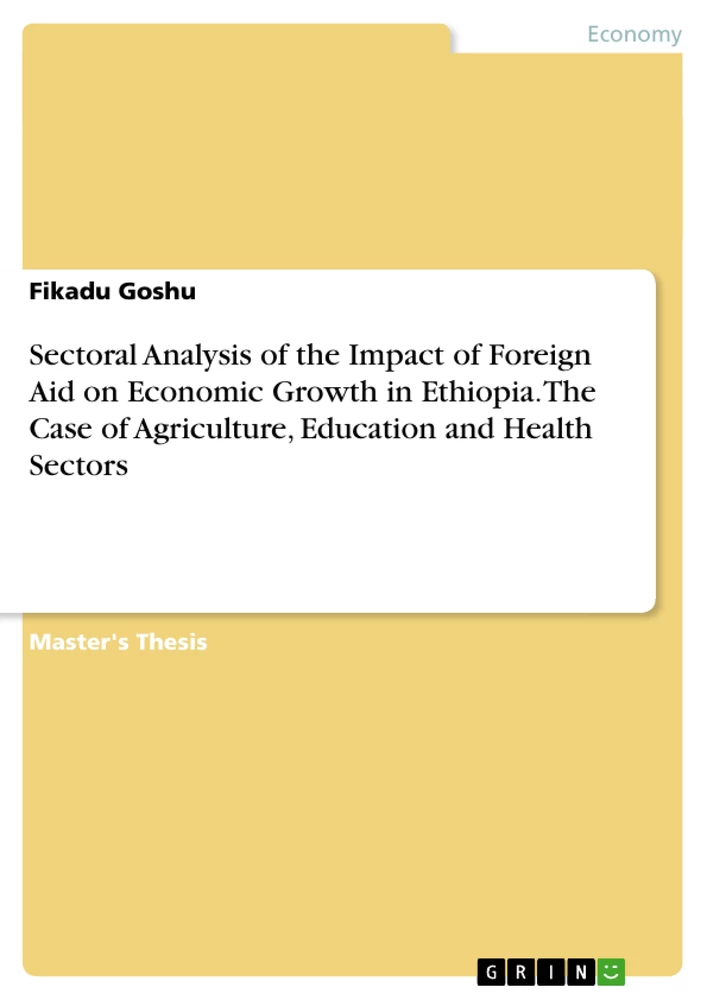
Table of Contents
CHAPTER ONE: INTRODUCTION
1.1. Background
1.2. Statement of the Problem
1.3. Objective of the Study
1.3.1. General Objectives
1.3.2. Specific Objectives
1.4. Research Questions
1.5. Hypothesis to be tested
1.6. Significance of the Study
1.7. Scope and Limitation of the Study
1.7.1. Scope of the Study
1.7.2. Limitation of the Study
1.8. Organization of the Paper
CHAPTER TWO: METHODOLOGY OF THE STUDY
2.1. Data Types and Sources
2.2. Description of Variables
2.3. Model Specification
2.4. Econometric Estimation Techniques
2.4.1. Testing for Unit Root
2.4.2. Test for Cointegration
2.4.3 Vector Error Correction Model
2.4.4 Causality Test in Vector Error Correction Model
CHAPTER TREE: RESULT AND DISCUSSION
3.1. Descriptive Analysis of Macroeconomic Performance in Ethiopia
3.1.1. Analysis of Aggregate Economic Growth in Ethiopia
3.1.2. Sector Wise Analysis of Economic Growth in Ethiopia
3.1.3. Trends of Domestic Savings and Investment in Ethiopia
3.1.4. Trends of External Sector Economic Growth in Ethiopia
3.1.5. Government Expenditure and Economic Growth
3.1.6. Foreign Aid (ODA) and Economic Growth in Ethiopia
3.1.7. Sectorial Composition of Foreign Aid (ODA) in Ethiopia
3.2. Empirical Results Analysis and Interpretations
3.2.1. Results for Unit-Root Test
3.2.2. Co-integration and Long run Growth Equation Analysis
3.2.3. Short Run VECM Estimation of Economic Growth
3.2.4. Causality Analysis of Aggregate and Sectoral Economic Growth
CHAPTER FOUR: SUMMARY AND CONCLUSION
4.1. Summary
4.2. Conclusion
4.3. Policy Implication
Research Objectives and Key Topics
This thesis aims to investigate the sectoral impact of foreign aid on economic growth in Ethiopia by examining how aid is channeled into agriculture, education, and health sectors and its subsequent influence on their respective GDP growth using multivariate Vector Autoregressive (VAR) and Vector Error Correction (VEC) models for the period 1981 to 2012.
- Analysis of macroeconomic performance trends under different political regimes.
- Econometric assessment of foreign aid effectiveness at the aggregate and sectoral levels.
- Examination of long-run equilibrium relationships between foreign aid and sector-specific economic growth.
- Investigation of bi-directional causality between foreign aid and economic growth in selected sectors.
- Policy implications for enhancing domestic revenue mobilization and aid utilization effectiveness.
Excerpt from the Book
1.1. Background
Developing countries face challenges of massive poverty, slow Gross Domestic Product (GDP) growth, high mortality rates from illnesses, and low levels of education. More than 20 percent of the developing world (1.1 billion) people subsist on less than $1 a day. In some developing countries, such as those of Sub-Saharan Africa (SSA), more than 70 percent of the population lives in extreme poverty (i.e. the proportion of population earning less than $2 a day) (Kumler'07, 2007; Leeson, 2008). The governments in these countries do not have sufficient financial resources to fight these challenges effectively. Foreign aid has played an instrumental role in the implementation of development programs to combat the challenges (Lohani'04, 2004; Pattillo, Polak, & Roy, 2007).
Foreign aid is defined as any flow of capital to a developing countries for the objective that should be non commercial from the point of view of the donor on development, poverty reduction, or income distribution grounds and it should be characterized by concessional terms; that is, the interest rate and repayment period for borrowed capital should be softer (less stringent) than commercial terms (Bakare, 2011; Randhawa, 2012; Todaro & Smith, 2012). Official Development Assistance (ODA), commonly known as foreign aid is a flow of financial resources from developed countries to developing countries on development grounds (Eroglu & Yavaz, 2005; Moreira, 2005; Leeson, 2008; Paul & Pistor, 2009). It is an international transfer of public funds in the form of loans or grants either directly from one government to another (bilateral) or indirectly through multilateral assistance agency such as International Monetary Fund and World Bank (Radelet, 2006; UNCTAD, 2006; Abuzeid, 2009; OECD, 2009).
Summary of Chapters
CHAPTER ONE: INTRODUCTION: This chapter provides an overview of the challenges faced by developing countries, specifically Ethiopia, in terms of poverty and economic growth, and outlines the objectives, research questions, and scope of the study regarding foreign aid effectiveness.
CHAPTER TWO: METHODOLOGY OF THE STUDY: This chapter details the econometric framework, including the use of Vector Autoregressive (VAR) and Vector Error Correction Models (VECM) and data sources used to analyze the impact of foreign aid on sectoral GDP.
CHAPTER TREE: RESULT AND DISCUSSION: This chapter presents the descriptive analysis of Ethiopia's macroeconomic performance and the empirical results regarding the unit-root tests, cointegration analysis, and the impact of foreign aid on aggregate and sectoral economic growth.
CHAPTER FOUR: SUMMARY AND CONCLUSION: This chapter synthesizes the main findings of the research, provides conclusions regarding the effectiveness of foreign aid in different sectors, and offers policy implications for Ethiopia's economic development.
Keywords
foreign aid, economic growth, sector, aggregate, Ethiopia, impact, vector error correction model, ODA, macroeconomics, GDP, sectoral analysis, development economics, causality, Ethiopia, domestic saving
Frequently Asked Questions
What is the core focus of this research paper?
The research fundamentally explores the sectoral impact of foreign aid on economic growth in Ethiopia, analyzing its effectiveness in the agricultural, educational, and health sectors compared to aggregate economic growth.
What are the primary themes addressed?
The study focuses on the relationship between official development assistance (ODA) and GDP growth, government expenditure, domestic savings, trade openness, and the dynamic nature of aid flows over the period 1981–2012.
What is the central research question?
The study seeks to determine if foreign aid has a significant impact on economic growth within specific developmental sectors and whether a causal relationship exists between aid allocation and sector-specific GDP growth in Ethiopia.
Which scientific methodology is employed?
The research uses a multivariate Vector Autoregressive (VAR) model and Vector Error Correction Models (VECM), incorporating unit root tests and Granger causality tests to handle the dynamic nature of time-series data.
What topics are discussed in the main body of the work?
The main body covers macroeconomic trends in Ethiopia, the sectoral composition of foreign aid, empirical estimation of long-run growth equations, and causality analysis between aid and economic output.
Which keywords define the scope of this study?
Key terms include foreign aid, economic growth, sectoral analysis, Ethiopia, ODA, VECM, domestic saving, and public expenditure.
How does the study differentiate between the micro and macro levels of aid impact?
The paper addresses the "micro-macro paradox," noting that while aid may show significant success at the sectoral or micro-level—particularly in education—it often appears less visible or statistically insignificant at the aggregate national level.
What does the study conclude regarding educational sector aid?
The empirical results reveal that foreign aid has a significant, positive, and long-run impact on educational sector GDP in Ethiopia, exhibiting a bi-directional causal relationship.
What specific policy recommendations does the author provide?
The author recommends enhancing domestic revenue-raising capacity and establishing a sound macroeconomic environment to reduce long-term dependency on external aid sources.
Ende der Leseprobe aus 71 Seiten
- nach oben
- Arbeit zitieren
- Fikadu Goshu (Autor:in), 2014, Sectoral Analysis of the Impact of Foreign Aid on Economic Growth in Ethiopia. The Case of Agriculture, Education and Health Sectors, München, Page::Imprint:: GRINVerlagOHG, https://www.diplomarbeiten24.de/document/281966

neugierig - aktuell - relevant
Entdecken Sie hilfreiche Tipps und Tricks rund ums Studium!

Entdecken Sie hilfreiche Tipps und Tricks rund ums Studium!
Ihre Hausarbeit / Abschlussarbeit:

- - Publikation als E-Book und Buch
- - Hohes Honorar auf die Verkäufe
- - Für Sie komplett kostenlos - mit ISBN
- - Es dauert nur 5 Minuten
- - Jede Arbeit findet Leser

- © GRIN Publishing GmbH.
- Alle Inhalte urheberrechtlich geschützt. Kopieren und verbreiten untersagt.
- info@grin.com
- AGB
- Open Publishing
Der GRIN Verlag hat sich seit 1998 auf die Veröffentlichung akademischer eBooks und Bücher spezialisiert. Der GRIN Verlag steht damit als erstes Unternehmen für User Generated Quality Content. Die Verlagsseiten GRIN.com, Hausarbeiten.de und Diplomarbeiten24 bieten für Hochschullehrer, Absolventen und Studenten die ideale Plattform, wissenschaftliche Texte wie Hausarbeiten, Referate, Bachelorarbeiten, Masterarbeiten, Diplomarbeiten, Dissertationen und wissenschaftliche Aufsätze einem breiten Publikum zu präsentieren.
Kostenfreie Veröffentlichung: Hausarbeit, Bachelorarbeit, Diplomarbeit, Dissertation, Masterarbeit, Interpretation oder Referat jetzt veröffentlichen!
Folgen Sie GRIN auf


- GRIN Verlag GmbH
-
- Nymphenburger Str. 86
- 80636
- Munich, Deutschland
- +49 89-550559-0
- +49 89-550559-10
- info@grin.com
-
