
präsentiert von

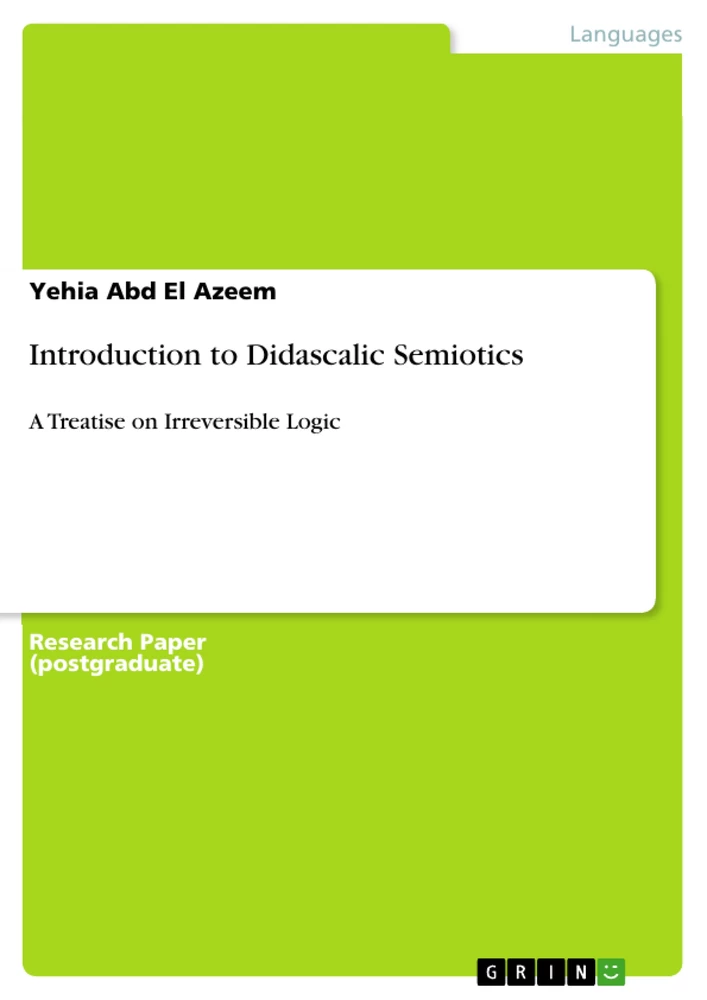
Table of Contents
1. Introduction
2. Disassembling of Narrative Method
3. Introduction to Dual Omniscience
4. Towards Didascalic Chronology (Imminence)
5. Non-Alignment of Narrative Didascalia
5.1 Proof of Crisis in Narrative Diegesis; when Generic Omniscience Multiplies
6. The Ir-referentiality of Dual Omniscience
7. Imminence Definitions from Experimentations
7.1 First-Rhetoric and Didascalic Truth
7.2 Dramatic Truth Contra Dramatic Fact
8. Parameters of Imminence
8.1 Imminence of omniscience (I.O)
8.2 The Sixth Wall
8.3 From Imminent Irrelevance to Imminent Salience
8.4 Statistic-Signal
9. The Royal Chronology to Didascalic-Audience
10. Reading Force Or Narrative Inertia?
11. Didascalic Audience
12. Suggestion of an Un-Liberated Didascalic Energy
13. Works Cited
Research Objectives and Themes
This work explores the concept of "didascalic semiotics" to analyze the meta-textual liberation of stage directions from narrative drama, aiming to establish a framework for "dual omniscience" where rhetorical space operates independently of performance linearity.
- Theoretical reconstruction of narrative didascalia as a meta-textual rhetorical domain.
- Development of "dual omniscience" and "didascalic imminence" as analytical coefficients.
- Critique of narrative diegesis and the crisis of generic omniscience in modern drama.
- Examination of the "sixth wall" and the role of the reader versus the audience in semiotic interpretation.
- Proposing a non-commutative, irreversible logic for didascalic signifiers.
Excerpt from the Book
7.1 First-Rhetoric and Didascalic Truth
The suggestion of multiple-omniscience/s and accordingly applications of omnidirectional sign’s self-explication entails as a preliminary subsuming of first direction (where sign’s relation commits its first resistance against choices of resemblances for the sake of formal consolidation of non-reversible logic) a necessity for dual precedence (against the modal order of unreliable determination of sign towards extensive correspondences) according to which a proposal of finite assessment/first rhetoric/ rehearsed space- is a question of meta-text (against the reformative multiplication of representatives or carriers of interest) where signification is rather a variable of one value than an infinity of two.
In other words, though such dialogical point is to be tackled in a different paper, sign elements are offered as not to be motivators of extensive representation, but crucial intruders in the transitional spaces of mimesis. Such supremacy of precedence as an interjectory ir-reference of sign-hood intrinsic within the cognitive mutation of rhetoric (since that sign’s enablement is always conditionally rhetorical to an awaited speech act via succession) from conservatory experiment of space (through opposites of diegesis) towards liberated (repressions of presence), could to an associative/relative extent be applicable as a modal introduction of semiotic didascalia, such as would alone still be a phenomenal precedence of meta-text.
It could be claimed on one side, that first rhetoric, which precedes relentlessly acquiescence of counter-references (or in other words significations of counter-inquiry against which sign-hood proposes autology away from a per-formative space of formal logic) entangled between allocators of performance, is conditional on the dual-signified of omniscience, according to which assumptions of opposite diegesis are differed not in terms of modal implications (including co-occurrence of referential preferences) or propositions of expositions but in terms of didascalic imminence (didascalia of diegesis) against the interactive notion of an absolute semio-sphere.
Summary of Chapters
1. Introduction: Outlines the theoretical necessity of analyzing didascalia as a meta-textual, non-fictive interjection that separates narrative drama from its performed realization.
2. Disassembling of Narrative Method: Investigates the shift from fictive semiotics to didascalic semiotics, highlighting the potential for an autonomous, auto-logical voice within stage directions.
3. Introduction to Dual Omniscience: Proposes coefficients of space and cyclic imminence as a way to understand rhetorical subjects independent of linear synchronization.
4. Towards Didascalic Chronology (Imminence): Explores how narrative didascalia necessitates a dual hierarchy of timing, moving beyond standard semiotic trace.
5. Non-Alignment of Narrative Didascalia: Argues that the repression of didascalia occurs when generic omniscience multiplies, leading to a crisis of diegetic space.
5.1 Proof of Crisis in Narrative Diegesis; when Generic Omniscience Multiplies: Provides evidence of diegetic crisis by examining liberated rhetorical spaces and the contradictions of multiple omniscience.
6. The Ir-referentiality of Dual Omniscience: Examines the concept of inwardness in diegesis and the contrast between generic imminence and auto-logical self-reference.
7. Imminence Definitions from Experimentations: Uses the model of phototropic animals to demonstrate how contrastive values define didascalic semiosis.
7.1 First-Rhetoric and Didascalic Truth: Analyzes the interplay between first-rhetoric and the potential for truth that excludes standard narrative modes.
7.2 Dramatic Truth Contra Dramatic Fact: Distinguishes between the potential of dramatic truth and the empirical constraints of dramatic fact within the didascalic framework.
8. Parameters of Imminence: Establishes foundational definitions for didascalic imminence and the logic of contrastive equipoises.
8.1 Imminence of omniscience (I.O): Defines the two-sided irreversibility of imminent logic as a replacement for anthropological sign-hood.
8.2 The Sixth Wall: Introduces the "sixth wall" as an un-theatrical chronology of readership that opposes hierarchies of first-rhetoric.
8.3 From Imminent Irrelevance to Imminent Salience: Investigates how the irrelevance of signs functions as a non-selective mechanism within communicative environments.
8.4 Statistic-Signal: Explains the "statistic-signal" as a formalization of isochronal forces within a centripetal meta-text.
9. The Royal Chronology to Didascalic-Audience: Discusses the emergence of a "didascalic audience" based on contrastive values and points of subtense.
10. Reading Force Or Narrative Inertia?: Differentiates between reading force as a pause in the meta-text and narrative inertia as the acceleration of comparable values.
11. Didascalic Audience: Re-evaluates narrative inertia and the role of contrastive values in defining the limits of rhetorical audience.
12. Suggestion of an Un-Liberated Didascalic Energy: Explores the philosophical implications of evolution and reversion in didascalic energy and comparability.
13. Works Cited: Lists the philosophical and semiotic references foundational to the treatise.
Keywords
Didascalic Semiotics, Dual Omniscience, Imminence, First-Rhetoric, Meta-text, Diegesis, Auto-logy, Sixth Wall, Statistic-Signal, Narrative Inertia, Ir-referentiality, Semio-sphere, Contrastive Values, Didascalia, Narrative Diegesis.
Frequently Asked Questions
What is the primary focus of this work?
The work focuses on "didascalic semiotics," an experimental study of how stage directions function independently of narrative drama, treating them as a meta-textual space with its own logical chronology.
What are the central themes explored?
Key themes include the distinction between "imminence" and "immediacy," the concept of "dual omniscience," the "sixth wall" of reader engagement, and the irreducibility of didascalic signs.
What is the goal of the proposed research?
The goal is to provide a rigorous framework for understanding how signifiers in stage directions create a non-fictive, autonomous reality that transcends traditional performative or narrative interpretation.
What methodology is employed?
The author employs a semiotic methodology rooted in Peircean logic, extending concepts of sign relations, interpretants, and diegetic structures into the domain of non-dramatic stage directions.
How is the "sixth wall" defined?
The "sixth wall" represents the un-theatrical chronology of reader-engagement where the meta-textual nature of stage directions prevents the usual reflexive interpretation, creating a boundary between the reader and the narrative.
Which keywords best characterize this research?
Didascalic Semiotics, Dual Omniscience, Imminence, First-Rhetoric, and Auto-logy are the essential terms that define the author's unique theoretical lexicon.
How does the author define "First-Rhetoric"?
First-Rhetoric is defined as an "ir-referential" anthropology, a pre-sign state of logic that precedes the dialogue and acts as a foundation for didascalic truth, distinct from the performative rhetoric of the play itself.
How does the "Statistic-Signal" function in the model?
The "Statistic-Signal" is presented as a method for chronologizing space; it acts as a focal trend of didascalic sign-hood that captures the ir-relevance of signals as they reach a point of circular imminence.
Ende der Leseprobe aus 56 Seiten
- nach oben
- Arbeit zitieren
- Yehia Abd El Azeem (Autor:in), 2013, Introduction to Didascalic Semiotics, München, Page::Imprint:: GRINVerlagOHG, https://www.diplomarbeiten24.de/document/282046

neugierig - aktuell - relevant
Entdecken Sie hilfreiche Tipps und Tricks rund ums Studium!

Entdecken Sie hilfreiche Tipps und Tricks rund ums Studium!
Ihre Hausarbeit / Abschlussarbeit:

- - Publikation als E-Book und Buch
- - Hohes Honorar auf die Verkäufe
- - Für Sie komplett kostenlos - mit ISBN
- - Es dauert nur 5 Minuten
- - Jede Arbeit findet Leser

- © GRIN Publishing GmbH.
- Alle Inhalte urheberrechtlich geschützt. Kopieren und verbreiten untersagt.
- info@grin.com
- AGB
- Open Publishing
Der GRIN Verlag hat sich seit 1998 auf die Veröffentlichung akademischer eBooks und Bücher spezialisiert. Der GRIN Verlag steht damit als erstes Unternehmen für User Generated Quality Content. Die Verlagsseiten GRIN.com, Hausarbeiten.de und Diplomarbeiten24 bieten für Hochschullehrer, Absolventen und Studenten die ideale Plattform, wissenschaftliche Texte wie Hausarbeiten, Referate, Bachelorarbeiten, Masterarbeiten, Diplomarbeiten, Dissertationen und wissenschaftliche Aufsätze einem breiten Publikum zu präsentieren.
Kostenfreie Veröffentlichung: Hausarbeit, Bachelorarbeit, Diplomarbeit, Dissertation, Masterarbeit, Interpretation oder Referat jetzt veröffentlichen!
Folgen Sie GRIN auf


- GRIN Verlag GmbH
-
- Nymphenburger Str. 86
- 80636
- Munich, Deutschland
- +49 89-550559-0
- +49 89-550559-10
- info@grin.com
-
