
präsentiert von

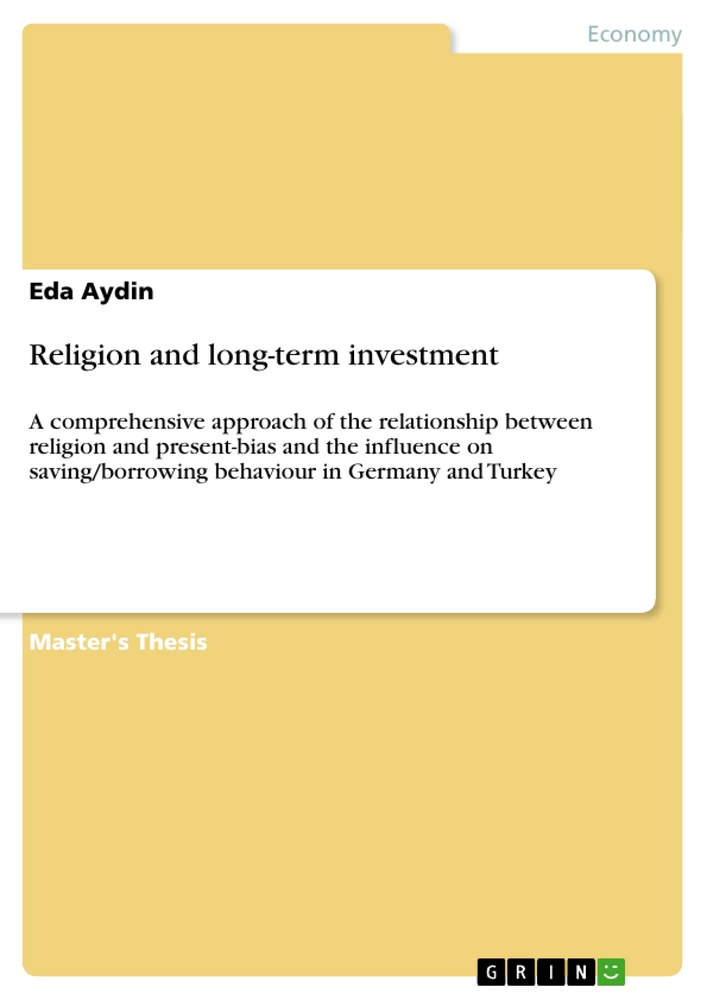
Table of Contents
Introduction
2. Research questions
3. Comparison Turkey and Germany
4. Literature Review of Present-bias
4.1 Factors influencing Present-bias
5. Literature Review on Religiosity Measures
5.1 Problem of Measuring Religion
5.2 Overview of Previous Researchers on Religiosity Measures
5.3 Religious Attitude and Orientation
5.4 Religious Commitment and Involvement
5.5 The Measurement of Religious Dimensions in European Surveys
5.6 Relevant Dimensions
6. Religion and Present-Bias
6.1 Religion influences Self-Control
6.2 Religion influences Present-Bias
7. Hypotheses Development
8. Research Design and Methodology
8.1 Design
8.2 Sample
8.3 Questionnaire Development
9. Empirical Results
9.1 Sample Summary
9.2 Impatience under exponential and quasi-hyperbolic model
10. Hypothesis Testing
11. Discussion
12. Limitations and Future Research
12.1 Future Research
Research Objectives and Themes
This master's thesis aims to investigate the relationship between individual religiosity and the "present-bias" phenomenon, which affects decision-making processes regarding long-term investments and saving or borrowing behavior. By conducting a comparative empirical study among students in Germany and Turkey, the research seeks to understand if and how religious beliefs influence an individual's self-control and time preferences.
- The impact of religiosity on present-bias and self-control.
- Comparative analysis of financial decision-making in Germany and Turkey.
- Examination of quasi-hyperbolic discounting models and time preferences.
- Evaluation of various survey-based religiosity measurement scales.
- Identification of demographic and sociocultural variables influencing saving behavior.
Excerpt from the Book
4. Literature Review of Present-bias
The rational behaviour of humans has been frequently question in recent years. H. Simon (1972) also appraised the rationality axiom; his exploration of the bounded rationality of people implemented a different perspective of explaining human behaviour. Thus, people use heuristics during their decision making process in order to shorten this procedure. Kahneman and Tversky (1974) provide several examples of the different use of these so-called heuristics. In doing so, they mainly use methods that refer to certainty, probability and possibility pattern of people’s behaviour. For instance, a phenomenon known as certainty effect, illustrates how people overweight outcomes that are considered certain, relative to outcomes that are merely probable. Thus, certainty about an outcome is preferred, whereas risky outcomes are neglected. Various examples of different heuristics are illustrated by Kahneman and Tversky (1974), but also by Pearl (1984), Gigerenzer (1999), Riel (1996), Gilovich et al.(2002), Schultze and Pfeiffer (2002), Epley and Gilovich (2006), Song and Schwarz (2009) and Nestler and Egloff (2009). Thus, a person’s feeling about a specific situation effects the decision making process, which can lead to irrational behaviour. Following Rubinstein’s (2003) suggestion and combining the psychological and economical levels of perspectives, gives a better understanding of the right use of economic models. Therewith irrational behaviour could for instance also appear when it comes to savings or spending of money. Examining savings as a choice on a specific point in time could also be influenced by a heuristic in which parts of information are neglected and the personal preference would be shifted into the focus (Carrillo and Mariotti, 2000).
Summary of Chapters
Introduction: Provides the motivation for the study, outlining the intersection of irrational economic behavior, time-inconsistency, and the potential role of religion.
2. Research questions: Discusses the significance of financial decision-making in the post-2008 economic landscape and formally states the research question regarding the influence of religion on present-bias.
3. Comparison Turkey and Germany: Contrasts the economic and religious landscapes of Germany and Turkey to establish the contextual basis for the study.
4. Literature Review of Present-bias: Explores theoretical foundations of human decision-making, including bounded rationality, heuristics, and time-inconsistency models.
5. Literature Review on Religiosity Measures: Critically evaluates existing scales for measuring religious orientation, attitude, and commitment, justifying the chosen methodology.
6. Religion and Present-Bias: Reviews existing research linking religion, self-control, and future orientation to build a theoretical framework for the study.
7. Hypotheses Development: Formulates specific hypotheses regarding the relationship between religion, demographic variables, and the present-bias parameter in Germany and Turkey.
8. Research Design and Methodology: Details the empirical survey approach, sample characteristics, and the structure of the questionnaires used for data collection.
9. Empirical Results: Presents the primary data collected, including descriptive statistics and the analysis of impatience using exponential and quasi-hyperbolic models.
10. Hypothesis Testing: Performs statistical regression and correlation analysis to validate or reject the research hypotheses based on the gathered survey data.
11. Discussion: Interprets the findings, addresses the significance of the observed correlations (or lack thereof), and explores reasons for discrepancies between the two country samples.
12. Limitations and Future Research: Reflects on the methodological constraints of the study and offers suggestions for how future researchers can improve upon these findings.
Keywords
Present-bias, Time-Inconsistency, Quasi-Hyperbolic Discounting, Exponential Discounting, Religion, Self-control, Impatience, Time Preferences, Financial Decision-Making, Behavioral Economics, Religiosity Measurement, Comparative Study, Saving Behavior, Germany, Turkey
Frequently Asked Questions
What is the core focus of this research?
The research investigates the correlation between individual religious commitment and the economic concept of "present-bias," which refers to the tendency of people to prefer smaller immediate rewards over larger future ones.
What are the primary themes discussed?
Key themes include behavioral economics, the measurement of personal religiosity, self-control mechanisms, and the cross-cultural analysis of financial decision-making in Germany and Turkey.
What is the main objective of the thesis?
The primary objective is to determine whether higher levels of religiosity correlate with reduced present-bias, thereby potentially fostering more rational long-term saving and borrowing behaviors.
Which scientific methods were employed?
The author utilized a quantitative approach, conducting a cross-sectional survey among students in Germany and Turkey, and applied regression analysis and t-tests to evaluate the collected data against economic models.
What content is covered in the main body?
The main body includes a comprehensive literature review on time-inconsistency and religiosity, the formulation of specific research hypotheses, a detailed methodological description, and an empirical analysis of survey results.
Which keywords best describe this study?
The most relevant keywords include present-bias, time-inconsistency, behavioral economics, self-control, religiosity, and financial decision-making.
How does religiosity affect present-bias according to the study?
The study suggests that for certain groups, particularly in Turkey, there is a positive correlation between religion and rationality in financial choices, implying that highly religious individuals may demonstrate better self-control.
Why are Turkey and Germany chosen for comparison?
They provide a valuable contrast between a largely secular, industrialized European economy and a rapidly developing economy with a different cultural and religious background, allowing for a diverse test of the research hypotheses.
What are the main limitations mentioned?
The author highlights the relatively small sample size, the use of different methods to reach participants in the two countries, and the fact that student participants may not perfectly represent the general population's financial behavior.
Ende der Leseprobe aus 112 Seiten
- nach oben
- Arbeit zitieren
- Eda Aydin (Autor:in), 2014, Religion and long-term investment, München, Page::Imprint:: GRINVerlagOHG, https://www.diplomarbeiten24.de/document/282184

neugierig - aktuell - relevant
Entdecken Sie hilfreiche Tipps und Tricks rund ums Studium!

Entdecken Sie hilfreiche Tipps und Tricks rund ums Studium!
Ihre Hausarbeit / Abschlussarbeit:

- - Publikation als E-Book und Buch
- - Hohes Honorar auf die Verkäufe
- - Für Sie komplett kostenlos - mit ISBN
- - Es dauert nur 5 Minuten
- - Jede Arbeit findet Leser

- © GRIN Publishing GmbH.
- Alle Inhalte urheberrechtlich geschützt. Kopieren und verbreiten untersagt.
- info@grin.com
- AGB
- Open Publishing
Der GRIN Verlag hat sich seit 1998 auf die Veröffentlichung akademischer eBooks und Bücher spezialisiert. Der GRIN Verlag steht damit als erstes Unternehmen für User Generated Quality Content. Die Verlagsseiten GRIN.com, Hausarbeiten.de und Diplomarbeiten24 bieten für Hochschullehrer, Absolventen und Studenten die ideale Plattform, wissenschaftliche Texte wie Hausarbeiten, Referate, Bachelorarbeiten, Masterarbeiten, Diplomarbeiten, Dissertationen und wissenschaftliche Aufsätze einem breiten Publikum zu präsentieren.
Kostenfreie Veröffentlichung: Hausarbeit, Bachelorarbeit, Diplomarbeit, Dissertation, Masterarbeit, Interpretation oder Referat jetzt veröffentlichen!
Folgen Sie GRIN auf


- GRIN Verlag GmbH
-
- Nymphenburger Str. 86
- 80636
- Munich, Deutschland
- +49 89-550559-0
- +49 89-550559-10
- info@grin.com
-
