
präsentiert von

Contents
1 Introduction
2 Objectives and Methodology
2.1.) Problem Identification and Explanation
2.2.) Research Questions
2.2.1.) Questions and objectives
2.2.2) Islamic finance institution, detail "interest-free"
2.2.3) Islamic finance institution, detail "Helal"
2.2.4) internal view of banks
2.2.5) external view of customers
2.3.) Methodology
2.3.1 Methods
2.3.2 Data
3 Survey of Literature
3.1.) Islamic Finance
3.1.1. Islamic economic thought
3.1.2. Cornerstones of Islamic finance
3.2.) Detail "interest free"
3.2.1. Internal view "interest-free"
3.2.2. External view "interest-free"
3.3.) Detail "Helal"
3.3.1. Islamic finance, the German and European law
3.3.2. Islamic finance, detail "helal" in the global context
3.4.) Internal View, Banks
3.4.1 Basic construction of Islamic banks, disadvantages
3.4.2 Advantages of Islamic banks
3.4.3 “Gelehrten-Rat” of Islamic banks
3.4.4 Staff of the Islamic banks
3.4.5 International Interface between Islamic and Conventional Banking
3.4.6 Conventional to Islamic banks
3.4.7 Experience and achievements of Islamic banks in the UK
3.5.) External View, Customers
3.5.1. Muslims in Germany
3.5.2. Muslim organizations in Germany
3.5.3 The Muslim population and their need for financial products
3.6) Summary of Literature survey
4 Results
4.1.) Expectations
4.1.1. Questionnaire Results
4.1.2. Results of Muslim economic thoughts
4.2.) Detail "interest free"
4.2.1 internal view, DETAIL: INTEREST FREE
4.2.2 external view, DETAIL: INTEREST FREE
4.3.) Detail "Helal"
4.4.) Internal View, Banks
4.4.1. Results of modern Islamic banking (internal, external)
4.4.2. Results of Islamic banks compared with customary banks
4.5.) External View, Customers
4.5.1. Results of Muslims in non-Muslim countries, e.g. Germany
4.5.2. Results: Muslim population and demand of financial products
4.6.) Summary of empirical part
5 Discussions
5.1.) Introduction
5.2.) Detail "interest free"
5.3.) Detail "Helal"
5.4.) Internal View, Banks
5.5.) External View, Customers
6 Conclusions
6.1.) Main Objective
6.2.) Detail "interest free"
6.3.) Detail "Helal"
6.4.) Internal View, Banks
6.5.) External View, Customers
Research Objectives and Key Focus Areas
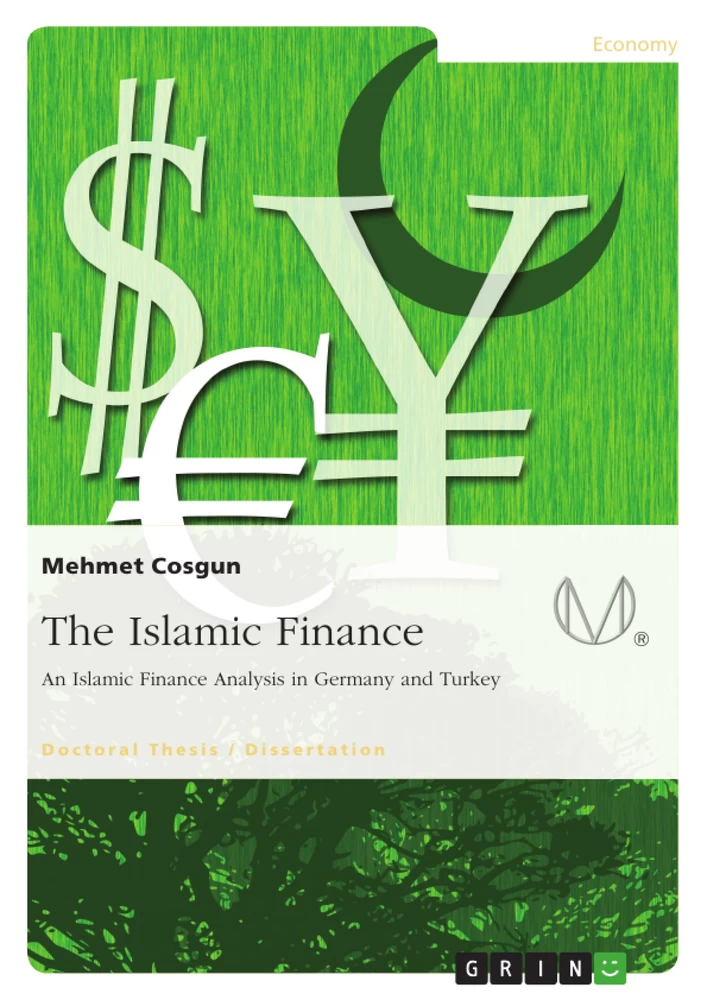
This dissertation examines the potential for Islamic financial institutions to operate successfully within a non-Muslim environment, specifically focusing on the German market. The study aims to evaluate whether there is a correlation between the size of the Muslim population in a country and the viable implementation of Islamic financial services, while comparing these findings against the market experience of Turkey.
- The practical implementation of Islamic financial principles in non-Muslim environments.
- Statistical analysis of Muslim demand for Islamic financial products in Germany.
- Comparative analysis of conventional versus Islamic bank performance and stability.
- The regulatory and legal challenges faced by Islamic banks when entering the German market.
- Synthesis of demand and supply side factors influencing Islamic financial market entry.
Excerpt from the Book
3.4.5 International Interface between Islamic and Conventional Banking
Figure 5 provides the financial needs in general. The horizontal axes depict the age clusters, and with the vertical characteristics we can see different titles and reasons for financial demands. If we take these findings as conventional, the author would like to test the Muslim behavior in selecting financial services and most importantly whether their motivation is different or the same?
Citibank has offered Islamic financial services since 1983 in London, Great Britain; this was 15 years before the opening of their first Islamic branch in Bahrain. During this period, a fortune of more than $ 1 billion for Islamic investors had been created. With the opening of the Islamic Investment Bank in Bahrain, the product range and strategic positioning in terms of Islamic financial services has been expanded.
The intention was to add to existing products the characteristics of "Mudarabah" and connect "Musharakah". It is designed to provide objectivity, the liquidity created by private investment management, private banking and asset management, and investment-based financial and investment advice (Dr Mohammad Omar Zubair in Iqbal, Llewellyn, 2002 -, p 196).
Summary of Chapters
1 Introduction: Introduces the author's background and the motivation for researching the implementation of Islamic finance in non-Muslim countries.
2 Objectives and Methodology: Outlines the research focus on the relationship between Muslim population size and Islamic financial success, detailing the survey and empirical methods used.
3 Survey of Literature: Reviews theoretical foundations of Islamic finance, the "interest-free" concept, and internal/external views of Islamic banks in global and specific national contexts.
4 Results: Presents empirical findings from surveys and financial audits of banks in Germany and Turkey, focusing on the viability of Islamic financial instruments.
5 Discussions: Synthesizes the literature and empirical results to assess the operational feasibility of Islamic finance, considering regulatory challenges and consumer demand.
6 Conclusions: Summarizes the research, stating that there is no direct relationship between population size and market entry, and provides recommendations for future policy.
Keywords
Islamic economics, Islamic finance, Islamic banking, economics, theory of finance, finance, bank stability, confidence, welfare, Germany, Turkey, Interest-free, Helal, Muslim population.
Frequently Asked Questions
What is the core subject of this dissertation?
The work primarily explores the viability of implementing Islamic financial systems in non-Muslim countries, with a specific focus on the potential for market entry in Germany.
What are the primary themes analyzed?
The study examines the structural differences between Islamic and conventional banking, the role of Islamic principles like "interest-free" and "helal" operations, and the demand patterns among Muslim communities.
What is the central research question?
The author investigates whether there is a direct relationship between the number of Muslims residing in Germany and the potential for successful Islamic financial placement.
Which scientific methods are employed?
The researcher utilizes both qualitative interviews with banking representatives and a quantitative empirical survey of approximately 1,000 participants to assess supply-side realities and demand-side behavior.
What topics are covered in the main section?
The main part covers the theoretical foundations of Islamic finance, a comparative study of bank performance, and detailed analyses of financial data from Germany and Turkey.
Which keywords define this research?
Key terms include Islamic finance, Islamic banking, interest-free banking, bank stability, economic welfare, and comparative analysis of financial systems in Germany and Turkey.
How do German authorities perceive Islamic banks?
The study notes that German regulatory authorities, such as BaFin, have shown hesitation or lack of familiarity with Islamic models, leading to significant hurdles for licensing.
How do small Islamic banks perform?
The research suggests, based on Cihak and Hesse's work, that small Islamic banks often exhibit higher financial stability compared to their larger counterparts and conventional peers.
Does the "Life Cycle Hypothesis" apply to Muslims in Germany?
The author adapts the life cycle model to reflect the unique financial behavior of first-generation "guest workers" and their descendants, noting a shift toward asset accumulation over time.
Ende der Leseprobe aus 139 Seiten
- nach oben
- Arbeit zitieren
- Mehmet Cosgun (Autor:in), 2014, The Islamic Finance, München, Page::Imprint:: GRINVerlagOHG, https://www.diplomarbeiten24.de/document/282437

neugierig - aktuell - relevant
Entdecken Sie hilfreiche Tipps und Tricks rund ums Studium!

Entdecken Sie hilfreiche Tipps und Tricks rund ums Studium!
Ihre Hausarbeit / Abschlussarbeit:

- - Publikation als E-Book und Buch
- - Hohes Honorar auf die Verkäufe
- - Für Sie komplett kostenlos - mit ISBN
- - Es dauert nur 5 Minuten
- - Jede Arbeit findet Leser

- © GRIN Publishing GmbH.
- Alle Inhalte urheberrechtlich geschützt. Kopieren und verbreiten untersagt.
- info@grin.com
- AGB
- Open Publishing
Der GRIN Verlag hat sich seit 1998 auf die Veröffentlichung akademischer eBooks und Bücher spezialisiert. Der GRIN Verlag steht damit als erstes Unternehmen für User Generated Quality Content. Die Verlagsseiten GRIN.com, Hausarbeiten.de und Diplomarbeiten24 bieten für Hochschullehrer, Absolventen und Studenten die ideale Plattform, wissenschaftliche Texte wie Hausarbeiten, Referate, Bachelorarbeiten, Masterarbeiten, Diplomarbeiten, Dissertationen und wissenschaftliche Aufsätze einem breiten Publikum zu präsentieren.
Kostenfreie Veröffentlichung: Hausarbeit, Bachelorarbeit, Diplomarbeit, Dissertation, Masterarbeit, Interpretation oder Referat jetzt veröffentlichen!
Folgen Sie GRIN auf


- GRIN Verlag GmbH
-
- Nymphenburger Str. 86
- 80636
- Munich, Deutschland
- +49 89-550559-0
- +49 89-550559-10
- info@grin.com
-
