
präsentiert von

Table of Contents
1 Introduction
2 Target markets
2.1 European professional team sports market
2.2 European television market
2.2.1 Broadcasting in sports
2.2.2 Legal background
3 Theoretical frameworks
3.1 Multi-sided markets
3.2 Analysis dimensions
3.2.1 Theory of competitive balance
3.2.2 Theory of media rights selling systems
3.2.3 Theory of revenue sharing systems
4 Status quo
4.1 Competitive balance
4.2 Media rights selling systems
4.3 Revenue sharing systems
4.4 Influence factors
5 Research design
5.1 Method discussion
5.2 Hypotheses
5.3 Design of the analysis
6 Presentation and evaluation of the analysis
6.1 Results of the RSD
6.2 Results of the CR5 and CR2
6.3 Statistical analysis of the results
6.4 Evaluation of the hypotheses
7 Conclusion
Research Objectives and Key Topics
The objective of this thesis is to determine whether collective selling of media rights in European major football leagues contributes to long-term competitive balance, addressing the potential impact of different revenue-generating models on league parity and financial distribution.
- The competitive relationship between individual versus collective TV rights sales.
- Economic theories of multi-sided markets and competitive balance in professional sports.
- Quantitative measurement of league balance using Ratio of Standard Deviation (RSD) and Concentration Ratios (CR2/CR5).
- Impact of external financial factors, such as investors and UEFA club competition revenues, on sporting parity.
- Evaluation of league stability and financial inequalities within the "Big Five" European leagues and the Portuguese Primeira Liga.
Excerpt from the Book
2.2.2 Legal background
In recent history several interventions and legal processes occurred concerning the combination of broadcasting and professional sports. The base for this line of legal discussions was built up on the Bosman ruling of the European Court of Justice in 1995. This ruling says that talents are allowed to move freely among clubs in the European Union. This paved the way for highly attractive club competitions on a European level combined with huge broadcasting revenue potentials. The collective selling of these media rights has called national and European legal authorities into action likewise, but for a better understanding the legal construct should be regarded from the base.
According to the European Court of Justice sport is a ”subject to Community law only in so far as it constitutes an economic activity within the meaning of Article 2 of the Treaty.” However, the professional team sports business sector features some specific characteristics compared to conventional economics which lead to the situation that clubs are not pure competitive rivals. They are in equal measure interested in a balanced competition and need the competitors to produce their “good”. This is the most distinctive difference in competitive relationships between undertakings compared to other markets.
To pick up the topic of the rights’ ownership, several appending discussions and processes occurred on a national and European level. The conclusion of these processes is that generally the rights belong to the club as natural right owners and “the question whether federations may also have a claim to ownership in different circumstances has not been answered.” Furthermore, the European Commission and some national authorities declared that specific events in the sports sector are of a high importance for the society. For this reason the broadcasting of these events, like the FIFA World Cup final or the Olympic Games have to be provided for everyone. After regarding the legal frameworks in European Sports broadcasting one should have a closer look on the specific legal decisions concerning the target market, the European football.
Summary of Chapters
1 Introduction: Defines the research question regarding media rights selling systems and their influence on the competitive balance in European football leagues.
2 Target markets: Analyzes the economic structure of professional team sports, the broadcasting market, and the legal framework surrounding the industry.
3 Theoretical frameworks: Explores theories concerning multi-sided markets, the mechanics of competitive balance, and the economics of revenue sharing.
4 Status quo: Provides an overview of the current competitive landscape, existing media rights models, and various external factors influencing financial stability.
5 Research design: Discusses the methodology, including measurement tools like RSD and CR, and introduces the five hypotheses tested in the study.
6 Presentation and evaluation of the analysis: Presents the calculated results, statistical analyses, and evaluates the validity of the proposed hypotheses.
7 Conclusion: Summarizes the findings, provides a critical review of the research process, and offers insights into future developments in the sports industry.
Keywords
Competitive Balance, Media Rights, Collective Selling, Professional Football, European Leagues, TV Broadcasting Revenues, Revenue Sharing, Uncertainty of Outcome, Sports Economics, Multi-sided Markets, Financial Power, Sporting Success, Concentration Ratio, Ratio of Standard Deviation, Financial Fair Play
Frequently Asked Questions
What is the primary focus of this master thesis?
The thesis investigates whether the collective selling of media rights leads to a higher level of long-term competitive balance in major European football leagues compared to individual selling systems.
What are the core thematic fields covered?
The work covers sports economics, media rights distribution, the legal landscape of professional sports, and the measurement of competitive parity using statistical tools.
What is the central research question?
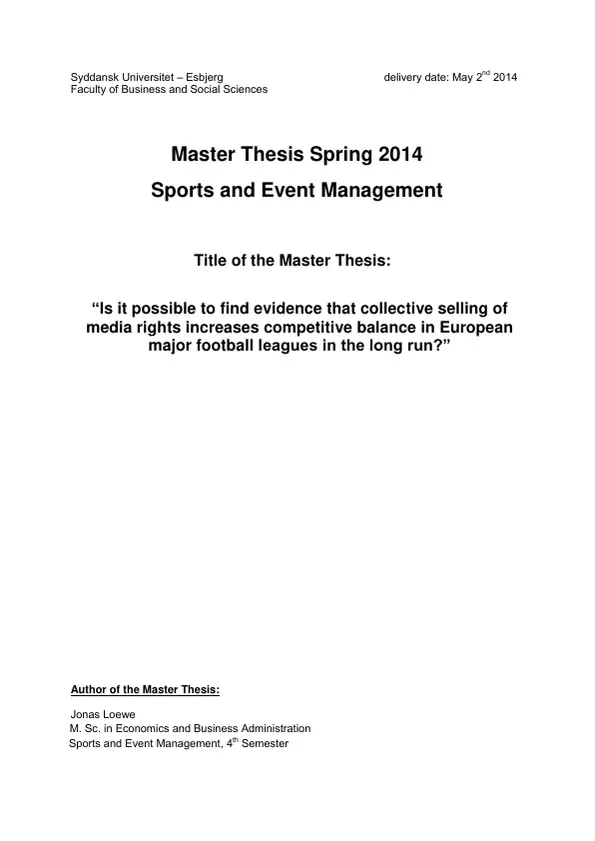
The research asks: “Is it possible to find evidence that collective selling of media rights increases competitive balance in European major football leagues in the long run?”
Which scientific methods are utilized?
The author employs a quantitative approach using the Ratio of Standard Deviation (RSD) and Concentration Ratios (CR2 and CR5) to analyze league data from 1984 to 2013.
What is addressed in the main body of the work?
The main body examines the theoretical background of multi-sided sports markets, current status reports on league revenues, and a comparative statistical evaluation of six European leagues.
How would you characterize the work using keywords?
The work is characterized by terms such as competitive balance, media rights, revenue sharing, sports economics, and league dominance.
How does the financial power of clubs influence competitive balance?
The author identifies a "positive helix" where financial success leads to sporting success, which in turn generates more financial power, potentially creating an imbalance within leagues.
What role do external investors play in professional football?
The thesis concludes that external investors and significant financial injections can undermine the effects of media rights distribution, making the choice of selling system less impactful on overall financial stability.
Ende der Leseprobe aus 95 Seiten
- nach oben
- Arbeit zitieren
- Jonas Loewe (Autor:in), 2014, Collective selling of media rights as instrument for competitive balance in European major football leagues, München, Page::Imprint:: GRINVerlagOHG, https://www.diplomarbeiten24.de/document/283662

neugierig - aktuell - relevant
Entdecken Sie hilfreiche Tipps und Tricks rund ums Studium!

Entdecken Sie hilfreiche Tipps und Tricks rund ums Studium!
Ihre Hausarbeit / Abschlussarbeit:

- - Publikation als E-Book und Buch
- - Hohes Honorar auf die Verkäufe
- - Für Sie komplett kostenlos - mit ISBN
- - Es dauert nur 5 Minuten
- - Jede Arbeit findet Leser

- © GRIN Publishing GmbH.
- Alle Inhalte urheberrechtlich geschützt. Kopieren und verbreiten untersagt.
- info@grin.com
- AGB
- Open Publishing
Der GRIN Verlag hat sich seit 1998 auf die Veröffentlichung akademischer eBooks und Bücher spezialisiert. Der GRIN Verlag steht damit als erstes Unternehmen für User Generated Quality Content. Die Verlagsseiten GRIN.com, Hausarbeiten.de und Diplomarbeiten24 bieten für Hochschullehrer, Absolventen und Studenten die ideale Plattform, wissenschaftliche Texte wie Hausarbeiten, Referate, Bachelorarbeiten, Masterarbeiten, Diplomarbeiten, Dissertationen und wissenschaftliche Aufsätze einem breiten Publikum zu präsentieren.
Kostenfreie Veröffentlichung: Hausarbeit, Bachelorarbeit, Diplomarbeit, Dissertation, Masterarbeit, Interpretation oder Referat jetzt veröffentlichen!
Folgen Sie GRIN auf


- GRIN Verlag GmbH
-
- Nymphenburger Str. 86
- 80636
- Munich, Deutschland
- +49 89-550559-0
- +49 89-550559-10
- info@grin.com
-
