
präsentiert von

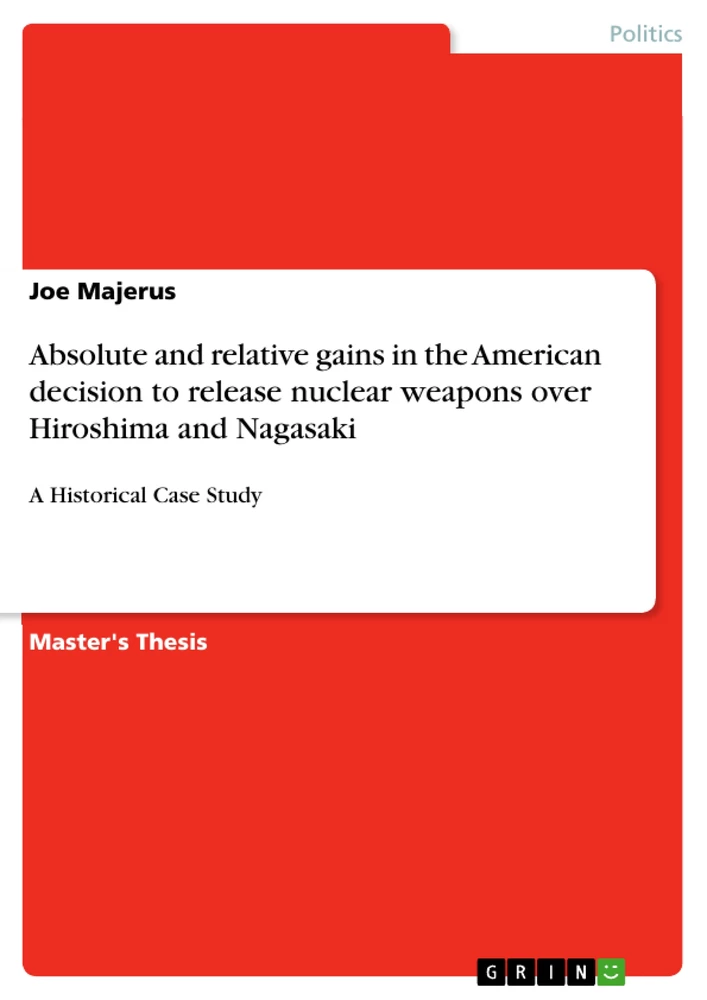
Table of Contents
Introduction
Part I: Theoretical Framework
1.1 Neo-realist and Neo-liberal Views
1.2 Absolute Gains via Absolute Objectives
1.3 Social-Constructivism
1.4 Alexander Wendt's Self-Help/Other-Help Antinomy
Part II: Historical Analysis
2.1 Primary Level Analysis / Literature Review
2.1.1 Military Imperatives
2.1.2 Domestic Concerns
2.1.3 Ideological Motivations
2.1.4 Geopolitical Considerations
2.2 Secondary Level Analysis
2.2.1 Domestic Rehabilitation
2.2.2 International Peace
Peace in the Longer Term
Peace in the Short Term
Part III: The Primacy of Absolute Gains
3.1 Construction of Reality
3.2 The United States as a Revisionist Status-Quo Power
3.3 American Identity and Interests
4. Conclusion
Research Objectives and Core Themes
This dissertation examines the decision-making process of the Truman Administration regarding the use of nuclear weapons against Hiroshima and Nagasaki, arguing that American leadership was driven primarily by the pursuit of absolute gains rather than relative gains. The research investigates how these objectives were deeply embedded in the reconstruction of national identity and the broader strategic vision for a stable post-war international order.
- The theoretical tension between neo-realist and neo-liberal perspectives on state gains.
- The application of social-constructivist theory to explain state interest formation.
- The impact of domestic socio-economic imperatives on foreign policy decisions.
- The interplay between short-term military objectives and long-term geopolitical stability.
Excerpt from the Book
2.1.1 Military Imperatives
The arguably most often cited reason by 'orthodox' scholars for detonating atomic bombs over Hiroshima and Nagasaki pertains to the American need for bringing the Pacific war to a swift conclusion. Following Nazi Germany's surrender on 8 May 1945, American military forces were still engaged in a gruelling conflict in East Asia which to many contemporary observers seemed poised to rage on with unbridled ferocity for an unspecified period of time. Consequently, American leaders felt an increasing urgency for finally achieving total victory over an intransigent enemy which even after three years of relentless warfare, large-scale devastation, socio-economic deprivations and an unbearably high toll in both civilian and military casualties vehemently refused to admit to its defeat. Unwilling to accept an "unconditional surrender" on American terms, Japanese decision-makers instead focused all their energy, men and resources on denying the Americans additional operating bases for attacking Japanese cities. As a result, American troops met with especially fierce resistance as they attempted to seize the strategically important, yet heavily fortified islands of Iwo Jima and Okinawa.
Chapter Summary
Introduction: Outlines the debate between neo-realism and neo-liberalism regarding absolute and relative gains and introduces the social-constructivist approach.
Part I: Theoretical Framework: Examines neo-realist and neo-liberal views, absolute gains via absolute objectives, social-constructivism, and Alexander Wendt’s self-help/other-help antinomy.
Part II: Historical Analysis: Investigates primary level motivations including military, domestic, ideological, and geopolitical factors, followed by a secondary level analysis of domestic rehabilitation and international peace.
Part III: The Primacy of Absolute Gains: Analyzes the construction of reality, the U.S. as a revisionist status-quo power, and the formation of American identity and interests.
Conclusion: Synthesizes the findings, confirming that American policy in 1945 was driven by the pursuit of absolute gains to ensure long-term stability and economic prosperity.
Keywords
Absolute Gains, Relative Gains, Neo-realism, Neo-liberalism, Social-constructivism, Truman Administration, Hiroshima, Nagasaki, Atomic Bomb, National Identity, International Anarchy, Foreign Policy, Post-war Order, Security, Economic Recovery.
Frequently Asked Questions
What is the central focus of this research?
The dissertation focuses on whether the Truman Administration's decision to use nuclear weapons on Japan was motivated by the pursuit of absolute or relative gains in international politics.
What are the primary theoretical themes?
The study contrasts neo-realist and neo-liberal theories of state behavior and incorporates social-constructivist arguments about how state interests and identities are constructed.
What is the primary research question?
The paper asks to what extent absolute versus relative gains influenced the decision-making process of the Truman Administration, and whether these preferences are predetermined by anarchy or formed through social processes.
Which methodology is employed?
The author uses a historical case study methodology, analyzing primary sources such as government documents and cabinet minutes, supported by a secondary level literature review.
What does the main body cover?
It covers theoretical frameworks, primary level military and ideological motivations, secondary level analysis of domestic economic rehabilitation, and the broader goal of establishing an international order.
Which keywords characterize this work?
Key terms include absolute gains, relative gains, Truman Administration, social-constructivism, and international anarchy.
Why were absolute gains prioritized by the Truman Administration?
American leaders believed that achieving absolute goals, such as swift socio-economic recovery and a stable security environment, was the only way to ensure the long-term national and international position of the U.S.
How does this work challenge existing interpretations?
It argues against the notion that relative gains are a natural or inevitable consequence of an anarchic system, suggesting instead that states, influenced by their identity and social environment, can prioritize absolute objectives.
Ende der Leseprobe aus 77 Seiten
- nach oben
- Arbeit zitieren
- Joe Majerus (Autor:in), 2014, Absolute and relative gains in the American decision to release nuclear weapons over Hiroshima and Nagasaki, München, Page::Imprint:: GRINVerlagOHG, https://www.diplomarbeiten24.de/document/284040

neugierig - aktuell - relevant
Entdecken Sie hilfreiche Tipps und Tricks rund ums Studium!

Entdecken Sie hilfreiche Tipps und Tricks rund ums Studium!
Ihre Hausarbeit / Abschlussarbeit:

- - Publikation als E-Book und Buch
- - Hohes Honorar auf die Verkäufe
- - Für Sie komplett kostenlos - mit ISBN
- - Es dauert nur 5 Minuten
- - Jede Arbeit findet Leser

- © GRIN Publishing GmbH.
- Alle Inhalte urheberrechtlich geschützt. Kopieren und verbreiten untersagt.
- info@grin.com
- AGB
- Open Publishing
Der GRIN Verlag hat sich seit 1998 auf die Veröffentlichung akademischer eBooks und Bücher spezialisiert. Der GRIN Verlag steht damit als erstes Unternehmen für User Generated Quality Content. Die Verlagsseiten GRIN.com, Hausarbeiten.de und Diplomarbeiten24 bieten für Hochschullehrer, Absolventen und Studenten die ideale Plattform, wissenschaftliche Texte wie Hausarbeiten, Referate, Bachelorarbeiten, Masterarbeiten, Diplomarbeiten, Dissertationen und wissenschaftliche Aufsätze einem breiten Publikum zu präsentieren.
Kostenfreie Veröffentlichung: Hausarbeit, Bachelorarbeit, Diplomarbeit, Dissertation, Masterarbeit, Interpretation oder Referat jetzt veröffentlichen!
Folgen Sie GRIN auf


- GRIN Verlag GmbH
-
- Nymphenburger Str. 86
- 80636
- Munich, Deutschland
- +49 89-550559-0
- +49 89-550559-10
- info@grin.com
-
