
präsentiert von

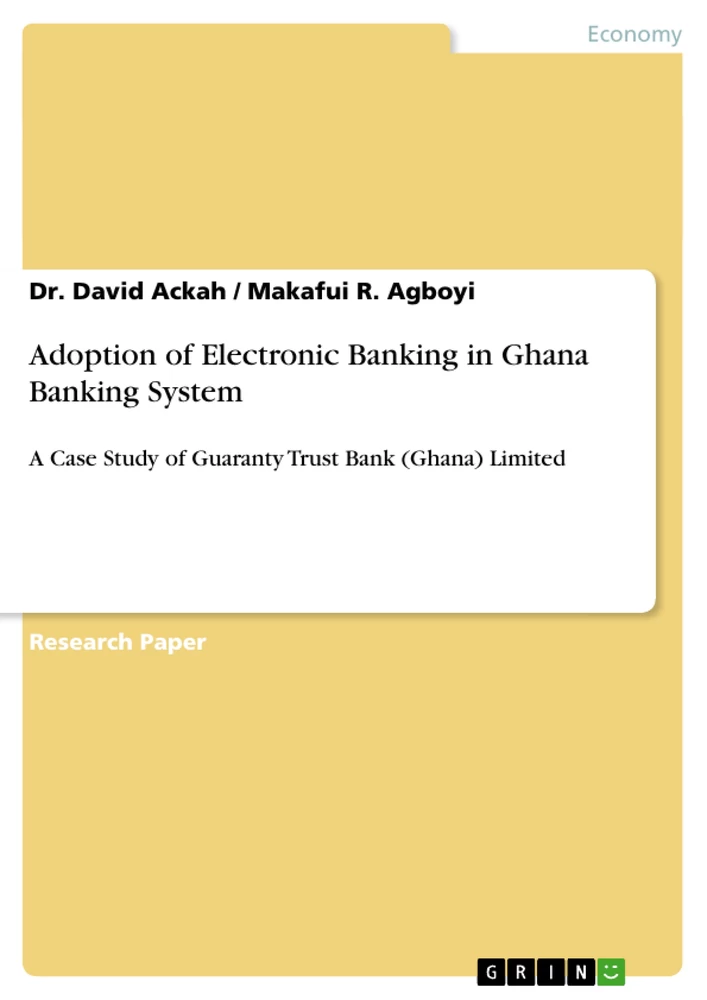
Table of Contents
1. INTRODUCTION
1.1 BACKGROUND TO THE STUDY
1.2 STATEMENT OF THE PROBLEM
1.3 RESEARCH OBJECTIVES
1.4 RESEARCH QUESTIONS
1.5 SIGNIFICANCE OF THE STUDY
1.6 SCOPE AND LIMITATION OF STUDY
1.7 BRIEF METHODOLOGY
1.8 STRUCTURE OF THE STUDY
2. LITERATURE REVIEW AND THEORETICAL FRAMEWORK
2.1 INTRODUCTION
2.2 DEFINITION OF E-BANKING
2.3 THE ADOPTION OF ELECTRONIC BANKING
2.4 BANKING DEVELOPMENTS IN GHANA
2.5 HISTORY OF ELECTRONIC BANKING IN GHANA
2.6 ELECTRONIC BANKING ADOPTIONS IN GHANAIAN BANKING SECTOR
2.7 FORMS OF E-BANKING SERVICE DELIVERY CHANNELS
2.7.1 Automated Teller Machines (ATMs)
2.7.2 Telephone Banking
2.7.3 Personal Computer Banking
2.7.4 Internet Banking
2.7.5 Branch Networking
2.8 BENEFITS OF E-BANKING
2.9 CRITICAL SUCCESS FACTORS OF E-BANKING
2.10 CHALLENGES OF E-BANKING
3. ORGANIZATIONAL PROFILE AND RESEARCH METHODOLOGY
3.1 COMPANY PROFILE
3.2 CORPORATE GOVERNANCE
3.3 BANKING PRODUCTS AND SERVICES
3.4 RESEARCH METHODOLOGY
3.4.1 Research Design
3.4.2 Population
3.4.3 Survey Instrument: Design and Administration
3.5 SOURCES OF DATA GATHERED
3.6 SAMPLING TECHNIQUE
3.7 TEST-INSTRUMENT
3.8 PROBLEMS ENCOUNTERED
3.9 DATA ANALYSIS TECHNIQUE
4. PRESENTATION AND DISCUSSION OF FINDINGS
4.1 INTRODUCTION
4.2 FINDING FROM OFFICIALS OF GTBANK
4.2.1 Gender Profile of Respondents
4.2.2 Age Profile of Respondents
4.2.3 Educational Background of Respondents
4.2.4 Years of Service with GT Bank
4.2.5 GTBank’s E-banking Adoption
4.2.6 E-Banking Services offered by GTBank
4.2.7 Benefits of E-Banking Adoption
4.2.8 Critical Success Factors
4.2.9 Challenges of E-banking Adoption
4.3 FINDING FROM OFFICIALS OF GTBANK
4.3.1 Gender Profile of Respondents
4.3.2 Age Profile of Respondents
4.3.3 Doing business with the bank
4.3.4 Subscription to E-banking products
4.3.5 E-Banking Services Subscribed
4.3.6 Benefits of E-Banking to Customers
4.3.7 Effectiveness of e-banking services
4.3.8 Dealing with system challenges
4.3.9 Banks response to system challenges and failures
4.3.10 Level of Satisfaction
4.3.11 Recommending to Friends
5. SUMMARY OF FINDINGS, CONCLUSION AND RECOMMENDATION
5.1 INTRODUCTION
5.2 SUMMARY OF FINDINGS
5.3 CONCLUSION
5.4 RECOMMENDATIONS
Research Objectives and Themes
This study aims to examine the status of electronic banking (e-banking) adoption within the Ghanaian banking industry, using Guaranty Trust Bank Ghana Limited (GTBank) as a case study to identify the specific benefits, challenges, and critical success factors associated with this transition.
- Analysis of e-banking services and their impact on operational efficiency.
- Identification of benefits for both the bank and its customers.
- Evaluation of challenges, specifically concerning technological infrastructure and security.
- Determination of critical success factors for successful e-banking implementation.
- Exploration of customer satisfaction and loyalty in the context of digital banking services.
Excerpt from the Book
2.2 DEFINITION OF E-BANKING
Vilattes (1997) defines E-banking as a distance banking that not only handles the flow of information between customers’ “living spaces” (e.g. homes, offices, etc) and the physical facilities of the bank, but also deals with solicitation, sales, distribution and access to services, all without requiring the customer and the financial institution representative to be in the same physical place at the same time. According to Mols (1998), electronic banking is the automated delivery of new and traditional banking products and services directly to customers through electronic medium. This system allows customers to access their accounts, transact business, make enquiries and have prompt responses from banks.
Daniel (1999) described electronic banking as the provision of banking services to customers through Internet technology. Other authors (Mols, 1998; Karjaluoto et al., 2002) indicated that banks have the choice to offer their banking services through various electronic distribution channels technologies such as Internet technology, video banking technology, telephone banking technology, and Wireless Application Protocol technology (WAP). Karjaluoto et al. (2002) also indicated that Internet technology is the main electronic distribution channel in the banking industry. In more detail the author described E-banking as an online banking that involves the provision of banking services such as accessing accounts, transferring funds between accounts, and offering an online financial service.
Summary of Chapters
1. INTRODUCTION: Outlines the background, research objectives, statement of the problem, and the significance of the study regarding e-banking adoption in Ghana.
2. LITERATURE REVIEW AND THEORETICAL FRAMEWORK: Provides a comprehensive appraisal of existing literature on e-banking, covering definitions, adoption factors, service delivery channels, and historical context.
3. ORGANIZATIONAL PROFILE AND RESEARCH METHODOLOGY: Details the profile of Guaranty Trust Bank (GTBank) and explains the qualitative research design and data collection instruments used.
4. PRESENTATION AND DISCUSSION OF FINDINGS: Analyzes the data collected from bank staff and customers regarding e-banking benefits, challenges, and levels of satisfaction.
5. SUMMARY OF FINDINGS, CONCLUSION AND RECOMMENDATION: Concludes the study by summarizing key findings and providing recommendations for enhancing e-banking services in Ghana.
Keywords
Electronic Banking, E-banking, GTBank, Ghana Banking Sector, Information Technology, Customer Satisfaction, Service Delivery, Financial Services, Technology Infrastructure, Security, Competitive Advantage, Adoption, Banking Innovation, Digital Transformation, Operational Efficiency.
Frequently Asked Questions
What is the primary focus of this research?
The research focuses on examining the adoption of electronic banking in the Ghanaian banking industry, specifically using Guaranty Trust Bank (GTBank) as a case study to understand its benefits, challenges, and critical success factors.
What are the main thematic areas covered?
The study covers the evolution of banking technology, forms of e-banking delivery channels, the benefits of e-banking for institutions and customers, and the challenges faced in a developing country like Ghana.
What is the core research objective?
The general objective is to describe the current status of e-banking adoption at GTBank and to identify the specific services, benefits, and challenges associated with its implementation.
Which research methodology is employed?
The study utilizes a qualitative, exploratory, and descriptive research approach, employing semi-structured interviews with bank staff and questionnaires for customers to gather empirical data.
What topics are discussed in the main body?
The main body examines the definition of e-banking, historical developments in the Ghanaian banking sector, specific service delivery channels like ATMs and internet banking, and an analysis of empirical findings derived from surveys.
What key terms characterize this study?
The study is characterized by terms such as e-banking, digital transformation, Ghana, GTBank, financial inclusion, technology infrastructure, and customer service quality.
Why was Guaranty Trust Bank (GTBank) selected as the case study?
GTBank was selected due to its recognized success and awards in product innovation and electronic banking, making it a representative example of a technology-driven bank in the Ghanaian market.
What does the study conclude regarding the future of e-banking in Ghana?
The study concludes that there is a promising future for e-banking in Ghana, as customers are increasingly willing to embrace electronic services provided the benefits are promoted and technical issues are addressed promptly.
How does the study address the challenge of infrastructure?
The study highlights that the lack of solid technological infrastructure in Ghana has forced banks like GTBank to outsource specific banking processes to external providers, such as companies in Egypt for card processing.
Ende der Leseprobe aus 47 Seiten
- nach oben
- Arbeit zitieren
- Dr. David Ackah (Autor:in), Makafui R. Agboyi (Autor:in), 2014, Adoption of Electronic Banking in Ghana Banking System, München, Page::Imprint:: GRINVerlagOHG, https://www.diplomarbeiten24.de/document/284721


neugierig - aktuell - relevant
Entdecken Sie hilfreiche Tipps und Tricks rund ums Studium!

Entdecken Sie hilfreiche Tipps und Tricks rund ums Studium!
Ihre Hausarbeit / Abschlussarbeit:

- - Publikation als E-Book und Buch
- - Hohes Honorar auf die Verkäufe
- - Für Sie komplett kostenlos - mit ISBN
- - Es dauert nur 5 Minuten
- - Jede Arbeit findet Leser

- © GRIN Publishing GmbH.
- Alle Inhalte urheberrechtlich geschützt. Kopieren und verbreiten untersagt.
- info@grin.com
- AGB
- Open Publishing
Der GRIN Verlag hat sich seit 1998 auf die Veröffentlichung akademischer eBooks und Bücher spezialisiert. Der GRIN Verlag steht damit als erstes Unternehmen für User Generated Quality Content. Die Verlagsseiten GRIN.com, Hausarbeiten.de und Diplomarbeiten24 bieten für Hochschullehrer, Absolventen und Studenten die ideale Plattform, wissenschaftliche Texte wie Hausarbeiten, Referate, Bachelorarbeiten, Masterarbeiten, Diplomarbeiten, Dissertationen und wissenschaftliche Aufsätze einem breiten Publikum zu präsentieren.
Kostenfreie Veröffentlichung: Hausarbeit, Bachelorarbeit, Diplomarbeit, Dissertation, Masterarbeit, Interpretation oder Referat jetzt veröffentlichen!
Folgen Sie GRIN auf


- GRIN Verlag GmbH
-
- Nymphenburger Str. 86
- 80636
- Munich, Deutschland
- +49 89-550559-0
- +49 89-550559-10
- info@grin.com
-
