
präsentiert von

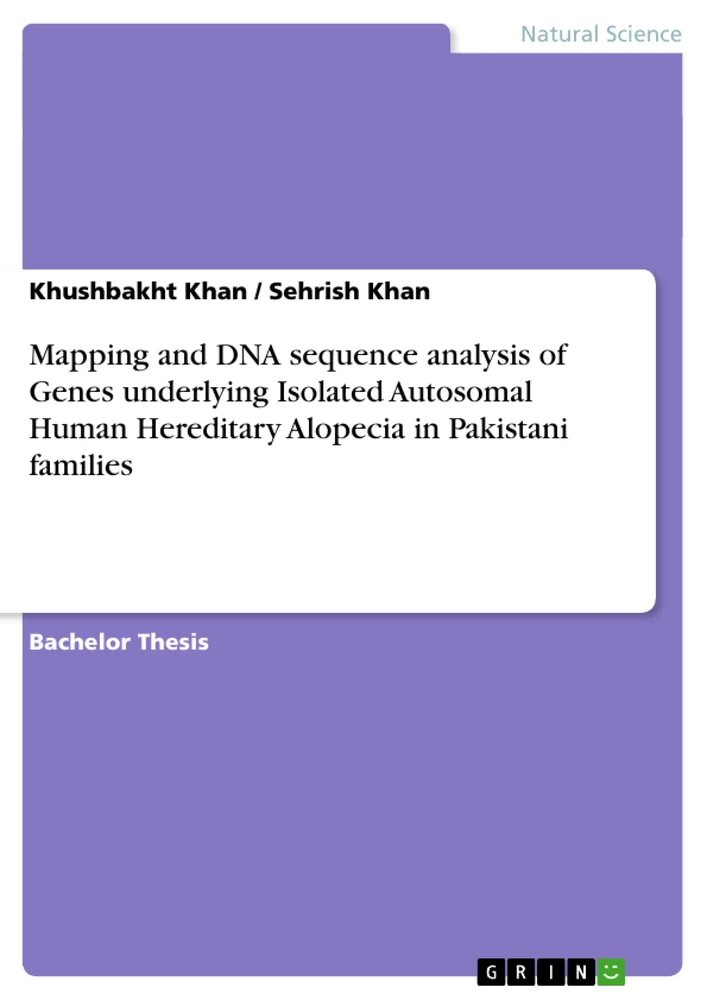
Table of Contents
1. Chapter 1: Introduction
1.1. Hair composition and structure
1.2. Hair follicle morphogenesis
1.3. Hair follicle cycling:
1.4. Types of Hair Disorder/Alopecia
1.4.1. Complex Hair Disorders
1.4.1.1. Androgenic Alopecia
1.4.1.2. Alopecia Areata
1.4.2. Syndromic Alopecia
1.4.2.1. Alopecia with mental retardation syndrome
1.4.2.2. Hypotrichosis with juvenile macular dystrophy
1.4.2.3. Netherton Syndrome
1.4.2.4. Human Nude Phenotype
1.4.3. Inherited Isolated Alopecias
1.4.3.1. Inherited Isolated Autosomal Dominant Alopecias
1.4.3.2. Inherited Isolated Autosomal Recessive Alopecias
1.5. Genetics of Alopecia
2. Chapter 2: Materials and Methods
2.1. Families studied
2.2. Pedigree Analysis
2.3. Extraction of Genomic DNA
2.3.1. Phenol-Chloroform Method
2.3.2. Thermo scientific commercially available kit
2.4. Polymerase Chain Reaction
2.5. Linkage Analysis
2.6. Gel Electrophoresis
2.6.1. Agarose Gel Electrophoresis
2.6.2. Polyacrylamide Gel Electrophoresis (PAGE)
2.7. Gene Sequencing
2.7.1. Genomic DNA Amplification for Sequencing
2.7.1.1. First sequencing PCR
2.7.1.2. First Purification
2.7.1.3. Second sequencing PCR
2.7.1.4. Second Purification
2.8. Mutation analysis
3. Chapter 3: Results
3.1. Family A
3.2. Family B
3.3. Genetic mapping of candidate genes for autosomal recessive alopecia
3.4. CDH3 gene sequencing
4. Chapter 4: Discussion
5. Chapter 5: References
Research Objectives and Themes
This thesis aims to investigate the genetic causes of isolated hereditary alopecia in Pakistani families by identifying the specific loci and genes involved. By performing linkage analysis and homozygosity mapping in affected families, the research seeks to unveil novel sequence variants and better understand the phenotypic variability associated with these hereditary conditions.
- Phenotypic and genetic characterization of hereditary alopecia families in Pakistan.
- Linkage analysis and homozygosity mapping to localize disease-causing genes.
- DNA sequencing to identify pathogenic mutations in candidate genes.
- Analysis of the relationship between specific genetic mutations and clinical hair loss phenotypes.
Excerpt from the Book
1.4.3.2 Inherited Isolated Autosomal Recessive Alopecia
Atrichia with Papular Lesions (APL; MIM 209500) is an autosomal recessive form of alopecia. It is characterized by presence of papules and cornified, material filled follicular cysts on scalp skin with no other defect of ectodermal appendages like nails, sweat gland and teeth. Normal hair are present at the time of birth that shad off during first month of life. Affected individuals have no scalp, axillary and body hair and are completely devoid of eyebrows and eyelashes (Ahmad et al., 1993; Ahmad et al., 1998a).
Localized Autosomal Recessive Hypotrichosis is a rare type of alopecia caused by abnormality in hair follicles. It is histologically identified by atrophic and thin shafts that are coiled up within the skin due to their inability to penetrate the epidermis. Hairs are present on the scalp at birth but regrow sparsely after ritual shaving. Three types of autosomal recessive hypotrichosis have been reported to date.
Chapter Summaries
Chapter 1: Introduction: Provides an overview of human hereditary hair loss phenotypes, the biology of hair follicles, and the genetics of various types of alopecia.
Chapter 2: Materials and Methods: Details the methodologies used for family recruitment, pedigree analysis, DNA extraction, PCR, linkage analysis, gel electrophoresis, and sequencing.
Chapter 3: Results: Presents the findings from the clinical analysis of families, genetic mapping, and the sequencing results of the CDH3 gene.
Chapter 4: Discussion: Analyzes the genetic findings in the context of previous literature, discussing the involvement of novel genes and the implications for genetic counseling.
Chapter 5: References: A comprehensive list of scientific literature cited throughout the dissertation.
Keywords
Alopecia, Hereditary Alopecia, Autosomal Recessive, Hypotrichosis, Genetic Mapping, Linkage Analysis, CDH3, HR, DSG4, LIPH, LPAR6, Mutation Screening, DNA Sequencing, Pakistani Families, Consanguinity.
Frequently Asked Questions
What is the primary focus of this research?
The research focuses on mapping and analyzing DNA sequences of genes underlying isolated autosomal human hereditary alopecia within Pakistani families.
What are the main thematic areas covered?
The study covers hair follicle biology, genetic inheritance patterns, linkage analysis techniques, and the molecular mechanisms of alopecia.
What is the primary objective of this work?
The main objective is to identify the genes and pathogenic mutations responsible for isolated hereditary alopecia in specific Pakistani families to better understand the disease's genetic basis.
Which scientific methods were utilized in this study?
The study employed pedigree analysis, genomic DNA extraction, Polymerase Chain Reaction (PCR), linkage analysis, gel electrophoresis, and DNA sequence analysis.
What is addressed in the main body of the work?
The main body details the materials and methods used for genetic analysis and presents the clinical results and genetic mapping data for the studied families.
Which keywords define this work?
Key terms include hereditary alopecia, autosomal recessive inheritance, genetic mapping, linkage analysis, and various candidate genes like CDH3 and HR.
How was Family A analyzed in this study?
Family A was subjected to mutation screening, specifically focusing on the CDH3 gene, which was linked to their condition based on prior research.
Why was Family B tested for linkage?
Family B showed clinical features of Atrichia with Papular Lesions (APL), and linkage analysis was performed to test if known candidate loci were responsible for their condition.
What were the findings regarding the CDH3 gene in Family A?
Sequencing of all 16 exons of the CDH3 gene in Family A revealed no functional pathogenic sequence variants, suggesting that any causative mutation is likely located in regulatory or intronic regions.
Ende der Leseprobe aus 84 Seiten
- nach oben
- Arbeit zitieren
- Khushbakht Khan (Autor:in), Sehrish Khan (Autor:in), 2014, Mapping and DNA sequence analysis of Genes underlying Isolated Autosomal Human Hereditary Alopecia in Pakistani families, München, Page::Imprint:: GRINVerlagOHG, https://www.diplomarbeiten24.de/document/286264

neugierig - aktuell - relevant
Entdecken Sie hilfreiche Tipps und Tricks rund ums Studium!

Entdecken Sie hilfreiche Tipps und Tricks rund ums Studium!
Ihre Hausarbeit / Abschlussarbeit:

- - Publikation als E-Book und Buch
- - Hohes Honorar auf die Verkäufe
- - Für Sie komplett kostenlos - mit ISBN
- - Es dauert nur 5 Minuten
- - Jede Arbeit findet Leser

- © GRIN Publishing GmbH.
- Alle Inhalte urheberrechtlich geschützt. Kopieren und verbreiten untersagt.
- info@grin.com
- AGB
- Open Publishing
Der GRIN Verlag hat sich seit 1998 auf die Veröffentlichung akademischer eBooks und Bücher spezialisiert. Der GRIN Verlag steht damit als erstes Unternehmen für User Generated Quality Content. Die Verlagsseiten GRIN.com, Hausarbeiten.de und Diplomarbeiten24 bieten für Hochschullehrer, Absolventen und Studenten die ideale Plattform, wissenschaftliche Texte wie Hausarbeiten, Referate, Bachelorarbeiten, Masterarbeiten, Diplomarbeiten, Dissertationen und wissenschaftliche Aufsätze einem breiten Publikum zu präsentieren.
Kostenfreie Veröffentlichung: Hausarbeit, Bachelorarbeit, Diplomarbeit, Dissertation, Masterarbeit, Interpretation oder Referat jetzt veröffentlichen!
Folgen Sie GRIN auf


- GRIN Verlag GmbH
-
- Nymphenburger Str. 86
- 80636
- Munich, Deutschland
- +49 89-550559-0
- +49 89-550559-10
- info@grin.com
-
