
präsentiert von

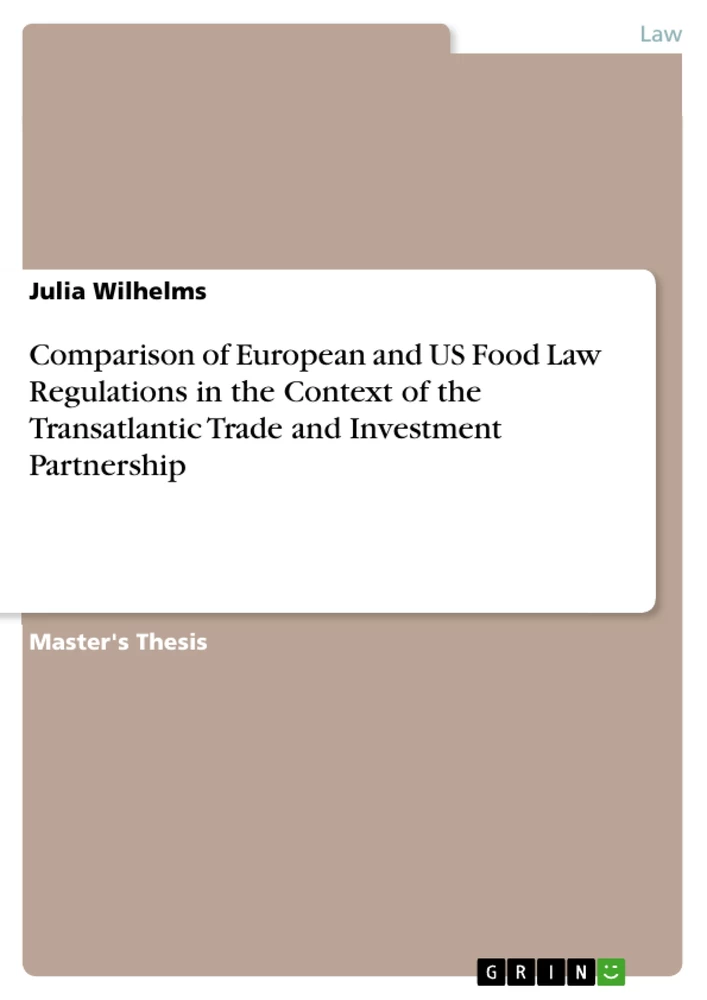
Table of Contents
1. Introduction and Objective
2. Structure of the food safety system
2.1. Food Safety System in the U.S.
2.2. Food Safety System in the EU
3. Risk Analysis
3.1. Risk Assessment
3.2. Prevention of food safety problems
3.3. Response and risk communication
4. Special cases
4.1. Meat production
4.1.1. Hormones in meat
4.1.2. Antibiotics in meat
4.1.3. Beta-Agonists in meat
4.2. Organic food
4.3. Food labeling
4.4. Genetically modified crops, food and feed
4.5. Food additives
4.6. Eggs
5. Chances and challenges of the Transatlantic Free Trade Agreement (TAFTA)
5.1. The Transatlantic Trade and Investment Partnership (TTIP)
5.2. General Benefits
5.3. Consequences for the EU and the U.S.
6. Conclusion
7. Summary
Objectives and Thematic Focus
The primary objective of this study is to compare the food safety systems of the United States and the European Union, specifically addressing how their structural differences in risk assessment, prevention, and communication impact potential negotiations regarding the Transatlantic Trade and Investment Partnership (TTIP). The study aims to identify regulatory hurdles that complicate these trade negotiations and provides recommendations to achieve positive outcomes.
- Comparison of U.S. and EU food safety governance structures.
- Analysis of risk assessment principles, including the precautionary principle vs. scientific certainty.
- Examination of specific contested commodities: meat, GMOs, organic products, and food additives.
- Evaluation of the potential impact of TTIP on existing food safety standards.
- Assessment of cross-Atlantic regulatory transparency and cooperation mechanisms.
Excerpt from the Book
3.1 Risk Assessment
Risk assessment describes the process of hazard identification, hazard characterization, exposure assessment and risk characterization. (Saxowksy, 2014b) The result of the risk assessment is the basis for the respective food law system.
Both the European and the U.S. Food Law have the intention to prevent food safety problems, rather than react to problems after they occur. However, differences in the implementation of the risk assessment subsist. In general, the differences in the prevention of food safety problems can be summarized in three chapters: The precautionary principle, the farm-to-fork approach and the acknowledgement of other factors in the evaluation of food safety.
Precautionary principle
Probably the most prominent difference in approaching prevention of food safety problems as well as in the context of the TTIP is the concept of the precautionary principle. (Barker, 2014) The EU General Food Law states that if there is the possibility of harmful effects but “scientific uncertainty persists” (European Parliament and Council of the European Union, 2002, Article 7), risk management measures may be conducted in order to maintain the high level of health protection while additional scientific data is obtained. That means, safety measures may be conducted although no certain scientific proof exists about the harmful effects of the product in question and thus, a proactive approach is chosen.
Summary of Chapters
1. Introduction and Objective: Outlines the initiation of TTIP negotiations and the study's aim to present and compare U.S. and EU food safety systems.
2. Structure of the food safety system: Compares the federal U.S. food safety governance with the more complex, multi-layered EU regulatory framework.
3. Risk Analysis: Examines foundational differences in risk assessment methodologies, specifically focusing on the precautionary principle, farm-to-fork strategies, and crisis communication systems like RASFF.
4. Special cases: Investigates specific areas of trade friction, including hormone-treated meat, antibiotic usage, beta-agonists, organic food standards, GMO approval, and egg safety.
5. Chances and challenges of the Transatlantic Free Trade Agreement (TAFTA): Details the negotiations of the TTIP, highlighting economic benefits versus regulatory risks and the role of stakeholders.
6. Conclusion: Synthesizes the challenges of harmonizing food safety standards and suggests that mutual admissions are necessary for successful agreement.
7. Summary: Provides a final overview of the study's findings regarding the structural and philosophical differences between the two food safety systems.
Keywords
TTIP, Food Safety, Risk Assessment, Precautionary Principle, GMOs, Meat Production, Hormones, Antibiotics, Beta-agonists, Organic Food, FDA, EFSA, Food Labeling, Trade Barriers, HACCP.
Frequently Asked Questions
What is the core focus of this research?
The research focuses on comparing the food safety law frameworks of the United States and the European Union, specifically in the context of how these differences impact Transatlantic Trade and Investment Partnership (TTIP) negotiations.
What are the primary themes discussed in the work?
The main themes include food safety governance, the precautionary principle vs. scientific certainty, the farm-to-fork approach, and specific trade conflicts involving meat, GMOs, and additives.
What is the central research question?
The study aims to determine how differences in the implementation of food safety systems (risk assessment, prevention, and communication) create challenges for the harmonization of trade regulations in the TTIP agreement.
Which scientific methodology does the author use?
The author uses a theoretical analysis of legal frameworks and policy documents, complemented by practical examples and case studies (such as the horsemeat scandal or specific hormone disputes) to illustrate regulatory discrepancies.
What topics are covered in the main section of the paper?
The main section covers the institutional structures of food safety agencies, principles of risk analysis, and detailed case studies on meat production, organic standards, GMOs, food labeling, and food additives.
How would you describe the key terminology?
The work is characterized by terms related to regulatory governance, such as "precautionary principle," "farm-to-fork," "non-tariff barriers," and "SPS measures," which are central to the trade conflict discourse.
Why is the "precautionary principle" such a major point of contention?
It acts as a fundamental barrier because the EU uses it to justify restrictive measures when scientific uncertainty exists, whereas the U.S. typically requires distinct proof of risk before banning a product.
What impact does the "farm-to-fork" approach have on trade?
This approach in the EU emphasizes monitoring the entire production chain, which often conflicts with the U.S. focus on end-product testing and chemical decontamination, leading to disputes over safety standards for items like meat and eggs.
Ende der Leseprobe aus 80 Seiten
- nach oben
- Arbeit zitieren
- Julia Wilhelms (Autor:in), 2014, Comparison of European and US Food Law Regulations in the Context of the Transatlantic Trade and Investment Partnership, München, Page::Imprint:: GRINVerlagOHG, https://www.diplomarbeiten24.de/document/286574

neugierig - aktuell - relevant
Entdecken Sie hilfreiche Tipps und Tricks rund ums Studium!

Entdecken Sie hilfreiche Tipps und Tricks rund ums Studium!
Ihre Hausarbeit / Abschlussarbeit:

- - Publikation als E-Book und Buch
- - Hohes Honorar auf die Verkäufe
- - Für Sie komplett kostenlos - mit ISBN
- - Es dauert nur 5 Minuten
- - Jede Arbeit findet Leser

- © GRIN Publishing GmbH.
- Alle Inhalte urheberrechtlich geschützt. Kopieren und verbreiten untersagt.
- info@grin.com
- AGB
- Open Publishing
Der GRIN Verlag hat sich seit 1998 auf die Veröffentlichung akademischer eBooks und Bücher spezialisiert. Der GRIN Verlag steht damit als erstes Unternehmen für User Generated Quality Content. Die Verlagsseiten GRIN.com, Hausarbeiten.de und Diplomarbeiten24 bieten für Hochschullehrer, Absolventen und Studenten die ideale Plattform, wissenschaftliche Texte wie Hausarbeiten, Referate, Bachelorarbeiten, Masterarbeiten, Diplomarbeiten, Dissertationen und wissenschaftliche Aufsätze einem breiten Publikum zu präsentieren.
Kostenfreie Veröffentlichung: Hausarbeit, Bachelorarbeit, Diplomarbeit, Dissertation, Masterarbeit, Interpretation oder Referat jetzt veröffentlichen!
Folgen Sie GRIN auf


- GRIN Verlag GmbH
-
- Nymphenburger Str. 86
- 80636
- Munich, Deutschland
- +49 89-550559-0
- +49 89-550559-10
- info@grin.com
-
