
präsentiert von

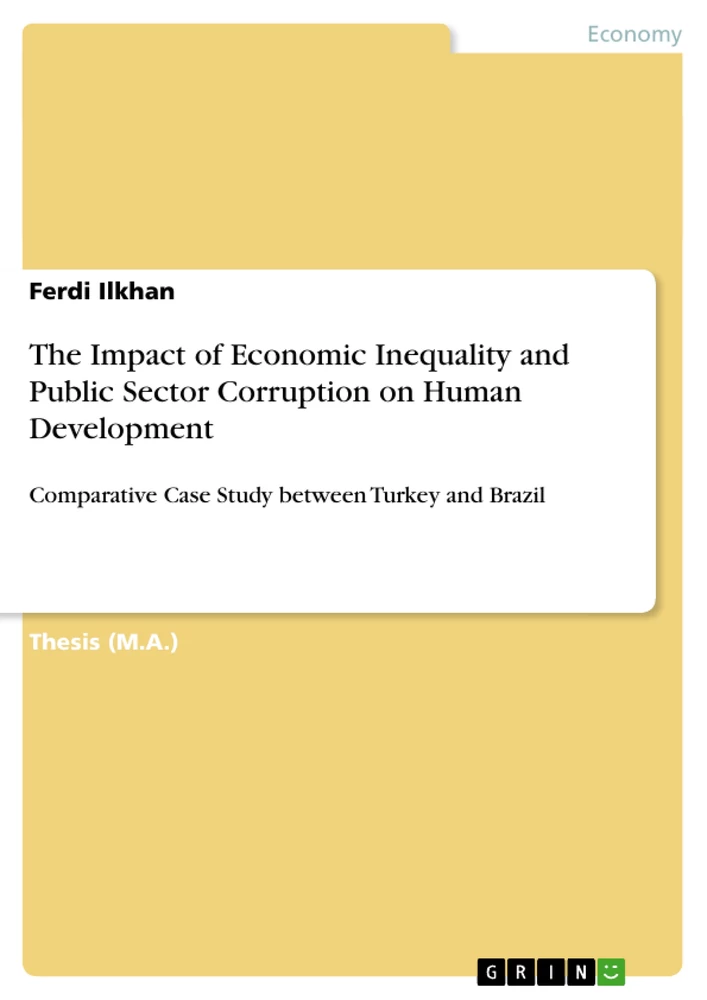
Table of Contents
Chapter One: Introduction
Chapter Two: Background Information
2.1 Human Development Index (HDI)
2.2 The Corruption Perceptions Index (CPI)
2.3 World Development Indicators (WDI)
Chapter Three: The Impact of Economic Inequality on Human Development in Turkey and Brazil
3.1 GNI per capita and Human Development Index in Turkey and Brazil
3.1.1 Comparing the per capita level of GNI in Turkey and Brazil
3.1.2 GNI per capita in Turkey and Brazil during the last decade
3.1.3 HDI value changes in Turkey and Brazil since 2010
3.2 Human Development Index (HDI) versus Inequality-Adjusted Human Development Index (IHDI)
3.2.1 The IHDI
3.2.2 HDI versus IHDI
3.2.3 Comparing inequalities in each component - Healthcare, Education, and Income
3.2.3.1 Healthcare
3.2.3.2 Education
3.2.3.3 Income
3.3 Focusing on Economic Inequality
3.3.1 What is meant by economic inequality?
3.3.2 Gini Coefficient in Turkey and Brazil
3.3.3 Income Distribution in Turkey and Brazil
Chapter Four: Public Sector Corruption in Turkey and Brazil
4.1 Why Focusing on Corruption Particularly in Public Sector?
4.2 Comparing relevant data in Turkey and Brazil in the year of 2013
4.3 Comparing relevant data in Turkey and Brazil since 2010
Chapter Five: Closing Thoughts
Research Objectives and Themes
This comparative case study examines the paradox where Turkey achieved higher levels of human development than Brazil despite lower economic growth, aiming to provide empirical evidence for the negative relationship between economic inequality, public sector corruption, and human development outcomes.
- The impact of economic inequality on human development indices.
- The role of public sector corruption in hindering human development.
- A comparative analysis of socio-economic data between Turkey and Brazil.
- Evaluation of GNI per capita vs. Inequality-Adjusted Human Development Index (IHDI).
- The efficacy of government policy in reducing inequality to improve social outcomes.
Excerpt from the Book
3.1.1 Comparing the per capita level of GNI in Turkey and Brazil
Depending on the current level of per capita gross national income based on purchasing power parity (formerly GNI per capita), the World Bank classifies Turkey and Brazil as upper middle income countries. GNI is the generated value of all domestic firms together with any product taxes not included in the sum of output added by net income receipts from abroad. Although middle income countries are a diverse group by size and population, these countries are defined as having a GNI per capita of USD 1,026 to USD 12,475. According to the most recent figures presented by the World Bank the Turkish economy produced a GNI per capita of USD 10,950 in the year 2013. In the same year, the GNI per capita in Brazil reached a higher level of USD 11,690 (The World Bank, 2014).
The figures above inform us that the World Bank classifies countries depending on their current level of GNI per capita. Since the World Bank uses this indicator to classify countries, this paper makes use of this figure to decide that the economies of Turkey and Brazil are comparable. Moreover, by providing the current level of GNI per capita these data present a picture only related to the values in the year of 2013. However, to be able to better understand the relation between this figure and the value of the HDI it could be useful first to consider the level of GNI per capita in Turkey and Brazil for a longer period of time.
Summary of Chapters
Chapter One: Introduction: This chapter outlines the research context, establishing that economic growth alone does not guarantee human development and introducing the thesis regarding the influence of inequality and corruption.
Chapter Two: Background Information: This section provides definitions and details on the key data sources utilized, specifically the Human Development Index (HDI), the Corruption Perceptions Index (CPI), and World Development Indicators (WDI).
Chapter Three: The Impact of Economic Inequality on Human Development in Turkey and Brazil: This chapter analyzes the relationship between economic growth and human development, using the IHDI, Gini Coefficient, and Lorenz Curve to highlight how income distribution impacts overall development rankings.
Chapter Four: Public Sector Corruption in Turkey and Brazil: This chapter examines how corruption in the public sector functions as a barrier to development, specifically analyzing its impact on healthcare and education services in both countries.
Chapter Five: Closing Thoughts: This concluding chapter synthesizes the study's findings, highlighting that Turkey's success in reducing inequality led to better human development outcomes, and suggests that long-term policy reforms are essential for Brazil to achieve similar progress.
Keywords
Economic Inequality, Public Sector Corruption, Human Development Index, HDI, Turkey, Brazil, GNI per capita, IHDI, Gini Coefficient, Lorenz Curve, Transparency International, World Bank, Healthcare, Education, Income Distribution.
Frequently Asked Questions
What is the core focus of this research paper?
The paper explores the reasons why Turkey achieved higher levels of human development than Brazil despite experiencing lower economic growth, specifically focusing on the roles of economic inequality and public sector corruption.
What are the primary thematic areas covered?
The central themes include the comparative analysis of human development indices, the impact of income distribution on social welfare, and the consequences of public sector corruption on essential public services.
What is the primary research question?
The primary research question asks how a country with lower levels of per capita income can achieve higher human development outcomes compared to a country with higher economic growth.
Which scientific methods were employed?
The research utilizes a comparative case study approach, critically analyzing and evaluating statistical data from the United Nations Development Programme (UNDP), the World Bank, and Transparency International.
What topics are discussed in the main body?
The main body examines GNI per capita trends, the Inequality-Adjusted Human Development Index (IHDI), Gini coefficients for income inequality, and the specific impact of corruption on public-funded healthcare and education.
Which keywords best characterize this work?
The work is characterized by terms such as economic inequality, public sector corruption, HDI, IHDI, income distribution, and socio-economic comparative analysis.
How does the author define public sector corruption?
Based on Transparency International, it is defined as the abuse of entrusted power for private gain within government bodies, which fundamentally undermines the ability of public institutions to serve the citizenry.
What role does the Gini Coefficient play in this study?
It serves as a summary statistic to measure the extent of income inequality within Turkey and Brazil, helping to visualize the gap between the rich and the poor in these economies.
What conclusion does the author reach regarding Brazil's performance?
The author concludes that Brazil failed to convert its economic growth into human progress effectively, largely due to significant inequalities in income, healthcare, and education, compounded by issues of public sector corruption.
Ende der Leseprobe aus 35 Seiten
- nach oben
- Arbeit zitieren
- Ferdi Ilkhan (Autor:in), 2015, The Impact of Economic Inequality and Public Sector Corruption on Human Development, München, Page::Imprint:: GRINVerlagOHG, https://www.diplomarbeiten24.de/document/288517

neugierig - aktuell - relevant
Entdecken Sie hilfreiche Tipps und Tricks rund ums Studium!

Entdecken Sie hilfreiche Tipps und Tricks rund ums Studium!
Ihre Hausarbeit / Abschlussarbeit:

- - Publikation als E-Book und Buch
- - Hohes Honorar auf die Verkäufe
- - Für Sie komplett kostenlos - mit ISBN
- - Es dauert nur 5 Minuten
- - Jede Arbeit findet Leser

- © GRIN Publishing GmbH.
- Alle Inhalte urheberrechtlich geschützt. Kopieren und verbreiten untersagt.
- info@grin.com
- AGB
- Open Publishing
Der GRIN Verlag hat sich seit 1998 auf die Veröffentlichung akademischer eBooks und Bücher spezialisiert. Der GRIN Verlag steht damit als erstes Unternehmen für User Generated Quality Content. Die Verlagsseiten GRIN.com, Hausarbeiten.de und Diplomarbeiten24 bieten für Hochschullehrer, Absolventen und Studenten die ideale Plattform, wissenschaftliche Texte wie Hausarbeiten, Referate, Bachelorarbeiten, Masterarbeiten, Diplomarbeiten, Dissertationen und wissenschaftliche Aufsätze einem breiten Publikum zu präsentieren.
Kostenfreie Veröffentlichung: Hausarbeit, Bachelorarbeit, Diplomarbeit, Dissertation, Masterarbeit, Interpretation oder Referat jetzt veröffentlichen!
Folgen Sie GRIN auf


- GRIN Verlag GmbH
-
- Nymphenburger Str. 86
- 80636
- Munich, Deutschland
- +49 89-550559-0
- +49 89-550559-10
- info@grin.com
-
