
präsentiert von

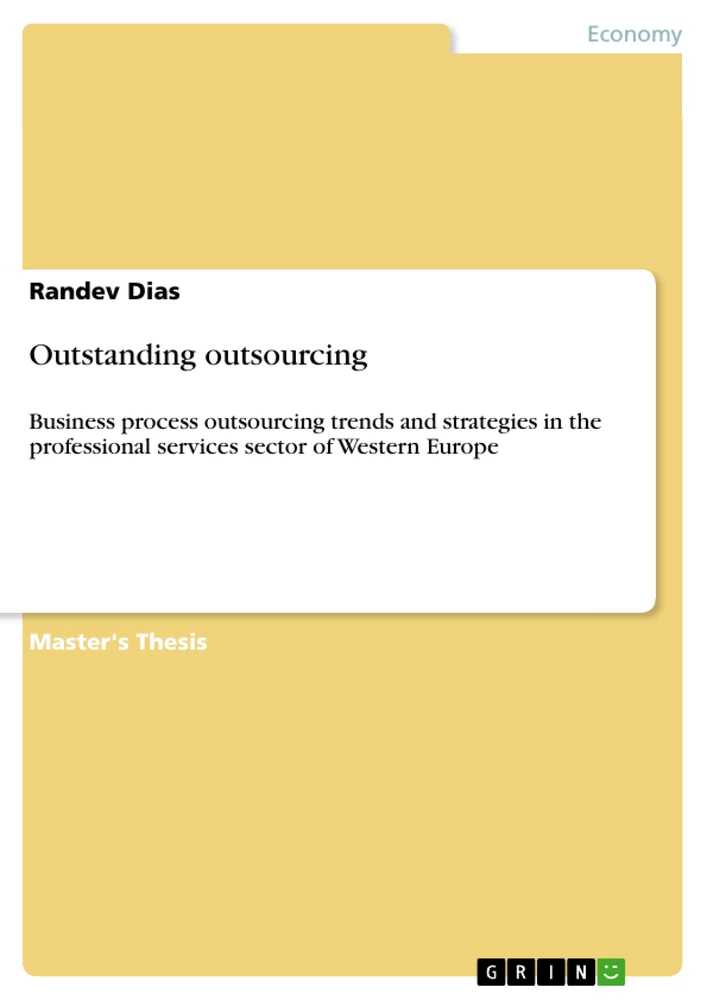
Table of Contents
1. Introduction and objectives
2. Process outsourcing
2.1. Business Process Outsourcing
2.2. Knowledge Process Outsourcing
2.3. Medium sized enterprise segment in EU
2.4. Prevalence of process outsourcing in Western Europe
3. Process Outsourcing analysis
3.1. Medium enterprises SWOT analysis
3.2. Medium Enterprise PESTEL analysis
3.4. BPO trends for SME in Western Europe
3.5. BPO strategies for improving outcomes
3.6. Regional differences in Europe on business process outsourcing
4. Process Outsourcing quantitative research
5. Summary
5.1. Summary of findings
Book Objective and Research Focus
The primary objective of this book is to examine the evolving trends and strategies of high-performance business process outsourcing (BPO) and knowledge process outsourcing (KPO) specifically for medium-sized enterprises within the services sector in Western Europe, aiming to identify how these firms can optimize costs and foster sustainable business growth.
- Strategic implementation of BPO and KPO in the medium-sized enterprise segment.
- Analysis of the Western European economic climate and its impact on outsourcing decisions.
- Evaluation of cost-saving potentials and operational efficiency gains through process outsourcing.
- Comparative regional analysis of outsourcing behaviors between Northwest and Southwest Europe.
Excerpt from the Book
2.1. Business Process Outsourcing
The interest in outsourcing business processes has seen constant growth especially within the medium segment enterprises within Europe. This is driven through the demand to reduce costs and resources, automate processes and have better quality and results from operations. BPO is a strategic decision. By careful outsourcing, companies can focus on their core operations and business development. Within the services sector, the knowledge process outsourcing (KPO) is closely connected to BPO. There are several important steps to be considered in the outsourcing process. The initiation stage is where a company analyzes its current operations process in order to understand its strengths and weaknesses. Strategic objectives should also be carefully considered. A categorization of primary (core) and secondary (non-core) processes is the then conducted. This helps to carefully plan on which processes to outsource and through which means. The best practice is to outsource secondary processes so the company can fully focus on its business (Ernst & Young, 2013).
In order to identify the business impact, a company needs to create a business case calculation. The principle here is to state all costs related to establishing and maintaining secondary processes. It is also important to define the business impact of outsourcing processes on an individual level. There could be secondary processes which are of high costs but still should not be outsourced. Therefore, each process should be carefully selected based on business and financial impact principles. The outsourcing partner selection is also a vital step. The company should decide if to outsource all processes to a single partner, or conduct a process based outsourcing to multiple partners. It is important to understand that process outsourcing is not only solution but is also generates a partnership with the BPO partner. It’s a long term commitment. Although price is one of the drivers in selecting outsourcing services providers, the quality and scalability are also important attributes to be considered. It is of critical importance to ensure that the partner provides the services according expectations and that there is future potential for growth.
Summary of Chapters
1. Introduction and objectives: Provides an overview of the global business environment and sets the research goal of studying BPO strategies for medium-sized services enterprises in Western Europe.
2. Process outsourcing: Defines the branches of BPO and KPO, their importance to SMEs, and analyzes the implementation lifecycle including risk management.
3. Process Outsourcing analysis: Conducts SWOT and PESTEL analyses to evaluate internal and external factors affecting SME outsourcing, alongside current market trends and regional comparisons.
4. Process Outsourcing quantitative research: Presents a practical business case calculation for an SME in the financial services sector to quantify potential cost savings over a five-year period.
5. Summary: Recaps the key findings regarding the role of BPO in economic value creation and operational optimization for the European SME segment.
Keywords
Business Process Outsourcing, Knowledge Process Outsourcing, Strategies, Medium Sized Enterprises, Western Europe, Services Sector, Operational Efficiency, Cost Savings, Risk Management, SME, PESTEL Analysis, SWOT Analysis, European Economy, Value Generation, Business Automation.
Frequently Asked Questions
What is the core focus of this research?
The book focuses on the application and strategic value of business process outsourcing (BPO) and knowledge process outsourcing (KPO) for medium-sized enterprises (SMEs) within the services sector in Western Europe.
What are the primary themes addressed in the work?
Key themes include the evolution of outsourcing trends, the transition from simple transactional BPO to knowledge-based outsourcing, and the importance of alignment between outsourced services and core business strategy.
What is the main objective of the author?
The goal is to study how SMEs can leverage outsourcing to reduce operational costs, increase process quality, and achieve sustainable business development despite economic volatility.
What methodology does the author utilize?
The research employs a mix of theoretical review, systematic analysis of external environmental factors (PESTEL/SWOT), and a quantitative business case analysis to provide empirical evidence for cost savings.
What does the main body of the text cover?
The main sections cover the definitions of BPO/KPO, analysis of SME growth within the EU, risk management frameworks, and comparative data on outsourcing preferences across different European regions.
Which keywords characterize this book?
The essential keywords involve Business Process Outsourcing, Knowledge Process Outsourcing, SME, Western Europe, and Operational Efficiency.
How does this book differentiate between BPO and KPO?
The book defines BPO as a method to handle standardized, rule-based processes for cost and efficiency, while KPO is defined as an advanced, expertise-driven continuation of BPO that utilizes deep industry knowledge and analytical insight.
What is the conclusion regarding SMEs in the services sector?
The author concludes that while SMEs in Western Europe face challenges like limited finance and skilled labor, they can gain significant competitive advantages by strategically outsourcing non-core functions and embracing technological advancements.
How does the author categorize the risks of outsourcing?
Risks are categorized into three distinct areas: Operational risks (daily disruptions), Strategic risks (long-term loss of control or knowledge), and Composite risks (macroeconomic and geopolitical instability).
Ende der Leseprobe aus 91 Seiten
- nach oben
- Arbeit zitieren
- Randev Dias (Autor:in), 2014, Outstanding outsourcing, München, Page::Imprint:: GRINVerlagOHG, https://www.diplomarbeiten24.de/document/292978

neugierig - aktuell - relevant
Entdecken Sie hilfreiche Tipps und Tricks rund ums Studium!

Entdecken Sie hilfreiche Tipps und Tricks rund ums Studium!
Ihre Hausarbeit / Abschlussarbeit:

- - Publikation als E-Book und Buch
- - Hohes Honorar auf die Verkäufe
- - Für Sie komplett kostenlos - mit ISBN
- - Es dauert nur 5 Minuten
- - Jede Arbeit findet Leser

- © GRIN Publishing GmbH.
- Alle Inhalte urheberrechtlich geschützt. Kopieren und verbreiten untersagt.
- info@grin.com
- AGB
- Open Publishing
Der GRIN Verlag hat sich seit 1998 auf die Veröffentlichung akademischer eBooks und Bücher spezialisiert. Der GRIN Verlag steht damit als erstes Unternehmen für User Generated Quality Content. Die Verlagsseiten GRIN.com, Hausarbeiten.de und Diplomarbeiten24 bieten für Hochschullehrer, Absolventen und Studenten die ideale Plattform, wissenschaftliche Texte wie Hausarbeiten, Referate, Bachelorarbeiten, Masterarbeiten, Diplomarbeiten, Dissertationen und wissenschaftliche Aufsätze einem breiten Publikum zu präsentieren.
Kostenfreie Veröffentlichung: Hausarbeit, Bachelorarbeit, Diplomarbeit, Dissertation, Masterarbeit, Interpretation oder Referat jetzt veröffentlichen!
Folgen Sie GRIN auf


- GRIN Verlag GmbH
-
- Nymphenburger Str. 86
- 80636
- Munich, Deutschland
- +49 89-550559-0
- +49 89-550559-10
- info@grin.com
-
