
präsentiert von

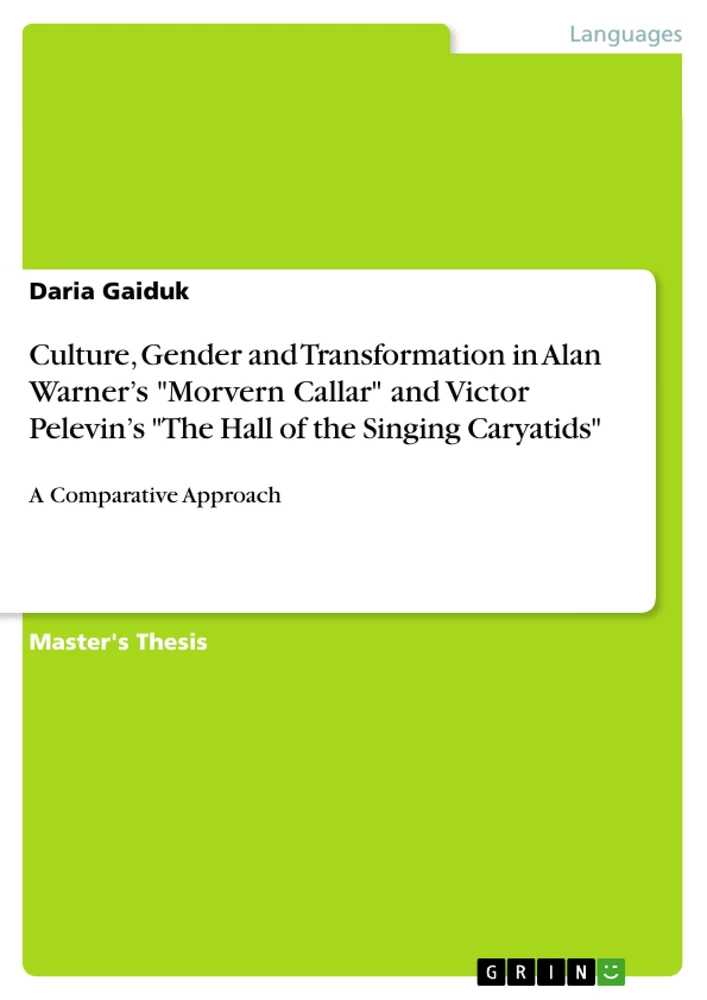
Table of Contents
Introduction
1. Culture
1.1 Definition of the term Culture
1.2 Culture forming identity
1.3 Transnationalism and transculturalism
2. Cultural Transformation. Subcultures
2.1 High Culture
2.2 Dismemberment of Orpheus
2.3 Low Culture
2.4 Mass Culture
2.5 Counterculture
2.6 Death in the books
2.7 Plastic world
3. Gender
3.1 Sexual Objectification
3.2 Gender and Identity
3.3 Femininity and Masculinity. Gender Roles
4. Transformation
4.1 Reality and Simulacrum
4.2 The Wind of Change (90s-00s)
4.3 Spiritual Transformation
Conclusion
Objectives and Research Themes
This thesis explores the comparative dynamics of culture, gender, and transformation within the bildungsroman genre as portrayed in Alan Warner’s "Morvern Callar" and Victor Pelevin’s "The Hall of the Singing Caryatids." The research investigates how these disparate narrative worlds at the turn of the twenty-first century shape the identities of young female protagonists facing significant life transitions and systemic societal pressures.
- The influence of postmodern culture and consumerism on identity formation.
- A comparative analysis of gender dynamics and the subversion of patriarchal roles.
- The impact of the Zeitgeist on the development of individual personality.
- The symbolic function of music, art, and "dismemberment" as transformative triggers.
- The role of "transculture" in allowing characters to transcend conventional societal borders.
Excerpt from the Book
2.2 Dismemberment of Orpheus
In Ovid’s Metamorphoses, after being torn apart by Maenads, Orpheus (more precisely, his head) is still singing (Ovid, trans. Garth, 1961, book XI), just like Morvern’s dead boyfriend, being dismembered and buried in the Highlands, still follows Morvern with his music. Yet, Morvern does not stay under His dead patriarchic eye for a long time. Having read His ‘Live the life people like me have denied you. You are better than us’, Morvern types on the novel’s title her name over her boyfriend’s (Warner, 1996, p. 82).
The same effect we can see with the music that Morvern’s boyfriend left her. While in the beginning of the novel Morvern distinguishes all the recordings she has into her boyfriend’s and hers, this difference disappears by the end of the book. There is no more clear distinction between Morvern’s records and her boyfriend’s ones. Every piece of music becomes Morvern’s. These are her records, playing in her walkman, shaping her life.
There is a soundtrack to almost every moment of Morvern’s life (see appendix 1). She listens to the music in Scotland and in Spain, in the air space between the countries and in the time space between two radically different periods of her life. This music does not merely serve as a background to the story. Morvern’s recordings shape her identity. Moreover, at the most important and difficult moments of Morvern’s life she turns her Walkman on to immerse into an alternative reality. Thus, she creates an alternative self, not a mere superstore assistant, but an adult and mature Morvern, who knows what she wants and where she goes.
While cutting her boyfriend’s body to pieces, Morvern listens to her favourite jazz and ambient music, which can be seen in terms of Ihab Hassan’s ‘Dismemberment of Orpheus’ as Postmodernism overcoming Modernism. Since the aesthetic of fragmentary narration is central to postmodern literature, the postmodern music reflects the literary ‘fragmentation’ of Morvern’s dead boyfriend. Dismemberment of Morvern’s dead boyfriend can also be seen as deconstruction of the text. Piece by piece Morvern tears off the limbs of her beloved, as if a postmodern reader deconstructs a novel.
Summary of Chapters
Introduction: Outlines the comparative framework of the two bildungsroman novels and establishes the focus on culture, gender, and transformation at the turn of the millennium.
1. Culture: Examines the definition of culture, its role in shaping national and personal identity, and the influence of transnationalism.
2. Cultural Transformation. Subcultures: Analyzes the dichotomy of high and low culture, the influence of mass culture, the concept of counterculture, and the symbolic use of death and artificiality.
3. Gender: Investigates the sexual objectification of the protagonists and explores how they construct gender and identity against patriarchal societal constraints.
4. Transformation: Explores the intersection of reality and simulacra, the impact of historical changes, and the spiritual shifts experienced by the protagonists.
Keywords
Bildungsroman, Postmodernism, Morvern Callar, The Hall of the Singing Caryatids, Cultural Transformation, Identity Formation, Gender Roles, Sexual Objectification, Simulacrum, Transculture, Counterculture, Ihab Hassan, Orpheus, Consumerism, Neo-nomadism.
Frequently Asked Questions
What is the primary focus of this research?
The thesis provides a comparative literary analysis of Alan Warner's "Morvern Callar" and Victor Pelevin's "The Hall of the Singing Caryatids," focusing on how the protagonists navigate culture, gender, and transformation.
What are the central themes explored in these novels?
Key themes include the construction of identity, the influence of mass and high culture, the subversion of patriarchal gender roles, and the transition from modernism to postmodernism.
What is the core objective of the work?
The goal is to demonstrate how these protagonists use cultural references, music, and personal transformation to redefine their own existence within the bildungsroman tradition.
Which theoretical framework is primarily applied?
The research relies heavily on Ihab Hassan’s "Dismemberment of Orpheus" as an axis for comparison, alongside cultural theories from Bourdieu, Barthes, and Giddens.
What does the main body of the work cover?
The analysis covers the definition of culture, the role of subcultures, the sexual objectification of women, the transformation of reality into simulacra, and the spiritual awakening of the characters.
Which keywords best describe this study?
Relevant keywords include Postmodernism, Identity Formation, Gender Roles, Simulacrum, Transculture, and Bildungsroman.
How does the author interpret the concept of "dismemberment" in the books?
Dismemberment is analyzed as a metaphorical process of deconstructing the past and patriarchal modernism to allow for the regeneration and postmodern transformation of the female protagonist.
How is the concept of "plastic" used in the analysis of Pelevin’s work?
Drawing on Roland Barthes, the author discusses "plastic" as a versatile, artificial substance that symbolizes the commercialization of human life and the uncanny nature of the brothel setting.
Ende der Leseprobe aus 104 Seiten
- nach oben
- Arbeit zitieren
- Daria Gaiduk (Autor:in), 2014, Culture, Gender and Transformation in Alan Warner’s "Morvern Callar" and Victor Pelevin’s "The Hall of the Singing Caryatids", München, Page::Imprint:: GRINVerlagOHG, https://www.diplomarbeiten24.de/document/294304

neugierig - aktuell - relevant
Entdecken Sie hilfreiche Tipps und Tricks rund ums Studium!

Entdecken Sie hilfreiche Tipps und Tricks rund ums Studium!
Ihre Hausarbeit / Abschlussarbeit:

- - Publikation als E-Book und Buch
- - Hohes Honorar auf die Verkäufe
- - Für Sie komplett kostenlos - mit ISBN
- - Es dauert nur 5 Minuten
- - Jede Arbeit findet Leser

- © GRIN Publishing GmbH.
- Alle Inhalte urheberrechtlich geschützt. Kopieren und verbreiten untersagt.
- info@grin.com
- AGB
- Open Publishing
Der GRIN Verlag hat sich seit 1998 auf die Veröffentlichung akademischer eBooks und Bücher spezialisiert. Der GRIN Verlag steht damit als erstes Unternehmen für User Generated Quality Content. Die Verlagsseiten GRIN.com, Hausarbeiten.de und Diplomarbeiten24 bieten für Hochschullehrer, Absolventen und Studenten die ideale Plattform, wissenschaftliche Texte wie Hausarbeiten, Referate, Bachelorarbeiten, Masterarbeiten, Diplomarbeiten, Dissertationen und wissenschaftliche Aufsätze einem breiten Publikum zu präsentieren.
Kostenfreie Veröffentlichung: Hausarbeit, Bachelorarbeit, Diplomarbeit, Dissertation, Masterarbeit, Interpretation oder Referat jetzt veröffentlichen!
Folgen Sie GRIN auf


- GRIN Verlag GmbH
-
- Nymphenburger Str. 86
- 80636
- Munich, Deutschland
- +49 89-550559-0
- +49 89-550559-10
- info@grin.com
-
