
präsentiert von

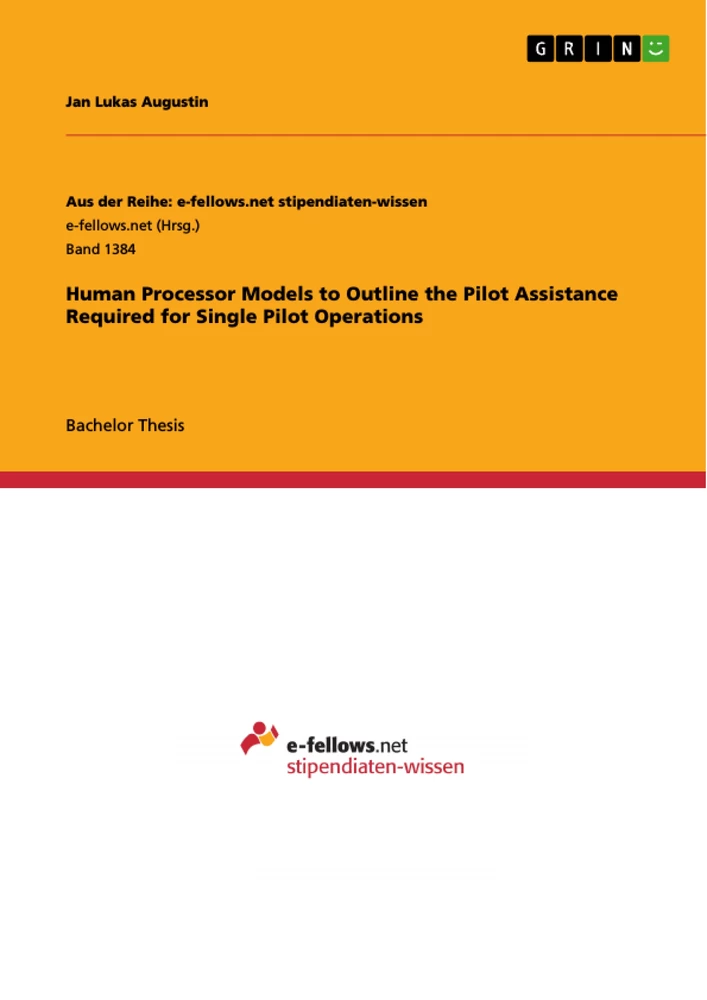
Table of Contents
1 Introduction
2 State of research
2.1 Human-factors engineering
2.2 Flight phases
2.3 Cockpit systems
2.4 Operating procedures
3 Model Human Processor
3.1 Perceptual System
3.1.1 Perceptual Memories
3.1.2 Perceptual Processor
3.2 Motor System
3.2.1 Motor Processor
3.3 Cognitive System
3.3.1 Cognitive Memories
3.3.2 Working Memory
3.3.3 Long-Term Memory
3.3.4 Cognitive Processor
3.4 Movement - Fitt’s Law
4 Model
4.1 Structure
4.1.1 Definitions
4.2 Model design
4.2.1 Assumptions
4.2.2 Identifying procedures, tasks and actions
4.2.3 Representation in spreadsheet
4.3 Simulation
4.3.1 Structure
4.3.2 Import
4.3.3 Sums of imported values
4.3.4 Distributions
4.3.5 Movement - Fitt’s Law
4.3.6 Procedure times
4.4 Results
4.4.1 Total action times
4.4.2 Procedure times for exemplary flight sectors
4.4.3 Workload of Pilot Flying
4.4.4 Summary
4.5 Validation
5 Pilot assistance
5.1 Interfaces
5.1.1 Control panels
5.1.2 Microphone
5.1.3 Touch screen
5.1.4 Loudspeaker
5.1.5 Head up display
5.1.6 Eye tracker
5.2 System outline
5.2.1 Cross checks
5.2.2 Check lists
5.3 Information design
5.3.1 Perceptual System
5.3.2 Cognitive System
5.3.3 Conclusion
5.4 Simultaneousness
5.4.1 Input
5.4.2 Output
5.5 Limitations
6 Conclusion
7 Appendix
7.1 Model Human Processor
7.2 Procedure representation
7.3 Matlab Code
7.4 Distributions
7.5 Results
Research Objectives and Themes
The primary goal of this thesis is to evaluate the feasibility of Single Pilot Operations (SPO) on airliners by assessing pilot workload. Using a human engineering approach, the study simulates operational procedures to compare the workload between two-pilot crews and a single pilot, ultimately identifying prospective assistance systems that can optimize workload and enhance flight safety.
- Cognitive modelling using the Model Human Processor (MHP).
- Standardization of aircraft operating procedures based on the Flight Crew Operating Manual (FCOM).
- Matlab-based workload simulation for various critical flight phases.
- Development and evaluation of human-machine interfaces to support single pilot operations.
Excerpt from the Book
3.1 Perceptual System
Sensations detected by the body’s sensory systems are carried into internal representations of the mind by using integrated sensory systems. A good example of such an integration can be found in the visual system: To be able to continuously follow a visual scene the perceiver has to combine central vision, peripheral vision, eye movements and head movements. The eye is in continuous movement in a sequence of saccades, each taking about 30 ms to jump to the new point of regard and dwelling there 60 700 ms for a total duration of
Eye − movement(travel + f ixation) = 230 [70 − 700]ms
(The number 230 ms represents a typical value and the numbers in brackets indicate that values may range from 70 ms to 700 ms depending on conditions of measurement, task variables or subject variables.) Whenever the target is more than 30 degrees away from the central vision, head movements occur in order to reduce the angular distance.
Summary of Chapters
1 Introduction: Provides an overview of the trend towards reduced-crew operations and defines the research focus on assessing pilot workload in Single Pilot Operations.
2 State of research: Discusses traditional workload measurement methods and introduces human-factors engineering and the Model Human Processor as an alternative modelling approach.
3 Model Human Processor: Details the cognitive modelling method, breaking down human capabilities into perceptual, cognitive, and motor subsystems.
4 Model: Describes the structure of the simulation model, its spreadsheet implementation, the use of Matlab, and the resulting quantitative workload comparisons.
5 Pilot assistance: Evaluates potential interface technologies like microphones, touch screens, and head-up displays to support a single pilot.
6 Conclusion: Summarizes the study's findings, highlighting that while quantitative workload for a single pilot can be managed through assistance systems, further research into qualitative aspects is necessary.
Keywords
Model Human Processor, Single Pilot Operations, workload, avionics, human-factors engineering, flight simulation, cognitive modelling, interface design, pilot assistance, cockpit systems, Fitt's Law, workload assessment, flight safety, task analysis, Matlab
Frequently Asked Questions
What is this research fundamentally about?
The work explores the possibility of reducing flight crews on commercial airliners to a single pilot by assessing the resulting increase in pilot workload and outlining potential technological solutions to mitigate it.
What are the central thematic fields covered?
The study centers on human-factors engineering, cognitive modelling via the Model Human Processor, procedure standardization, and the design of assistance interfaces.
What is the primary goal of this research?
The primary goal is to determine if a single pilot can safely operate an airliner and to design pilot assistance systems that replace the duties formerly performed by the second pilot.
Which scientific methods are employed?
The research utilizes a quantitative simulation-based approach, implementing the Model Human Processor (MHP) and Fitt’s Law within a Matlab framework to analyze procedure times and workload.
What is covered in the main section of the work?
The main sections establish the cognitive model (MHP), define the procedures and simulation structure, present the results of the workload assessment across different flight phases, and evaluate specific pilot assistance interfaces.
Which keywords characterize this work?
The work is characterized by terms such as Model Human Processor, Single Pilot Operations, workload, human-factors engineering, and avionics.
How is the Model Human Processor applied to the simulation?
The MHP provides parameters for cycle times of perceptual, cognitive, and motor processors. These are used in a Matlab simulation to predict the time taken by a pilot to complete specific tasks, allowing for workload comparisons between single and dual pilot scenarios.
Why are cross-checks and checklists significant to this study?
Cross-checks and checklists represent a significant portion of communication and interaction in a dual-pilot cockpit. The study shows that the omission or automation of these tasks is central to determining the feasibility and workload impact of single-pilot operations.
What specific pilot assistance systems are analyzed?
The study investigates the use of control panels, microphones for direct voice input, touch screens, loudspeakers, head-up displays, and eye-tracking technology.
Ende der Leseprobe aus 97 Seiten
- nach oben
- Arbeit zitieren
- Jan Lukas Augustin (Autor:in), 2015, Human Processor Models to Outline the Pilot Assistance Required for Single Pilot Operations, München, Page::Imprint:: GRINVerlagOHG, https://www.diplomarbeiten24.de/document/300264

neugierig - aktuell - relevant
Entdecken Sie hilfreiche Tipps und Tricks rund ums Studium!

Entdecken Sie hilfreiche Tipps und Tricks rund ums Studium!
Ihre Hausarbeit / Abschlussarbeit:

- - Publikation als E-Book und Buch
- - Hohes Honorar auf die Verkäufe
- - Für Sie komplett kostenlos - mit ISBN
- - Es dauert nur 5 Minuten
- - Jede Arbeit findet Leser

- © GRIN Publishing GmbH.
- Alle Inhalte urheberrechtlich geschützt. Kopieren und verbreiten untersagt.
- info@grin.com
- AGB
- Open Publishing
Der GRIN Verlag hat sich seit 1998 auf die Veröffentlichung akademischer eBooks und Bücher spezialisiert. Der GRIN Verlag steht damit als erstes Unternehmen für User Generated Quality Content. Die Verlagsseiten GRIN.com, Hausarbeiten.de und Diplomarbeiten24 bieten für Hochschullehrer, Absolventen und Studenten die ideale Plattform, wissenschaftliche Texte wie Hausarbeiten, Referate, Bachelorarbeiten, Masterarbeiten, Diplomarbeiten, Dissertationen und wissenschaftliche Aufsätze einem breiten Publikum zu präsentieren.
Kostenfreie Veröffentlichung: Hausarbeit, Bachelorarbeit, Diplomarbeit, Dissertation, Masterarbeit, Interpretation oder Referat jetzt veröffentlichen!
Folgen Sie GRIN auf


- GRIN Verlag GmbH
-
- Nymphenburger Str. 86
- 80636
- Munich, Deutschland
- +49 89-550559-0
- +49 89-550559-10
- info@grin.com
-
