
präsentiert von

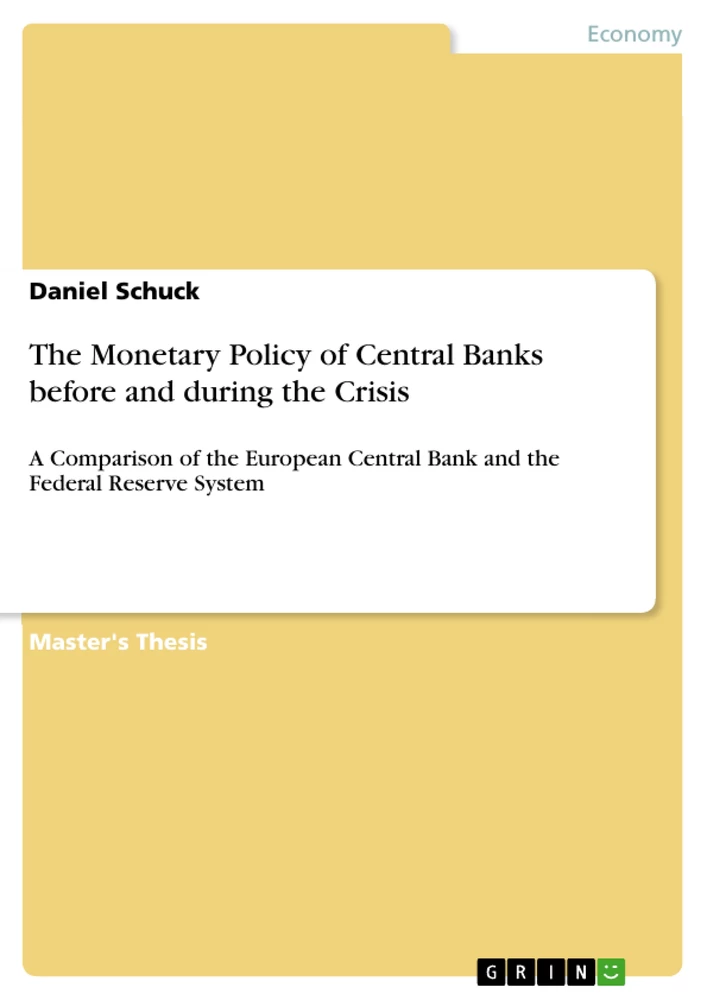
Table of Contents
1 Introduction
2 The Global Financial Crisis
2.1 The Onset of the Global Financial Crisis
2.2 Causes of the Global Financial Crisis
2.2.1 The US Housing Bubble and Innovative Financial Instruments
2.2.2 Expansive Monetary Policy
2.3 Consequences for the United States Economy
2.4 Consequences for the European Economy
3 The Crisis of the European Union
3.1 The Linkage between the Global Financial Crisis and the Crisis of the European Union
3.2 The European Banking Crisis
3.3 The European Sovereign Debt Crisis
3.4 Consequences for the European Economy
4 The Role and Importance of Central Banks
4.1 Basics of Central Banks and Monetary Policy
4.2 The Federal Reserve System
4.2.1 The History of the Federal Reserve System
4.2.2 Organization and Objectives of the Federal Reserve System
4.2.3 Monetary Policy of the Federal Reserve System
4.3 The European Central Bank
4.3.1 The History of the European Central Bank
4.3.2 Organization and Objectives of the European Central Bank
4.3.3 Monetary Policy of the European Central Bank
5 The Role and Importance of Central Banks during the Crisis
5.1 Monetary Policy of the Federal Reserve System during the Crisis
5.1.1 Conventional Monetary Policy Measures of the Federal Reserve System
5.1.2 Unconventional Monetary Policy Measures of the Federal Reserve System
5.1.2.1 Short-Term Liquidity Provisions
5.1.2.2 Long-Term Liquidity Provisions
5.2 Consequences of the Federal Reserve System’s Monetary Policy Responses
5.3 Monetary Policy of the European Central Bank during the Crisis
5.3.1 Conventional Monetary Policy Measures of the European Central Bank
5.3.2 Unconventional Monetary Policy Measures of the European Central Bank
5.3.2.1 Enhanced Credit Support
5.3.2.2 Outright Asset Purchases
5.4 Consequences of the European Central Bank’s Monetary Policy Responses
5.5 Comparison of the Federal Reserve System’s and the European Central Bank’s Monetary Policy Responses
5.5.1 The use of Conventional and Unconventional Monetary Policy Measures
5.5.2 The Federal Reserve System’s and the European Central Bank’s Balance Sheet
5.5.3 The use of Forward Guidance and Transparency
5.6 Risks and Uncertainties of Unconventional Monetary Policy Measures
6 Conclusion
Objectives and Research Focus
This thesis examines the monetary policy responses of the Federal Reserve System and the European Central Bank to the global financial crisis and its aftermath. The primary research goal is to investigate how both central banks employed unconventional monetary policy measures to restore stability and support their respective economies.
- Analysis of the origins and causes of the global financial crisis and its impact on the US and European economies.
- Comparison of conventional and unconventional monetary policy tools utilized by the FED and the ECB.
- Evaluation of the effectiveness and consequences of central bank balance sheet expansions.
- Examination of risks, uncertainties, and challenges associated with unconventional policy measures and exit strategies.
- Review of the institutional differences and mandates governing the FED and the ECB.
Excerpt from the Book
2.2.1 The US Housing Bubble and Innovative Financial Instruments
One of the greatest factors that caused the global financial crisis was a severe housing bubble in the United States followed by a dramatic decline in housing prices that was unprecedented in its scale. Driven by the concept of widespread home ownership, the US Congress and various administrations tried to implement policies to reduce down payment requirements for home owners with a special attention paid to the ability of minorities and low-income families to become home owners. While in the 1950s, the down payment for a real estate amounted to 20 percent of the purchase price, the Federal Housing Administration (FHA) subsequently lowered down payment requirements, implementing a “no money down” financing for qualified borrowers in the 1990’s. Furthermore, the Clinton administration together with the Congress decided to change regulations in favor of a significant increase of mortgage lending to low-income borrowers. However, lenders increasingly complained about the growing risk in their balance sheets and threatened to stop lending to low-income borrowers. Therefore, the Congress pushed the Federal National Mortgage Association (Fannie Mae) and the Federal Home Loan Mortgage Corporation (Freddie Mac) to extend their purchases of low-income mortgages.
As a result, banks and other mortgage lenders were able to give out new loans and sell them off to Freddie Mac and Fannie Mae. Hence, lenders made huge profits out of the service fees associated with the new loans, but faced significantly low risk, as risky loans were sold off immediately. By 2005, lenders further increased giving out loans without neither verifying the income of borrowers, nor their ability to make the required payments. In addition, the widespread use of adjustable interest rate loans with low initial interest rates flawed uninformed borrowers, as the high demand increased real estate prices.
Summary of Chapters
1 Introduction: Provides an overview of the global financial crisis, its impact on real economies, and the objective to compare the FED's and ECB's responses.
2 The Global Financial Crisis: Analyzes the onset, root causes like the US housing bubble, and the resulting economic consequences for the US and Europe.
3 The Crisis of the European Union: Discusses the transmission of the global crisis into the European banking and sovereign debt crises.
4 The Role and Importance of Central Banks: Outlines fundamental concepts of monetary policy and the institutional frameworks of the FED and ECB.
5 The Role and Importance of Central Banks during the Crisis: Details the specific conventional and unconventional measures taken by both institutions and compares their approaches.
6 Conclusion: Summarizes key findings regarding the effectiveness of unconventional policies and the challenges of exiting these programs.
Keywords
Monetary Policy, Federal Reserve System, European Central Bank, Global Financial Crisis, Unconventional Monetary Policy, Quantitative Easing, Credit Easing, Housing Bubble, Sovereign Debt Crisis, Financial Stability, Interest Rates, Liquidity Provisions, Balance Sheet, Forward Guidance, Transmission Mechanism
Frequently Asked Questions
What is the core focus of this thesis?
The thesis investigates and compares the monetary policy responses of the Federal Reserve System and the European Central Bank to the global financial crisis, with a specific focus on the implementation of unconventional measures.
What are the primary themes discussed in the work?
The work covers the origins of the financial crisis, the specific economic challenges in the US and the European Union, the institutional role of central banks, and the risks associated with large-scale unconventional policy intervention.
What is the main objective of the research?
The objective is to analyze how the FED and the ECB reacted to the crisis to restore financial stability and compare their strategies, given their different mandates and financial system structures.
Which scientific methods are employed?
The study relies on a comparative analysis of central bank interventions, examining balance sheet data, policy announcements, and existing literature on financial crises and monetary transmission mechanisms.
What topics are covered in the main section?
The main section covers conventional and unconventional tools (such as QE and credit easing), the impact on interbank markets, and the effectiveness of forward guidance and asset purchase programs.
Which keywords best characterize the paper?
Key terms include Monetary Policy, Federal Reserve, ECB, Global Financial Crisis, Quantitative Easing, Credit Easing, and Financial Stability.
How does the author differentiate between the FED's and ECB's approaches to liquidity?
The author notes that while the FED focused on massive asset purchases (quantitative easing) to lower long-term rates, the ECB emphasized credit easing and served as the primary counterparty to the banking system, often using fixed-rate tender procedures with full allotment.
What role did the "too big to fail" perception play in the crisis according to the text?
The text suggests that implicit guarantees for large financial institutions created moral hazard, as investors assumed governments and central banks would act as a safety net, leading to the mispricing of risk.
Ende der Leseprobe aus 88 Seiten
- nach oben
- Arbeit zitieren
- Daniel Schuck (Autor:in), 2014, The Monetary Policy of Central Banks before and during the Crisis, München, Page::Imprint:: GRINVerlagOHG, https://www.diplomarbeiten24.de/document/302431

neugierig - aktuell - relevant
Entdecken Sie hilfreiche Tipps und Tricks rund ums Studium!

Entdecken Sie hilfreiche Tipps und Tricks rund ums Studium!
Ihre Hausarbeit / Abschlussarbeit:

- - Publikation als E-Book und Buch
- - Hohes Honorar auf die Verkäufe
- - Für Sie komplett kostenlos - mit ISBN
- - Es dauert nur 5 Minuten
- - Jede Arbeit findet Leser

- © GRIN Publishing GmbH.
- Alle Inhalte urheberrechtlich geschützt. Kopieren und verbreiten untersagt.
- info@grin.com
- AGB
- Open Publishing
Der GRIN Verlag hat sich seit 1998 auf die Veröffentlichung akademischer eBooks und Bücher spezialisiert. Der GRIN Verlag steht damit als erstes Unternehmen für User Generated Quality Content. Die Verlagsseiten GRIN.com, Hausarbeiten.de und Diplomarbeiten24 bieten für Hochschullehrer, Absolventen und Studenten die ideale Plattform, wissenschaftliche Texte wie Hausarbeiten, Referate, Bachelorarbeiten, Masterarbeiten, Diplomarbeiten, Dissertationen und wissenschaftliche Aufsätze einem breiten Publikum zu präsentieren.
Kostenfreie Veröffentlichung: Hausarbeit, Bachelorarbeit, Diplomarbeit, Dissertation, Masterarbeit, Interpretation oder Referat jetzt veröffentlichen!
Folgen Sie GRIN auf


- GRIN Verlag GmbH
-
- Nymphenburger Str. 86
- 80636
- Munich, Deutschland
- +49 89-550559-0
- +49 89-550559-10
- info@grin.com
-
