
präsentiert von

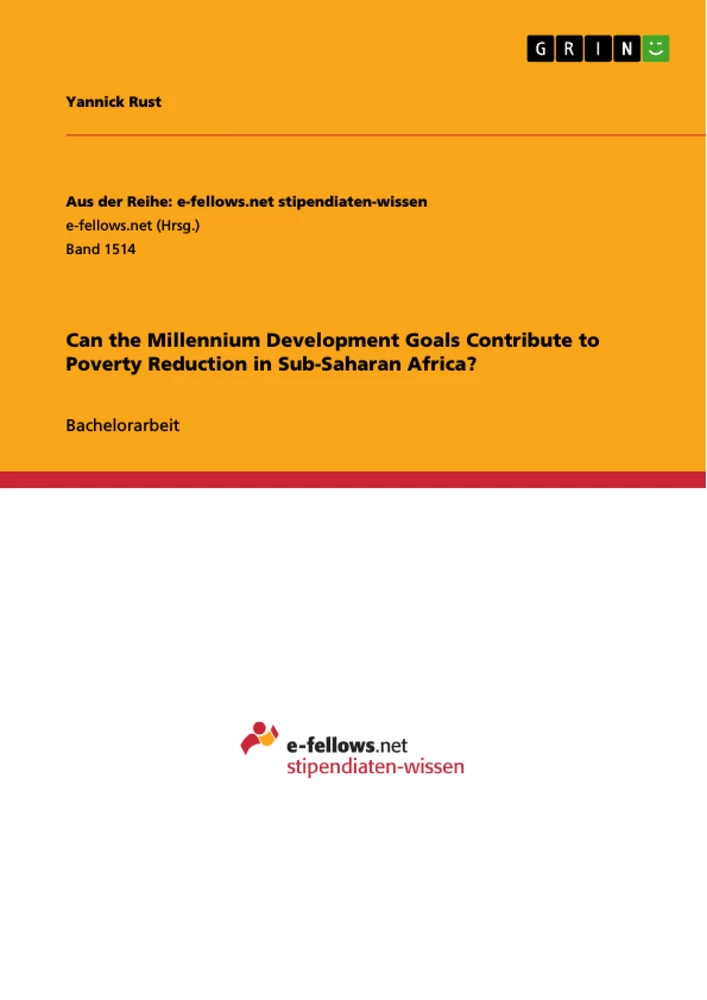
Inhaltsverzeichnis
Introduction
1 – The Millennium Development Goals
1.1 – Relevance of the MDGs
1.2 – Focus on MDG No. 1: Eradication of worldwide poverty and hunger
2 – Poverty in Sub – Saharan Africa
2.1 – Overall assessment of the poverty situation in Sub – Saharan Africa
2.2 – Characteristics of poverty in the Sub-Saharan region
3 - The United Nations strategic approach to reduce poverty: The use of employed indicators and their limitations
3.1 – Target No. 1: “Halve the proportion of people whose income is below US$1.25 PPP a day”
3.2 – Target No. 2: “Achieve full employment and decent work for all”
3.3 – Critical consideration of the indicators employed
4 – Development strategies derived from the employed ratios
4.1 – Strategies targeting poverty alleviation
4.1.1 – Investments in social safety nets
4.1.2 – Direct cash transfers
4.1.3 – Zero-interest development grants
4.2 – Strategies targeting employment creation
4.2.1 – Investing in agriculture
4.2.2 – Investing in infrastructure
4.2.3 – Investing in human capital
5 – Success evaluation of the poverty – reduction strategies
5.1 – Evaluation of strategies targeting poverty alleviation
5.1.1 – Investing in social safety nets
5.1.2 – Direct cash transfers
5.1.3 – Zero-interest development funding
5.2 – Evaluation of strategies sustaining employment creation
5.2.1 Investing in agricultural productivity
5.2.2 Investing in infrastructure
5.2.3 Investing in human capital
5.3 – Critical consideration of the evaluated strategies
6 – Investment needs and sources of funding to reach MDG No.1
6.1 – Investment needs
6.1.1 – Top–Down-Approach
6.1.2 – Bottom-up-Approach
6.2 – Sources of funding
7 – Alternative strategies of poverty alleviation and development financing
7.1 – Investing in Information and Communication Technologies
7.2 – Global taxes
7.3 – International Finance Facility for Immunization (IFFIm)
8 – Outlook for 2015 and the future development agendas
8.1 – The Post – Agenda
8.2 – The MDGs as benchmark for future development efforts
8.3 – Limitations of global goal – setting
Conclusion
Zielsetzung & Themen
Diese Bachelor-Thesis untersucht, ob die Millennium-Entwicklungsziele (MDGs) der Vereinten Nationen erfolgreich zur Armutsbekämpfung in Subsahara-Afrika beigetragen haben, indem sie die Wirksamkeit der auf ökonomischen Indikatoren basierenden Strategien bewertet.
- Analyse der Armutssituation in Subsahara-Afrika zwischen 1990 und 2015.
- Kritische Untersuchung der von der UNO verwendeten ökonomischen Indikatoren und deren Grenzen.
- Bewertung implementierter Entwicklungsstrategien (z.B. soziale Sicherungssysteme, Agrarinvestitionen, Infrastruktur).
- Erforschung von Finanzierungsbedarfen und alternativen Ansätzen wie globalen Steuern oder IFFIm.
- Diskussion zukünftiger Entwicklungsagenden und der Grenzen globaler Zielsetzungen.
Auszug aus dem Buch
3.3 – Critical consideration of the indicators employed
Although the UN employed ratios do reflect a country´s poverty situation and enable further analysis, their limitations have to be borne in mind.
The main critics target the “conceptual and operational constraints in the design of the indicators” 29. When elaborating the set of analytical instruments the UN did not take into account the political, social and cultural dimensions of destitution. By only reflecting a quantitative perspective on poverty, the effects of deprivation on people´s psyche such as vulnerability and social exclusion are being disregarded.30 This has given rise to the controversial debate of how to measure misery, which differs depending on the point of view considered.
With reference to the targets themselves, there was criticism of the indicators´ lack of disaggregation. As mentioned before, a distinction between urban and rural regions as well as sub-regions within countries needs to be adopted in order to distort the results. This fact further puts in question the relevance of the available data since the poorest countries do not have authorities collecting the required information.
Beyond that, it would be necessary to draw the attention towards the roots of poverty. Marginalized groups for example might hold an educational degree but might be denied the pursuit of any kind of market activity and are consequently excluded from society and forced into a situation of destitution. 31
Zusammenfassung der Kapitel
Introduction: Diese Einleitung erläutert die Forschungsfrage, ob die UN-Millennium-Entwicklungsziele zur Armutsminderung in Subsahara-Afrika beigetragen haben, und führt die verwendete Sieben-Schritte-Methodik auf Basis des PDCA-Zyklus ein.
1 – The Millennium Development Goals: Das Kapitel beschreibt die Entstehung der MDGs als weltweiten Versuch, multiple Dimensionen von Armut durch zeitlich begrenzte Zielvorgaben zu bekämpfen.
2 – Poverty in Sub – Saharan Africa: Hier erfolgt eine Analyse der Armutslage in Subsahara-Afrika, wobei die Region als diejenige mit den stärksten Destitutionsmustern weltweit identifiziert wird.
3 - The United Nations strategic approach to reduce poverty: The use of employed indicators and their limitations: Es werden die spezifischen Indikatoren zur Messung der Armut und Beschäftigung analysiert und kritisch hinterfragt, ob diese der komplexen Realität vor Ort gerecht werden.
4 – Development strategies derived from the employed ratios: Dieses Kapitel stellt konkrete, von den Indikatoren abgeleitete Entwicklungsstrategien vor, die von Regierungen und Organisationen implementiert wurden.
5 – Success evaluation of the poverty – reduction strategies: Hier wird der Erfolg der in Kapitel 4 genannten Strategien bewertet, wobei meist ein Scheitern an der Erreichung der MDG-Ziele festgestellt wird.
6 – Investment needs and sources of funding to reach MDG No.1: Es wird der immense Finanzierungsbedarf zur Erreichung der Ziele diskutiert und die Schwierigkeit der Mittelbeschaffung in einkommensschwachen Ländern thematisiert.
7 – Alternative strategies of poverty alleviation and development financing: Das Kapitel präsentiert innovative Ansätze wie Investitionen in IKT, globale Steuern und die International Finance Facility for Immunization (IFFIm).
8 – Outlook for 2015 and the future development agendas: Abschließend wird auf die Post-2015-Agenda geblickt und diskutiert, wie die Lehren aus den MDGs in zukünftige Entwicklungsziele einfließen können.
Schlüsselwörter
Millennium-Entwicklungsziele, MDG, Subsahara-Afrika, Armutsbekämpfung, wirtschaftliche Indikatoren, PDCA-Methodik, soziale Sicherungssysteme, Beschäftigungsförderung, Governance, nachhaltige Entwicklung, Finanzierungsbedarf, IKT, globale Steuern, Destitution, Armutsfalle.
Häufig gestellte Fragen
Worum geht es in dieser Arbeit grundsätzlich?
Die Arbeit untersucht, ob die von den Vereinten Nationen gesetzten Millennium-Entwicklungsziele (MDGs) erfolgreich dazu beigetragen haben, die extreme Armut in Subsahara-Afrika bis zum Jahr 2015 signifikant zu reduzieren.
Was sind die zentralen Themenfelder der Arbeit?
Zentrale Felder sind die Wirksamkeit entwicklungspolitischer Strategien, die Qualität und Aussagekraft ökonomischer Indikatoren zur Armutsmessung sowie die Herausforderungen von Governance und Finanzierung in Subsahara-Afrika.
Was ist das primäre Ziel oder die Forschungsfrage?
Die Hauptfrage lautet, ob die MDGs als Entwicklungsagenda einen effektiven Pfad zur Halbierung extremer Armut in Subsahara-Afrika bieten konnten und welche Gründe für eventuelle Erfolge oder Misserfolge vorliegen.
Welche wissenschaftliche Methode wird verwendet?
Der Autor nutzt eine Sieben-Schritte-Methodik, die auf dem "Plan-Do-Check-Act" (PDCA)-Zyklus des Projektmanagements basiert, um die Zielvorgaben, deren Umsetzung, die Kontrolle der Ergebnisse und daraus resultierende Empfehlungen systematisch zu analysieren.
Was wird im Hauptteil der Arbeit behandelt?
Der Hauptteil evaluiert spezifische Strategien – von Investitionen in soziale Sicherheit und Infrastruktur bis hin zur Förderung von Bildung – und gleicht diese mit den statistischen Ergebnissen der ökonomischen Indikatoren in verschiedenen Ländern Subsahara-Afrikas ab.
Welche Schlüsselwörter charakterisieren die Arbeit?
Wichtige Begriffe sind Millennium-Entwicklungsziele, Subsahara-Afrika, Armutsbekämpfung, PDCA-Methodik, Governance, Armutsfalle und nachhaltige Entwicklung.
Warum konnte Subsahara-Afrika die Ziele in vielen Bereichen nicht erreichen?
Der Autor identifiziert strukturelle Probleme wie mangelnde Governance, Korruption, das Fehlen einer soliden Bildungsbasis und die "Armutsfalle" als zentrale Faktoren, die eine effektive Umsetzung der Strategien vor Ort behinderten.
Welche Rolle spielt die Finanzierung in der Argumentation des Autors?
Die Finanzierung wird als kritischer Engpass identifiziert, da viele betroffene Länder nicht in der Lage sind, durch Steuereinnahmen die nötigen Mittel aufzubringen, was die Notwendigkeit für alternative Finanzierungsquellen wie die IFFIm verdeutlicht.
Ende der Leseprobe aus 78 Seiten
- nach oben
- Arbeit zitieren
- Yannick Rust (Autor:in), 2015, Can the Millennium Development Goals Contribute to Poverty Reduction in Sub-Saharan Africa?, München, Page::Imprint:: GRINVerlagOHG, https://www.diplomarbeiten24.de/document/303108

neugierig - aktuell - relevant
Entdecken Sie hilfreiche Tipps und Tricks rund ums Studium!

Entdecken Sie hilfreiche Tipps und Tricks rund ums Studium!
Ihre Hausarbeit / Abschlussarbeit:

- - Publikation als E-Book und Buch
- - Hohes Honorar auf die Verkäufe
- - Für Sie komplett kostenlos - mit ISBN
- - Es dauert nur 5 Minuten
- - Jede Arbeit findet Leser

- © GRIN Publishing GmbH.
- Alle Inhalte urheberrechtlich geschützt. Kopieren und verbreiten untersagt.
- info@grin.com
- AGB
- Open Publishing
Der GRIN Verlag hat sich seit 1998 auf die Veröffentlichung akademischer eBooks und Bücher spezialisiert. Der GRIN Verlag steht damit als erstes Unternehmen für User Generated Quality Content. Die Verlagsseiten GRIN.com, Hausarbeiten.de und Diplomarbeiten24 bieten für Hochschullehrer, Absolventen und Studenten die ideale Plattform, wissenschaftliche Texte wie Hausarbeiten, Referate, Bachelorarbeiten, Masterarbeiten, Diplomarbeiten, Dissertationen und wissenschaftliche Aufsätze einem breiten Publikum zu präsentieren.
Kostenfreie Veröffentlichung: Hausarbeit, Bachelorarbeit, Diplomarbeit, Dissertation, Masterarbeit, Interpretation oder Referat jetzt veröffentlichen!
Folgen Sie GRIN auf


- GRIN Verlag GmbH
-
- Nymphenburger Str. 86
- 80636
- Munich, Deutschland
- +49 89-550559-0
- +49 89-550559-10
- info@grin.com
-
