
präsentiert von

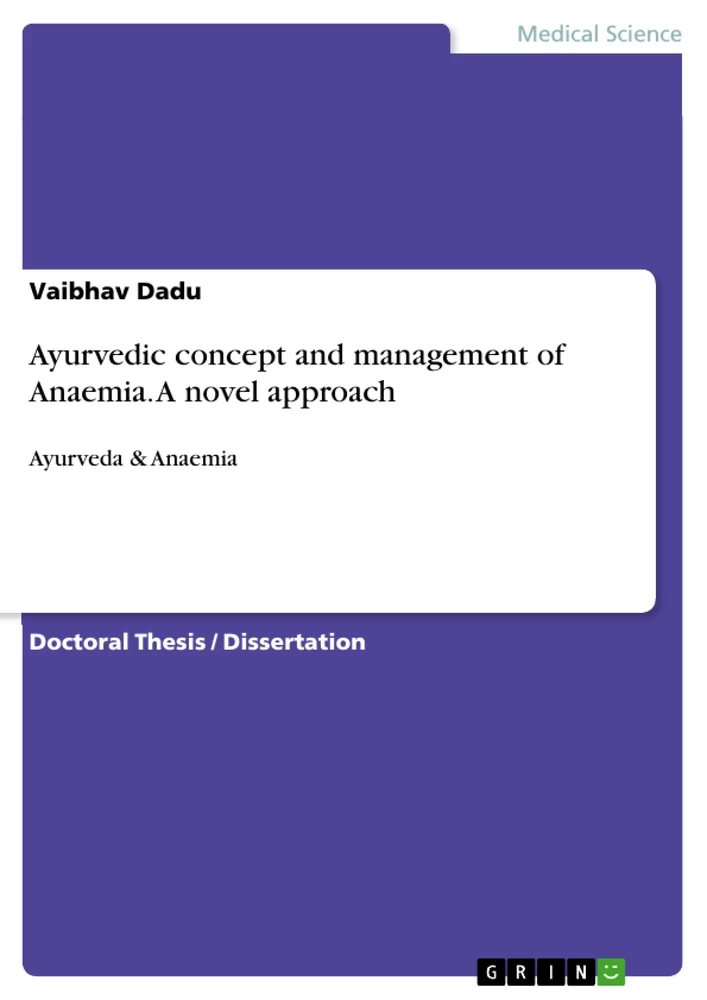
Table of Contents
02. Prologue
03. Chapter 1 (Conceptual study of the principle)
04. Chapter 2 (Disease Review)
05. Chapter 3 (Drug Review)
06. Clinical Study
07. Discussion
08. Conclusion
09. Summary
10. Bibliography
11. Research Proforma
Research Objectives & Core Topics
This work aims to evaluate the clinical application of the Ayurvedic principle "Poorvah purvo ati vriddhatvat vardhayeddhi param param" (the principle of tissue interconversion) in the management of Rakta-Kshaya (Anaemia). The study seeks to bridge the gap between classical Ayurvedic theoretical frameworks and contemporary clinical practice by assessing the efficacy of Shatavari Siddha Ksheera on patients suffering from Rakta-Kshaya.
- Fundamental conceptual study of the inter-tissue nourishment principle.
- Clinical evaluation of Shatavari Siddha Ksheera in treating Anaemia symptoms.
- Comparative analysis of treatment groups using Ayurvedic standard control protocols.
- Validation of Ayurvedic pathological concepts through clinical observation.
Excerpt from the Book
CONCEPTUAL STUDY
The fundamental principles of the study of the disease are mentioned in Ayurveda classics including the Sushruta Samhita. The disease as per the Ayurveda philosophy is termed as the imbalance of the three vital humors called as the vata, pitta and kapha. They are termed as dosha in Ayurveda parlance. The dosha is the strongest and independent unit of Ayurveda physiology and pathology. The Ayurveda has propagated the principle of the harmony of the microcosm and the macrocosm in the form of the lok-purusha samya siddhanta (The principle of the similarity of the universe and the living being).
The classics of Ayurveda elaborate on the diseases in the form of increase or decrease of the dosha-dhatu. The Sootra Sthana of Sushruta Samhita is the unique treasure of knowledge elaborating on all the fundamentals of Ayurveda. Though all the forty six chapters of the Sootra Sthana of Sushruta Samhita are unique in their subject and content having wide range of applications to every branch of Ayurveda this work is confined to the study of the Rakta Kshaya (Anaemia) and its management based on the principle of the inter-relation of tissues elaborated in the chapter15th of Sootra Sthana of Sushruta Samhita namely the“Dosha- dhatu- mala Kshaya Vriddhi Vijnaneeya Adhyaya”.
The homeostasis of the body is the equilibrium of these Dosha- dhatu- Mala while theunhealthy state is the disturbance of this equilibrium which is manifested either as Kshaya (diminution) or Vriddhi (increase). This Kshaya and Vriddhi of the Dosha Dhatu Mala is the crux of the chapter fifteen of the Sootra Sthana of the Sushruta Samhita namely “Dosha-dhatu-Mala-kshaya-Vriddhi Vijnaneeya Adhyaya”.
Summary of Chapters
Chapter 1 (Conceptual study of the principle): This chapter establishes the theoretical foundation by exploring the inter-relation of tissues through the principle "Poorvah purvo ati vriddhatvat vardhayeddhi param param".
Chapter 2 (Disease Review): This section provides an in-depth Ayurvedic analysis of Rakta-Kshaya (Anaemia), covering its etiology, pathogenesis, and clinical symptoms.
Chapter 3 (Drug Review): This chapter focuses on the pharmacological and classical review of Shatavari as a primary therapeutic agent for Rasa and Rakta replenishment.
Clinical Study: This section details the methodology and clinical trials conducted on patients to test the efficacy of the chosen pharmacological intervention.
Discussion: This segment correlates the theoretical findings with clinical observations, providing a logical reasoning for the therapeutic outcomes.
Conclusion: This final section synthesizes the results, confirming the practical application of the researched Ayurvedic principle in modern clinical settings.
Keywords
Ayurveda, Rakta-Kshaya, Anaemia, Shatavari, Dhatu-Poshana, Poorvah purvo ati vriddhatvat, Sootra Sthana, Sushruta Samhita, Tissue Nourishment, Clinical Study, Rasa Dhatu, Pathogenesis, Dosha, Dhatavagni, Kayachikitsa
Frequently Asked Questions
What is the primary focus of this research?
The research focuses on validating the Ayurvedic principle of tissue interconversion to treat Anaemia (Rakta-Kshaya) by nourishing the Dhatus.
What are the central themes discussed in the book?
The central themes include the theoretical framework of Dhatu Poshana (tissue nourishment), the pathogenesis of Rakta-Kshaya, and the therapeutic evaluation of Shatavari.
What is the core research question?
The core question is whether the principle of "Poorvah purvo ati vriddhatvat vardhayeddhi param param" can effectively manage Rakta-Kshaya in clinical practice.
Which scientific methodology is employed?
The study utilizes a literary research method for the conceptual framework and a randomized clinical trial for the applied study of the therapeutic agent.
What does the main body cover?
The main body covers a comprehensive review of Ayurvedic literature, the selection of test drugs, and the systematic clinical observation of 26 patients.
Which keywords best characterize this work?
Key terms include Ayurvedic Principles, Rakta-Kshaya, Dhatu-Poshana, and Clinical Validation.
How is Shatavari utilized in this study?
Shatavari is used as a Rasayana (rejuvenative) and Rasa-vardhaka (plasma-increasing) drug to assess its secondary effect on nourishing the Rakta Dhatu.
Does the book conclude that Rasa replenishment is vital for Anaemia?
Yes, the study concludes that replenishing Rasa Dhatu is a crucial prerequisite for the proper nourishment and stabilization of Rakta Dhatu.
Ende der Leseprobe aus 94 Seiten
- nach oben
- Arbeit zitieren
- Dr. Vaibhav Dadu (Autor:in), 2007, Ayurvedic concept and management of Anaemia. A novel approach, München, Page::Imprint:: GRINVerlagOHG, https://www.diplomarbeiten24.de/document/303332

neugierig - aktuell - relevant
Entdecken Sie hilfreiche Tipps und Tricks rund ums Studium!

Entdecken Sie hilfreiche Tipps und Tricks rund ums Studium!
Ihre Hausarbeit / Abschlussarbeit:

- - Publikation als E-Book und Buch
- - Hohes Honorar auf die Verkäufe
- - Für Sie komplett kostenlos - mit ISBN
- - Es dauert nur 5 Minuten
- - Jede Arbeit findet Leser

- © GRIN Publishing GmbH.
- Alle Inhalte urheberrechtlich geschützt. Kopieren und verbreiten untersagt.
- info@grin.com
- AGB
- Open Publishing
Der GRIN Verlag hat sich seit 1998 auf die Veröffentlichung akademischer eBooks und Bücher spezialisiert. Der GRIN Verlag steht damit als erstes Unternehmen für User Generated Quality Content. Die Verlagsseiten GRIN.com, Hausarbeiten.de und Diplomarbeiten24 bieten für Hochschullehrer, Absolventen und Studenten die ideale Plattform, wissenschaftliche Texte wie Hausarbeiten, Referate, Bachelorarbeiten, Masterarbeiten, Diplomarbeiten, Dissertationen und wissenschaftliche Aufsätze einem breiten Publikum zu präsentieren.
Kostenfreie Veröffentlichung: Hausarbeit, Bachelorarbeit, Diplomarbeit, Dissertation, Masterarbeit, Interpretation oder Referat jetzt veröffentlichen!
Folgen Sie GRIN auf


- GRIN Verlag GmbH
-
- Nymphenburger Str. 86
- 80636
- Munich, Deutschland
- +49 89-550559-0
- +49 89-550559-10
- info@grin.com
-
