
präsentiert von

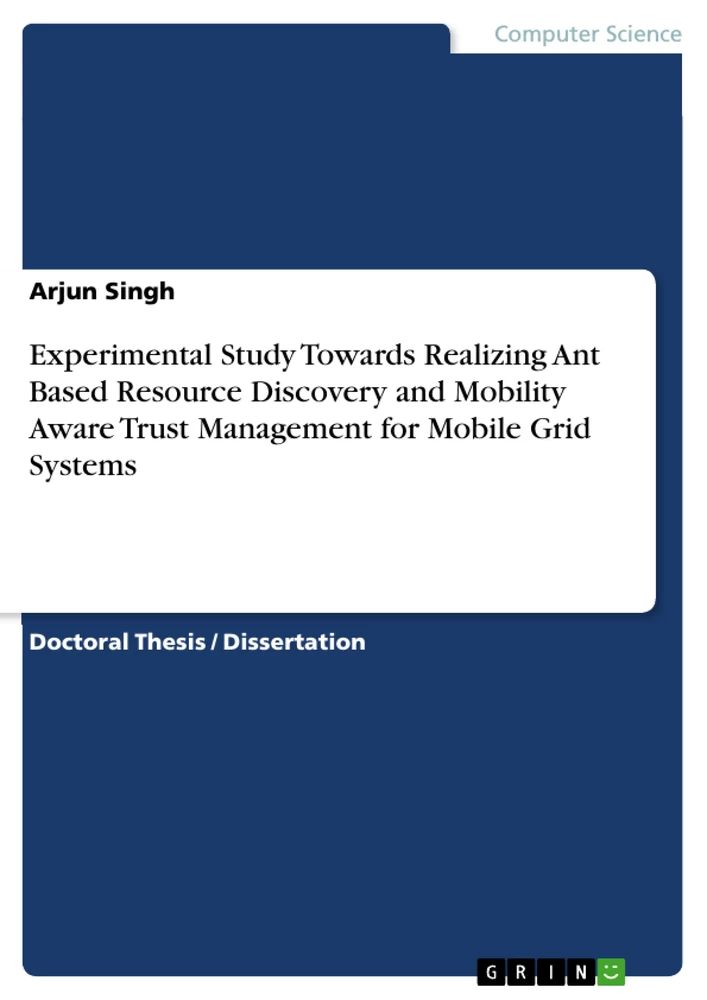
Table of Contents
1. INTRODUCTION
1.1 Motivation
1.2 Grid computing
1.3 Mobile computing
1.4 Integration of mobile computing and grid services
1.5 Challenges of the integration
1.6 Security in mobile grid computing
1.7 Mobile grid security requirements
1.8 Route and resource discovery in mobile grid system
1.9 Research gap and objectives
1.10 Methodology
2. REVIEW OF LITERATURE
2.1 Computational grid
2.2 Resource discovery
2.3 Need of resource discovery
2.4 Outline of the survey
2.4.1 Components of resource discovery
2.4.2 Grid resource management model and algorithms
2.5 Protocols
2.5.1 Grid Information Protocol (GRIP)
2.5.2 Grid Registration Protocol (GRRP)
2.5.3 Lightweight Directory Access Protocol
2.6 Approaches
2.6.1 Decentralized approach
2.6.2 Agent based approach
2.6.3 Routing transferring model-based approach
2.6.4 Ontology description- based approach
2.6.5 Parameter based approach
2.6.6 Quality of service based approach
2.6.7 Request forwarding approach
2.6.8 Peer-to-peer approach
2.7 Discovery mechanism on different platform
2.7.1 GLOBUS
2.7.2 Ninja service directory service
2.7.3 OPEN GRID SERVICE ARCHITECTURE (OGSA)
2.7.4 WEB SERVICE DISCOVERY ARCHITECTURE (WSDA)
2.7.5 NIMROD/G
2.7.6 UNIVERSAL DESCRIPTION, DISCOVERY AND INTEGRATION (UDDI)
2.7.7 MAPCENTER
2.7.8 NOM
2.7.9 MOGRID
2.7.10 DEEPG
2.7.11 A brokering protocol for agent based grid resource discovery
2.7.12 ANT COLONY OPTIMIZATION (ACO)
3. INTRODUCTION TO TRUST AND TRUST MANAGEMENT
3.1 Trust
3.2 Motivation for trust management
3.3 Definition of trust management
3.4 Trust context
3.5 Trust management: A survey
3.6 Discover and computations of trust
3.7 Trust propagation
3.8 Trust aggregation
3.9 Trust prediction
3.10 Existing research's applications
4. ANT BASED RESOURCE DISCOVERY AND MOBILITY AWARE TRUST MANAGEMENT FOR MOBILE GRID SYSTEMS
4.1 Matrices estimation
4.1.1 Estimation of distance
4.1.2 Estimation of residual battery power
4.1.3 Estimation of available bandwidth
4.1.4 Estimation of local trust and global trust (TG)
4.1.5 Estimation of mobility
4.2 Proposed scheme
4.2.1 Phase 1 - Ant based resource discovery mechanism
4.2.2 Phase 2- - A mobility aware trust management technique
4.3 Simulation setting
5. ENERGY CONSTRAINED HIERARCHICAL TASK SCHEDULING ALGORITHM FOR MOBILE GRIDS
5.1 Energy constrained Mobile Grids
5.2 Energy Constrained Hierarchical Task Scheduling Algorithm
5.2.1 Estimation of residual battery power and relevant mathematical representation
5.2.2 Hierarchical task scheduling
5.2.3 Proposed Algorithm
5.2.4 Merits of Proposed Scheme
5.3 Simulation setup
5.3.1 Based on Number of Requests
5.3.2 Simulation on Load
6. CONCLUSIONS AND FUTURE PROSPECTIVES
6.1 Main contributions
6.2 Future prospective research
Research Objectives and Core Themes
This thesis aims to address the challenges of resource discovery and security within mobile grid computing environments by proposing an ant-based discovery mechanism and a mobility-aware trust management system. The research focuses on the development of efficient, secure, and adaptable methodologies that accommodate the dynamic nature and resource constraints of mobile devices in large-scale grid systems.
- Development of an ant-colony optimization-based resource discovery mechanism for mobile grid nodes.
- Implementation of a robust trust management system that accounts for node mobility and security.
- Estimation of node metrics including battery power, bandwidth, and trust values to improve scheduling efficiency.
- Performance validation through extensive simulations comparing the proposed protocols against existing scheduling and discovery techniques.
Excerpt from the Book
1.2 Grid computing
The grid computing mainly focused on sharing computer power and data storage capacity over Internet. A well-known example of grid computing is SETI (Search for Extra Terrestrial Intelligence) project (@home) in which many users share the unused processing cycle of their PC. As earlier said, that our desktop or laptops spend vast majority of their time sitting ideal. Networking has improved from a few kilobytes per second to thousands of megabytes per second; at the same time it is unusual to find a machine not connected to a corporate network or Internet. Finally in the last 20 years disk capacity has increased from a few megabytes to hundreds of gigabytes on the desktop and many terabytes in the servers.
While these developments have occurred, business pressures have consistently forced companies to seek new and innovative ways to enhance the flow of their operations. A car manufactures wants to conduct simulations with maximal precision to come up with a competitive design of a new auto model. A bank may desire to process ever large sets of historical data to better forecast the coming months. A pharmaceutical researcher who has access to remote scientific data can make faster progress in developing a new medicine. Finally, dislocated teams of software developers want to access collaborative environments enabling them to cooperate on a common source code.
Grid computing, which deals with resource sharing, provides abstraction and technology addressing such issues. These are problems characterized by distribution, resource heterogeneity, large scale and the need for collaboration, at the same time requiring guaranteed levels of reliability, safety, security and quality of service.
Summary of Chapters
1. INTRODUCTION: This chapter provides an overview of mobile grid computing, covering motivations, definitions, security challenges, and the research objectives of the thesis.
2. REVIEW OF LITERATURE: A comprehensive survey of existing resource discovery methods, protocols, and architectural approaches in grid and mobile computing environments.
3. INTRODUCTION TO TRUST AND TRUST MANAGEMENT: This chapter defines trust in the context of mobile grids, exploring motivations, computation methods, and existing research on trust management.
4. ANT BASED RESOURCE DISCOVERY AND MOBILITY AWARE TRUST MANAGEMENT FOR MOBILE GRID SYSTEMS: Details the proposed ant-based discovery mechanism and the mobility-aware trust management technique, including the mathematical models for node estimation.
5. ENERGY CONSTRAINED HIERARCHICAL TASK SCHEDULING ALGORITHM FOR MOBILE GRIDS: Presents an energy-aware hierarchical scheduling algorithm, focusing on minimizing power consumption while managing tasks in dynamic mobile environments.
6. CONCLUSIONS AND FUTURE PROSPECTIVES: Summarizes the key research contributions and outlines potential areas for future exploration in mobile grid system optimization.
Keywords
Mobile Grid Computing, Resource Discovery, Ant Colony Optimization, Trust Management, Mobility-aware, Energy Constrained, Task Scheduling, Security, Node Discovery, Network Simulation, Decentralized Protocols, Performance Metrics, Quality of Service, Hierarchical Scheduling, Distributed Systems.
Frequently Asked Questions
What is the fundamental focus of this thesis?
This work focuses on addressing the limitations of mobile grid systems regarding resource discovery and secure trust management by introducing specialized, robust methodologies for highly dynamic environments.
What are the primary thematic fields covered in this research?
The core themes include mobile grid architectures, resource discovery mechanisms, security/trust management, energy efficiency, and task scheduling algorithms for mobile environments.
What is the primary objective of this doctoral study?
The primary objective is to design a resilient and efficient framework for node discovery and trust management that ensures secure and seamless service delivery for mobile users in large-scale grids.
Which scientific methodology is primarily employed?
The research adopts a hypothetical-deductive method, utilizing analytical modeling for protocol design followed by extensive simulation experiments in the NS-2 environment to validate the proposed theories.
What topics are explored in the main part of the thesis?
The main part covers the survey of existing literature, the development of ant-based discovery and trust management protocols, and the implementation of hierarchical, energy-constrained task scheduling algorithms.
Which keywords are essential to categorize this research?
Key terms include Mobile Grid Computing, Resource Discovery, Ant Colony Optimization, Trust Management, and Energy-constrained Scheduling.
How does the proposed scheme handle trust values for mobile nodes?
Trust values are calculated based on job response times, data delivery accuracy, and task completion, then updated based on the predicted residence time and mobility of the nodes to ensure reliability.
What role does Ant Colony Optimization (ACO) play in the discovery process?
ACO is utilized to establish super-grid nodes by evaluating criteria such as distance, CPU speed, bandwidth, and battery power, creating a pheromone-based path for efficient resource location.
Ende der Leseprobe aus 238 Seiten
- nach oben
- Arbeit zitieren
- Arjun Singh (Autor:in), 2014, Experimental Study Towards Realizing Ant Based Resource Discovery and Mobility Aware Trust Management for Mobile Grid Systems, München, Page::Imprint:: GRINVerlagOHG, https://www.diplomarbeiten24.de/document/307503

neugierig - aktuell - relevant
Entdecken Sie hilfreiche Tipps und Tricks rund ums Studium!

Entdecken Sie hilfreiche Tipps und Tricks rund ums Studium!
Ihre Hausarbeit / Abschlussarbeit:

- - Publikation als E-Book und Buch
- - Hohes Honorar auf die Verkäufe
- - Für Sie komplett kostenlos - mit ISBN
- - Es dauert nur 5 Minuten
- - Jede Arbeit findet Leser

- © GRIN Publishing GmbH.
- Alle Inhalte urheberrechtlich geschützt. Kopieren und verbreiten untersagt.
- info@grin.com
- AGB
- Open Publishing
Der GRIN Verlag hat sich seit 1998 auf die Veröffentlichung akademischer eBooks und Bücher spezialisiert. Der GRIN Verlag steht damit als erstes Unternehmen für User Generated Quality Content. Die Verlagsseiten GRIN.com, Hausarbeiten.de und Diplomarbeiten24 bieten für Hochschullehrer, Absolventen und Studenten die ideale Plattform, wissenschaftliche Texte wie Hausarbeiten, Referate, Bachelorarbeiten, Masterarbeiten, Diplomarbeiten, Dissertationen und wissenschaftliche Aufsätze einem breiten Publikum zu präsentieren.
Kostenfreie Veröffentlichung: Hausarbeit, Bachelorarbeit, Diplomarbeit, Dissertation, Masterarbeit, Interpretation oder Referat jetzt veröffentlichen!
Folgen Sie GRIN auf


- GRIN Verlag GmbH
-
- Nymphenburger Str. 86
- 80636
- Munich, Deutschland
- +49 89-550559-0
- +49 89-550559-10
- info@grin.com
-
