
präsentiert von

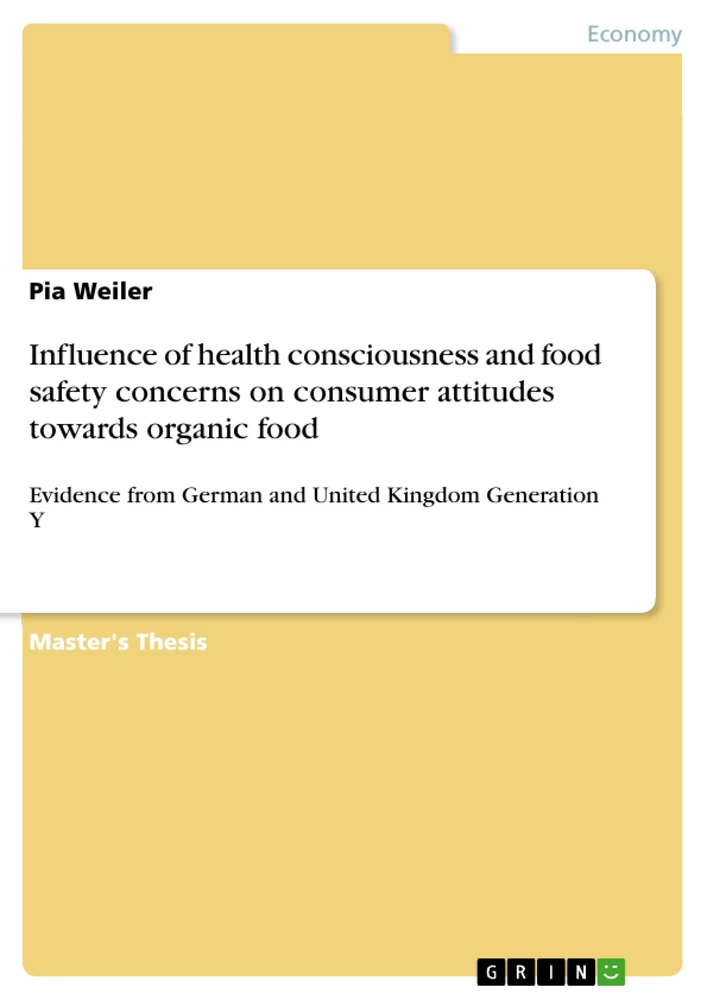
Table of Contents
CHAPTER I: INTRODUCTION
1.1 Chapter Introduction
1.2 Background of organic produce
1.3 Purpose and objectives
1.4 Research questions
1.5 Structure of the dissertation
CHAPTER II: LITERATURE REVIEW
2.1 Chapter Introduction
2.2 Organic food
2.2.1 Organic food in Germany
2.2.2 Organic food in the United Kingdom
2.3 Generation Y
2.4 Health consciousness
2.5 Food safety
2.6 Overview of present secondary literature
2.7 The Theory of Planned Behaviour
2.8 Research hypotheses relationships
2.9 Chapter Summary
CHAPTER III: METHODOLOGY
3.1 Chapter Introduction
3.2 Practical and ethical issues
3.3 Type of research
3.4 Research design
3.5 Structure of the questionnaire and data collection
3.6 Data measurements
3.7 Chapter Summary
CHAPTER IV: RESULTS
4.1 Chapter Introduction
4.2 Sample description
4.3 Differences between Germany and the United Kingdom
4.3.1 Health consciousness
4.3.2 Food safety
4.4 Chapter Summary
CHAPTER V: CONCLUSION AND OUTLOOK
5.1 Chapter Introduction
5.2 Limitations
5.3 Conclusion
5.4 Further recommendations and outlook
Research Objectives and Themes
This dissertation investigates the impact of health consciousness and food safety on the attitudes and purchase intentions of Generation Y consumers regarding organic food, focusing specifically on a cross-cultural comparison between Germany and the United Kingdom.
- The influence of health consciousness on organic food consumption.
- The role of food safety perceptions in shaping purchase intentions.
- A comparative analysis of Generation Y consumption patterns in Germany and the UK.
- Extension of the Theory of Planned Behaviour with self-identity and moral norms.
- Analysis of consumer responses via an online questionnaire.
Excerpt from the Book
1.1 Chapter Introduction
Today´s world is determined by many factors: technology, progress, finance and politics to only mention a few. Although medicine has developed rapidly, scientists forecast negative outcomes for the incoming generations. If younger generations continue to live like previous generations use to, then this will be the first time that children might not survive their parents (Mecking, 2014).
In the developed western world, illnesses like cancer, diabetes, blood pressure, allergies and heart failure have become well-established diseases although medical progress has never been faster. But where do they come from? Society has never consumed this many chemical and processed foods like they do today. These processed foods mainly consist of sugar, carbohydrates, fat and salt, which have now become empty calories which don´t nourish the body. Then big food companies like Nestlé, Mondelez International and Danone add vitamins and minerals to these products to sell them as healthy, but it has never been proven that the added supplements can replace real vitamins contained naturally in fruit and vegetables (De Jonge et al., 2015).
Summary of Chapters
CHAPTER I: INTRODUCTION: This chapter outlines the research problem, objectives, and the context of the study, highlighting the rising concerns regarding processed food and the importance of organic produce for Generation Y.
CHAPTER II: LITERATURE REVIEW: This chapter reviews the academic landscape, focusing on organic food definitions, Generation Y characteristics, health consciousness, food safety, and the Theoretical framework of the Theory of Planned Behaviour.
CHAPTER III: METHODOLOGY: This chapter describes the research design, the process of questionnaire development based on previous academic models, and the practical and ethical considerations for the cross-national data collection.
CHAPTER IV: RESULTS: This chapter presents the empirical findings from the survey, providing a descriptive analysis of the sample and testing the research hypotheses regarding the relationship between consumer attitudes and intentions.
CHAPTER V: CONCLUSION AND OUTLOOK: This chapter provides a final synthesis of the findings, acknowledges the study's limitations, and offers recommendations for future research and market strategies for organic products.
Keywords
Organic, health consciousness, food safety, consumption, Germany, United Kingdom, Generation Y, consumer attitudes, intention, Theory of Planned Behaviour
Frequently Asked Questions
What is the core focus of this dissertation?
The research primarily examines how health consciousness and concerns about food safety influence the attitudes and intentions of Generation Y consumers towards purchasing organic food in Germany and the UK.
Which demographic is studied in this research?
The study specifically focuses on the Generation Y cohort (Millennials), who are recognized as having distinct consumption patterns compared to older generations.
What is the primary objective of this work?
The objective is to fill the research gap concerning Generation Y's organic consumption behavior and to understand how personal and external factors shape their buying decisions.
What scientific framework is applied?
The study utilizes the Theory of Planned Behaviour (TPB) by Icek Ajzen, extended with additional factors like self-identity and moral norms to provide a more comprehensive model.
What is the main subject matter of the main body?
The main body covers the literature review of organic markets, the detailed methodology of the primary data collection, the analysis of results obtained from the questionnaire, and the final conclusions.
Which specific variables characterize the consumers in this study?
Key variables include behavioral attitudes, subjective norms, moral norms, perceived behavioral control, and self-identity.
How do German and British consumer behaviors differ according to the findings?
The results indicate that while both populations value health and safety, Germans tend to have a higher level of trust in their organic production chains compared to British consumers, who exhibit more skepticism.
What is the role of food safety in this context?
Food safety is identified as a critical influencing variable, often acting as a "sleeping giant" that significantly impacts consumer confidence, particularly in light of historical food scandals.
Ende der Leseprobe aus 103 Seiten
- nach oben
- Arbeit zitieren
- Pia Weiler (Autor:in), 2015, Influence of health consciousness and food safety concerns on consumer attitudes towards organic food, München, Page::Imprint:: GRINVerlagOHG, https://www.diplomarbeiten24.de/document/309699

neugierig - aktuell - relevant
Entdecken Sie hilfreiche Tipps und Tricks rund ums Studium!

Entdecken Sie hilfreiche Tipps und Tricks rund ums Studium!
Ihre Hausarbeit / Abschlussarbeit:

- - Publikation als E-Book und Buch
- - Hohes Honorar auf die Verkäufe
- - Für Sie komplett kostenlos - mit ISBN
- - Es dauert nur 5 Minuten
- - Jede Arbeit findet Leser

- © GRIN Publishing GmbH.
- Alle Inhalte urheberrechtlich geschützt. Kopieren und verbreiten untersagt.
- info@grin.com
- AGB
- Open Publishing
Der GRIN Verlag hat sich seit 1998 auf die Veröffentlichung akademischer eBooks und Bücher spezialisiert. Der GRIN Verlag steht damit als erstes Unternehmen für User Generated Quality Content. Die Verlagsseiten GRIN.com, Hausarbeiten.de und Diplomarbeiten24 bieten für Hochschullehrer, Absolventen und Studenten die ideale Plattform, wissenschaftliche Texte wie Hausarbeiten, Referate, Bachelorarbeiten, Masterarbeiten, Diplomarbeiten, Dissertationen und wissenschaftliche Aufsätze einem breiten Publikum zu präsentieren.
Kostenfreie Veröffentlichung: Hausarbeit, Bachelorarbeit, Diplomarbeit, Dissertation, Masterarbeit, Interpretation oder Referat jetzt veröffentlichen!
Folgen Sie GRIN auf


- GRIN Verlag GmbH
-
- Nymphenburger Str. 86
- 80636
- Munich, Deutschland
- +49 89-550559-0
- +49 89-550559-10
- info@grin.com
-
