
präsentiert von

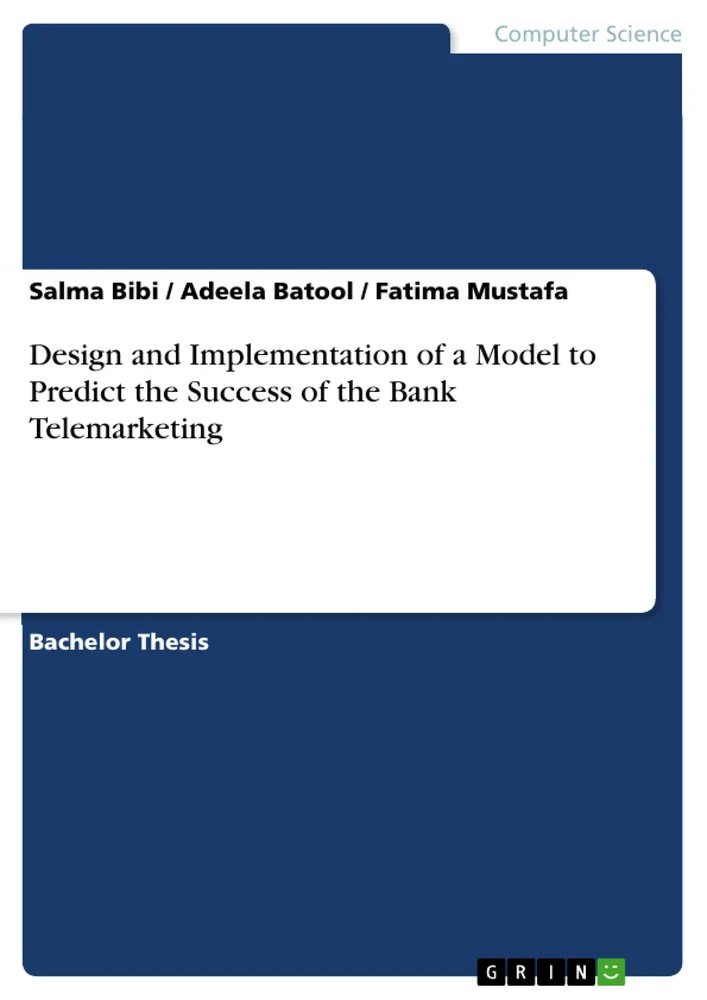
Table of Contents
INTRODUCTION
1.1 ID3 Algorithm:
1.2 Objective:
1.3 Problem Statement:
1.4 Project Scope:
1.5 Report Organization:
LITERATURE REVIEW
SYSTEM DESIGN
3.1 Introduction:
3.2 Proposed Model Design:
3.2.1 Logical Design (Flow Diagram):
3.2.2 Use Case Diagram:
3.2.3 Time Sequence Diagram
3.2.4 Structural diagram:
IMPLEMENTATION
4.1 System Development Requirements:
4.1.1 Software Requirements:
4.1.2 Hardware Requirements:
4.2 Data Set Description:
4.2.1 Attribute Description:
4.3 Decision Tree:
4.3.1 Decision Tree Algorithm:
4.3.2 Pseudo code:
4.3.3 Root node:
4.3.4 For further nodes (i.e. Internal and Leaf nodes):
RESULTS
CONCLUSION
FUTURE WORK
Project Objectives and Focus Areas
The primary objective of this research is to design and implement a predictive model for bank telemarketing success using data mining techniques, specifically the ID3 decision tree algorithm. The project aims to improve telemarketing efficiency by analyzing historical customer data to predict which clients are most likely to respond positively to new products.
- Application of the ID3 decision tree algorithm for classification and prediction.
- Utilization of benchmark datasets to extract meaningful marketing rules.
- Optimization of bank telemarketing strategies through data-driven insights.
- Development of a functional software tool to assist decision-making processes.
- Enhancement of customer retention and competitive edge in the banking sector.
Excerpt from the Book
1.1 ID3 Algorithm:
The proposed system used ID3 algorithm. ID3 algorithms stand for Iterative Dichotomiser 3.It is presented by J. Ross Quinlan in 1986. ID3 is a no incremental algorithm, which means it derives its classes from a fixed set of training instances. It builds the shortest and fastest tree. In ID3, prediction rules are created from training set. It is very efficient algorithm in terms of processing time as it searches the whole dataset to create tree and can handle continuous attribute. It is used to calculate logistic calculations. In ID3 algorithm, one attribute is tested at a time for making a decision. ID3 is a supervised algorithm.
A statistical property called information gain that is used for attribute selection. The attribute with the highest information gain is selected from training data set. In order to define information gain we must calculate the entropy measures, the amount of information in an attribute.
ID3 uses dataset to generate decision tree in top-down fashion. The tree is constructed in ID3 in two phases. One is tree building and second is pruning. ID3 use gain approach to determine suitable property for each node generated in decision tree.ID3 starts from set of objects. One property is tested based on maximizing information gain and minimizing entropy at each node of the tree, and then results are used to split objects. This process is continuous recursively until objects belongs to same category. Then it becomes the leaf node of the decision tree
Summary of Chapters
INTRODUCTION: This chapter outlines the role of telemarketing in banking and introduces the application of data mining for customer behavior prediction.
LITERATURE REVIEW: This section provides a survey of existing research regarding bank telemarketing, feature selection, and the use of various classification algorithms.
SYSTEM DESIGN: This chapter details the logical framework of the project, including flow diagrams, use case modeling, and structural system design.
IMPLEMENTATION: This part describes the software and hardware environments, data set attributes, and the specific implementation of the ID3 algorithm.
RESULTS: This chapter showcases the functional user interface and the generated outputs of the telemarketing prediction software.
CONCLUSION: This section summarizes the research findings, confirming the effectiveness of the ID3 algorithm in predicting telemarketing success.
FUTURE WORK: This chapter suggests potential improvements, such as utilizing more attributes and integrating advanced techniques like neural networks or genetic algorithms.
Keywords
Bank Telemarketing, Data Mining, ID3 Algorithm, Decision Tree, Information Gain, Entropy, Classification, Predictive Modeling, Customer Behavior, Feature Selection, UCI Database, System Design, Data Analysis, Marketing Strategy, Telephonic Services.
Frequently Asked Questions
What is the core focus of this research?
The research focuses on designing and implementing a model that uses data mining techniques, specifically the ID3 decision tree algorithm, to predict the success of bank telemarketing campaigns.
What are the primary themes of the project?
The central themes include improving telemarketing efficiency, analyzing customer data, applying ID3 classification, and developing a supportive decision-making tool for banks.
What is the main objective of the proposed system?
The goal is to enable banks to predict which customers are likely to respond positively to banking offers, thereby increasing the success rate of telemarketing calls and improving resource allocation.
Which scientific methodology is utilized?
The project employs the ID3 decision tree algorithm, utilizing entropy calculations and information gain to construct a top-down decision tree from training datasets.
What topics are covered in the main body of the work?
The main body covers the literature review, the logical system design (flowcharts and use case diagrams), the technical implementation requirements, and the analysis of the predictive results.
Which keywords define this work?
Key terms include Bank Telemarketing, Data Mining, ID3 Algorithm, Decision Tree, Predictive Modeling, and Customer Behavior.
How is the ID3 algorithm applied in this context?
The algorithm is used to process a dataset of 60 records to determine the best attributes for splitting data into homogeneous branches, ultimately generating rules for predicting telemarketing outcomes.
What are the hardware and software requirements for this system?
The system requires Microsoft Visual Studio C# 2010, at least 256MB of RAM (2GB recommended), a Dual Core processor, and 40GB of storage.
What is the significance of the "Information Gain" in this model?
Information gain is crucial for determining which attribute should be selected at each node of the decision tree to maximize the homogeneity of the resulting branches.
What future advancements are proposed for this model?
Future work involves incorporating a larger number of attributes, developing a web-based interface, and exploring more advanced techniques like support vector machines and neural networks.
Ende der Leseprobe aus 28 Seiten
- nach oben
- Arbeit zitieren
- Salma Bibi (Autor:in), Adeela Batool (Autor:in), Fatima Mustafa (Autor:in), 2015, Design and Implementation of a Model to Predict the Success of the Bank Telemarketing, München, Page::Imprint:: GRINVerlagOHG, https://www.diplomarbeiten24.de/document/310165

neugierig - aktuell - relevant
Entdecken Sie hilfreiche Tipps und Tricks rund ums Studium!

Entdecken Sie hilfreiche Tipps und Tricks rund ums Studium!
Ihre Hausarbeit / Abschlussarbeit:

- - Publikation als E-Book und Buch
- - Hohes Honorar auf die Verkäufe
- - Für Sie komplett kostenlos - mit ISBN
- - Es dauert nur 5 Minuten
- - Jede Arbeit findet Leser

- © GRIN Publishing GmbH.
- Alle Inhalte urheberrechtlich geschützt. Kopieren und verbreiten untersagt.
- info@grin.com
- AGB
- Open Publishing
Der GRIN Verlag hat sich seit 1998 auf die Veröffentlichung akademischer eBooks und Bücher spezialisiert. Der GRIN Verlag steht damit als erstes Unternehmen für User Generated Quality Content. Die Verlagsseiten GRIN.com, Hausarbeiten.de und Diplomarbeiten24 bieten für Hochschullehrer, Absolventen und Studenten die ideale Plattform, wissenschaftliche Texte wie Hausarbeiten, Referate, Bachelorarbeiten, Masterarbeiten, Diplomarbeiten, Dissertationen und wissenschaftliche Aufsätze einem breiten Publikum zu präsentieren.
Kostenfreie Veröffentlichung: Hausarbeit, Bachelorarbeit, Diplomarbeit, Dissertation, Masterarbeit, Interpretation oder Referat jetzt veröffentlichen!
Folgen Sie GRIN auf


- GRIN Verlag GmbH
-
- Nymphenburger Str. 86
- 80636
- Munich, Deutschland
- +49 89-550559-0
- +49 89-550559-10
- info@grin.com
-
