
präsentiert von

Contents
Chapter One: Introduction
1.1: Introduction
1.2: Aim and Objective of the study
1.3: Research Questions
1.4: Problem Definition
1.5 Structure of the thesis
Chapter Two: Literature Review
2.1:The Role of Remote Sensing in Land surface Tempreture Retrieval and Application
2.2: Algorithms Developed for Retrieving LST
2.3: Related Literature on Landsat- based Land Surface Temperature Retrieval
Chapter Three: Data and Methodology
3.1: Study area
3.2: Data Collection
3.3: Research method
3.5: Classification scheme
3.6: Image Classification Techniques
3.7: Accuracy Assessment
3.8: Normalized Difference Vegetation Index (NDVI)
Chapter four: Results and Discussion
4.1: Result of Classification Images
4.3: Land Surface Temperature Retrieval
4.4: Spatial Distribution of LST in Sulaymaniyah city
4.5: Spatial Distribution of LST in 1984
4.6: LST Spatial Distribution in 2010
5.1: Conclusion
Objectives and Research Themes
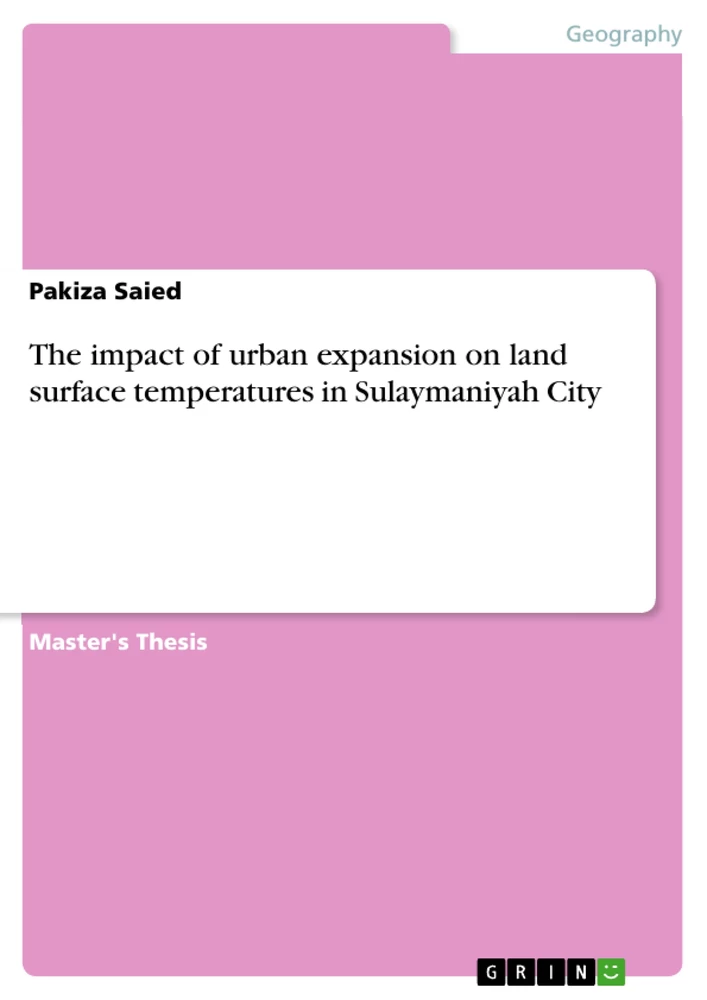
This research aims to investigate the impact of urban expansion on land surface temperature (LST) in Sulaymaniyah City, Iraq, by utilizing Landsat-5 TM imagery and GIS techniques to analyze spatial and temporal patterns over three decades.
- Analysis of land use/land cover changes from 1984 to 2010.
- Retrieval and spatial distribution mapping of Land Surface Temperature (LST).
- Evaluation of the relationship between vegetation cover (NDVI) and surface temperature.
- Assessment of urban growth impacts on the local thermal environment and urban heat/cool island phenomena.
Excerpt from the Book
1.1:Introduction
Rates of urbanization across the globe are rapid and it has put quality of physical environmental elements such as (temperature, rainfall, soil and water) at high risk. Thus, now every day, all over the world the subject of urban thermal environment attracts wide interests (Guo et al, 2012). Muhammadi et al, (2012) defined urban expansion as the extent of urbanization which mainly occurs by population growth and migration, and has an effect on the environment and natural resource.
Urbanization is an important topic for decision makers, planners and environmentalists (Jat et al, 2008). Urban expansion causes dramatic conversion in the areas around it. It leads to the loss of agricultural lands and their subsequent transformation to build up areas (Rimal 2012). In other words, the land surface is mostly covered by man-made features while the other natural land covers, including vegetation and water bodies, decreases. Urban growth leads to change in land surface characteristics including thermal capacity, surface albedo and the moisture of soil. This causes the differences in temperature between urban areas and the areas around it, as the surface materials are different between urban and suburban areas, such as asphalt, road pavements in the urban areas which highly absorb heat in days and emit it at nights; this is different in the suburban areas as it covered mostly by vegetation (Gallo et al, 1993) (Matthews, 2012). According to (Vernberg et al, 1996) urbanization affects the natural environment negatively; therefore having an effect on human activities and health directly and indirectly.
Summary of Chapters
Chapter One: Introduction: Provides an overview of global urbanization and its impact on the thermal environment, defining the research objectives, questions, and the structural scope of the study.
Chapter Two: Literature Review: Examines the role of remote sensing and GIS in LST retrieval, existing algorithms, and related studies on urban heat and cool island phenomena.
Chapter Three: Data and Methodology: Details the study area, data collection methods using Landsat imagery, image preprocessing, classification schemes, and the technical procedures for LST and NDVI analysis.
Chapter four: Results and Discussion: Presents the findings regarding land cover changes, classification accuracy, and the spatial distribution of LST, while analyzing the correlation between vegetation and surface temperature.
5.1: Conclusion: Synthesizes the research findings, confirming the impact of urban expansion on LST and providing recommendations for future urban planning and environmental management.
Keywords
Remote Sensing, GIS, Landsat-5 TM, Land Surface Temperature (LST), Urban Expansion, Urban Heat Island, NDVI, Land Use/Land Cover, Sulaymaniyah, Vegetation, Thermal Environment, Surface Emissivity, Urban Planning, Iraq, Environmental Monitoring.
Frequently Asked Questions
What is the primary focus of this study?
The study examines the relationship between rapid urban expansion and changes in Land Surface Temperature (LST) in Sulaymaniyah City, Iraq.
What are the central themes of the research?
The research explores land cover classification, thermal signature identification, the correlation between NDVI and LST, and the environmental implications of urban growth.
What is the main objective of this work?
The primary aim is to identify and map the spatial patterns of land use change and LST variation over three specific time periods (1984, 2000, and 2010).
What methodology is employed to retrieve LST?
The study utilizes Landsat-5 TM thermal band (Band 6) data processed through ENVI and ArcGIS, applying supervised classification and radiometric brightness temperature calculations.
What does the main body of the research cover?
The main body focuses on literature analysis, data collection, image processing workflows, and a detailed discussion of the results, including spatial distribution maps and statistical correlations.
Which keywords best characterize this research?
Key terms include Remote Sensing, GIS, Landsat, Land Surface Temperature, Urbanization, and NDVI.
How does urban growth affect LST in the context of this study?
The research suggests that in Sulaymaniyah, urban expansion can actually lead to a cooling effect in some areas when compared to barren lands, challenging the standard urban heat island model.
What is the significance of the NDVI analysis in this thesis?
NDVI is used as a critical indicator to assess the relationship between vegetation cover and LST, revealing a strong negative correlation where higher vegetation density corresponds to lower temperatures.
What specific challenges did the author face?
The author faced data limitations, such as differences in image capture seasons and a lack of previous localized literature on LST in Sulaymaniyah for direct comparison.
What are the key recommendations for city planners?
Recommendations include increasing green spaces, planting trees, utilizing light-colored building materials, and incorporating urban planning strategies that prioritize surface cooling in new developments.
Ende der Leseprobe aus 82 Seiten
- nach oben
- Arbeit zitieren
- Pakiza Saied (Autor:in), 2013, The impact of urban expansion on land surface temperatures in Sulaymaniyah City, München, Page::Imprint:: GRINVerlagOHG, https://www.diplomarbeiten24.de/document/312165

neugierig - aktuell - relevant
Entdecken Sie hilfreiche Tipps und Tricks rund ums Studium!

Entdecken Sie hilfreiche Tipps und Tricks rund ums Studium!
Ihre Hausarbeit / Abschlussarbeit:

- - Publikation als E-Book und Buch
- - Hohes Honorar auf die Verkäufe
- - Für Sie komplett kostenlos - mit ISBN
- - Es dauert nur 5 Minuten
- - Jede Arbeit findet Leser

- © GRIN Publishing GmbH.
- Alle Inhalte urheberrechtlich geschützt. Kopieren und verbreiten untersagt.
- info@grin.com
- AGB
- Open Publishing
Der GRIN Verlag hat sich seit 1998 auf die Veröffentlichung akademischer eBooks und Bücher spezialisiert. Der GRIN Verlag steht damit als erstes Unternehmen für User Generated Quality Content. Die Verlagsseiten GRIN.com, Hausarbeiten.de und Diplomarbeiten24 bieten für Hochschullehrer, Absolventen und Studenten die ideale Plattform, wissenschaftliche Texte wie Hausarbeiten, Referate, Bachelorarbeiten, Masterarbeiten, Diplomarbeiten, Dissertationen und wissenschaftliche Aufsätze einem breiten Publikum zu präsentieren.
Kostenfreie Veröffentlichung: Hausarbeit, Bachelorarbeit, Diplomarbeit, Dissertation, Masterarbeit, Interpretation oder Referat jetzt veröffentlichen!
Folgen Sie GRIN auf


- GRIN Verlag GmbH
-
- Nymphenburger Str. 86
- 80636
- Munich, Deutschland
- +49 89-550559-0
- +49 89-550559-10
- info@grin.com
-
