
präsentiert von

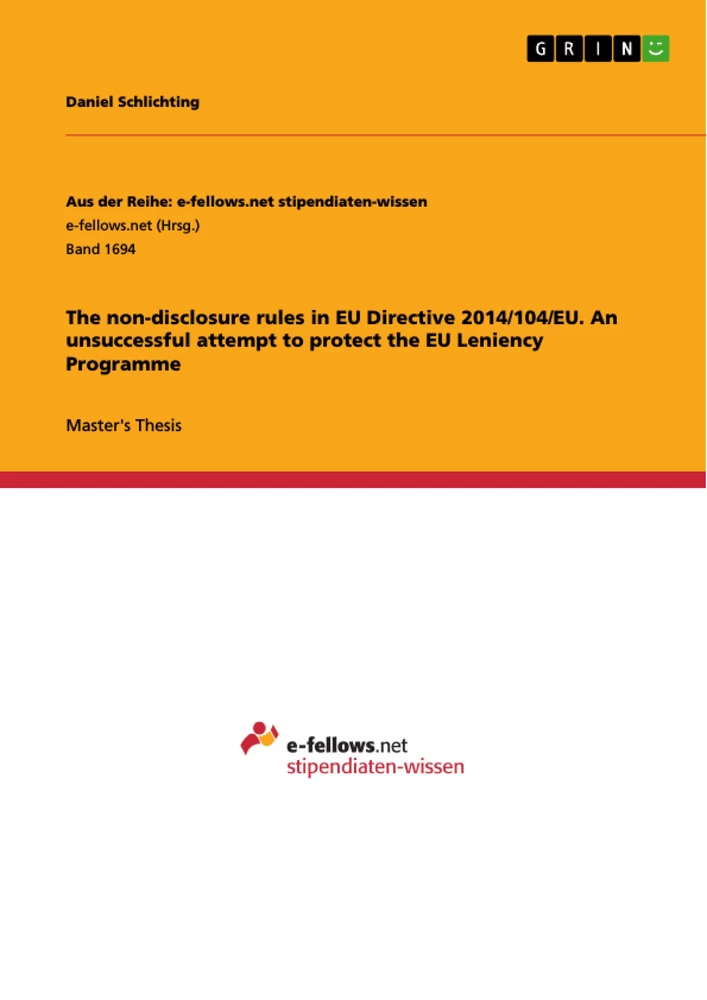
Table of Contents
I. The need to protect the leniency programme
II. Consistency of the Directive’s approach with primary EU Law
III. Desirability of non-disclosure rules
IV. Loopholes in the protection of leniency applicants
1. Access to files in possession of Commission through Transparency Regulation
2. Interrogating creator of leniency application
3. Access to drafts of oral leniency application
4. Access to EU leniency documents in the United States
V. The best way to protect the leniency programme
VI. Conclusion
Objectives and Themes
This work critically analyzes the non-disclosure rules established in EU Directive 2014/104/EU, specifically regarding their effectiveness in protecting the EU Leniency Programme while balancing the rights of private claimants in competition law damage actions. The research questions whether the directive's approach is consistent with primary EU law, assesses its desirability from a competition policy perspective, and identifies significant procedural loopholes that undermine its stated protective goals.
- The tension between public and private enforcement of EU competition law.
- Consistency of Article 6(6)(a) of the Damages Directive with ECJ jurisprudence (Pfleiderer, Donau Chemie).
- Procedural loopholes regarding access to files, witness interrogation, and drafting documents.
- The impact of international discovery regimes, particularly in the United States, on EU leniency protection.
- Alternative strategies for protecting leniency programmes through liability limitation.
Excerpt from the Book
IV. Loopholes in the protection of leniency applicants
Art 6 (6) (a) in particular and the new provisions of the Damages Directive in general intend to provide potential leniency applicants with higher security, yet they do not succeed. While a damage claimant will not successfully gain access to the Commission’s file through the Transparency Regulation there are several other gaps which are not closed by Directive 2014/104/EU or the amendment of Regulation 773/2004.
1. Access to files in possession of Commission through Transparency Regulation
Access to the leniency documents directly from the European Commission through Regulation (EC) No 1049/2001 (“Transparency Regulation”) is not possible. Although Gussone and Schreiber state that Art 6 (6) opposes the transparency regulation, since absolute protection of documents is not foreseen by the Transparency Regulation and cannot be introduced by the directive, it is possible to introduce such a protection through Regulation 773/2004 according to EnBW.
Chapter Summaries
I. The need to protect the leniency programme: Discusses the inherent tension between private damage claims and the effectiveness of leniency programmes, arguing that legal uncertainty discourages potential applicants.
II. Consistency of the Directive’s approach with primary EU Law: Analyzes whether the Directive's rigid non-disclosure provisions violate the principle of effectiveness and conflict with established ECJ case law such as Pfleiderer and Donau Chemie.
III. Desirability of non-disclosure rules: Evaluates whether overvaluing public enforcement at the expense of private compensatory mechanisms is policy-desirable, concluding that a more balanced approach is needed.
IV. Loopholes in the protection of leniency applicants: Identifies and examines specific gaps, including transparency regulations, witness interrogations, access to drafts, and challenges posed by discovery in the United States.
V. The best way to protect the leniency programme: Proposes an alternative strategy of immunizing immunity recipients from civil liability, coupled with full disclosure of evidence, to better serve both public and private enforcement.
VI. Conclusion: Summarizes the findings that the current Directive is insufficient and potentially unlawful, advocating for an amendment to establish a more effective 'beneficial-circle' for enforcement.
Keywords
EU Leniency Programme, Damages Directive, Private Enforcement, Public Enforcement, Non-disclosure rules, Article 6(6)(a), ECJ, Pfleiderer, Donau Chemie, Principle of effectiveness, Disclosure of evidence, Competition Law, Antitrust, Cartel damages, Legal uncertainty.
Frequently Asked Questions
What is the primary focus of this work?
The work focuses on the non-disclosure rules found in EU Directive 2014/104/EU and their impact on the effectiveness of the EU Leniency Programme in the context of private damage actions.
What are the central themes discussed?
Key themes include the balance between public and private enforcement, the consistency of secondary EU legislation with primary law, and the procedural risks that leniency applicants face despite the new directive.
What is the main research question or goal?
The primary goal is to demonstrate that the Directive's current approach to protecting leniency applicants is flawed, inconsistent with ECJ rulings, and fails to close critical loopholes that leave applicants vulnerable.
Which scientific methods are employed?
The author employs a legal-dogmatic analysis, examining directives and regulations, alongside a review of relevant ECJ case law and comparative legal perspectives (e.g., US discovery rules, German and UK procedural laws).
What does the main body cover?
It covers the legal need for leniency protection, the consistency of the Directive with EU case law, the desirability of such rules, and an in-depth analysis of loopholes like file access and witness interrogation.
Which keywords characterize this work?
The work is characterized by terms such as EU Leniency Programme, Damages Directive, private enforcement, non-disclosure, principle of effectiveness, and cartel damages.
Does the Directive effectively protect leniency applicants?
The author argues that the Directive does not protect applicants effectively, as it creates a false sense of security while leaving numerous gaps that allow claimants to obtain evidence.
What alternative solution is proposed by the author?
The author proposes a regime that immunizes immunity recipients from civil damage claims while permitting full disclosure of leniency documents, thereby creating a 'beneficial-circle' of incentives.
Ende der Leseprobe aus 47 Seiten
- nach oben
- Arbeit zitieren
- Daniel Schlichting (Autor:in), 2015, The non-disclosure rules in EU Directive 2014/104/EU. An unsuccessful attempt to protect the EU Leniency Programme, München, Page::Imprint:: GRINVerlagOHG, https://www.diplomarbeiten24.de/document/313745

neugierig - aktuell - relevant
Entdecken Sie hilfreiche Tipps und Tricks rund ums Studium!

Entdecken Sie hilfreiche Tipps und Tricks rund ums Studium!
Ihre Hausarbeit / Abschlussarbeit:

- - Publikation als E-Book und Buch
- - Hohes Honorar auf die Verkäufe
- - Für Sie komplett kostenlos - mit ISBN
- - Es dauert nur 5 Minuten
- - Jede Arbeit findet Leser

- © GRIN Publishing GmbH.
- Alle Inhalte urheberrechtlich geschützt. Kopieren und verbreiten untersagt.
- info@grin.com
- AGB
- Open Publishing
Der GRIN Verlag hat sich seit 1998 auf die Veröffentlichung akademischer eBooks und Bücher spezialisiert. Der GRIN Verlag steht damit als erstes Unternehmen für User Generated Quality Content. Die Verlagsseiten GRIN.com, Hausarbeiten.de und Diplomarbeiten24 bieten für Hochschullehrer, Absolventen und Studenten die ideale Plattform, wissenschaftliche Texte wie Hausarbeiten, Referate, Bachelorarbeiten, Masterarbeiten, Diplomarbeiten, Dissertationen und wissenschaftliche Aufsätze einem breiten Publikum zu präsentieren.
Kostenfreie Veröffentlichung: Hausarbeit, Bachelorarbeit, Diplomarbeit, Dissertation, Masterarbeit, Interpretation oder Referat jetzt veröffentlichen!
Folgen Sie GRIN auf


- GRIN Verlag GmbH
-
- Nymphenburger Str. 86
- 80636
- Munich, Deutschland
- +49 89-550559-0
- +49 89-550559-10
- info@grin.com
-
