
präsentiert von

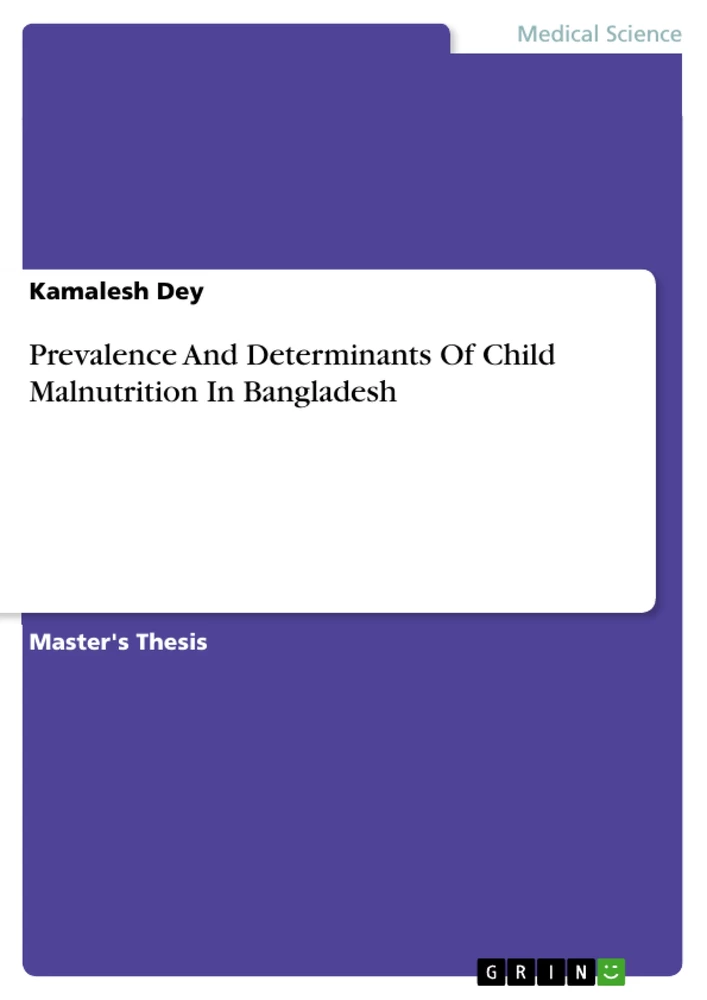
Table of Contents
1. INTRODUCTION
1.1 INTRODUCTION
1.2 BACKGROUND
1.3 RATIONALE
1.4 RESEARCH QUESTION
1.5 AIM AND OBJECTIVES
2. LITERATURE REVIEW
2.1 BACKGROUND
2.2 REVIEW OF THE LITERATURE METHODOLOGY
2.2.1 Keywords
2.3 REVIEW OF THE LITERATURE
2.3.1 Research Question
2.3.2 Rationale of the Study
2.4 MALNUTRITION AND CHILD MALNUTRITION
2.5 MEASUREMENT OF CHILD MALNUTRITION
2.6 PREVALENCE OF CHILD MALNUTRITION
2.7 DETERMINANTS OF CHILD MALNUTRITION
2.7.1 Demographic Factors
2.7.2 Low Birth Weight
2.7.3 Lack of Postnatal Care
2.7.4 Socio-economic Factors
2.7.5 Poverty
2.7.6 Occupation
2.7.7 Education
2.7.8 Food Insecurity
2.7.9 Environmental Factors
2.7.10 Poor Housing
2.7.11 Parental Smoking
2.7.12 Dietary Factors
2.7.13 Poor Practice of Exclusive Breastfeeding
2.7.14 Poor Feeding Practices
2.7.15 Micronutrient Deficiency
2.7.16 Immunisation Factors
2.7.17 Presence of Chronic Disease
2.8 IMPACT OF CHILD MALNUTRITION
2.8.1 Physical Consequences of Child Malnutrition
2.8.2 Economic Implications of Child Malnutrition
2.9 PROMOTIONAL STRATEGY
2.9.1 Public health nutrition program under MOHFW
2.9.2 The Bangladesh Integrated Nutrition Programme (BINP)
2.10 PREVENTATIVE STRATEGY
2.10.1 Vitamin-A Supplementation Programme
2.11 MANAGEMENT STRATEGY
3. RESEARCH METHODOLOGY
3.1 BACKGROUND
3.2 FRAMING RESEARCH (REVIEW) QUESTION
3.3 RESEARCH DESIGN/APPROACH
3.3.1 Inclusion and Exclusion Criteria
3.4 INCLUSION AND EXCLUSION CRITERIA
3.5 SEARCH STRATEGY
3.5.1 Boolean Operators
3.5.2 Database
3.6 SCREENING STRATEGY
3.6.1 Title and Abstract Screening
3.6.2 Full Manuscript Screening
3.7 RESULT FROM SEARCH
3.8 DATA EXTRACTION
3.9 DATA SYSTHESIS
3.10 ETHICAL APPROVAL
3.11 FUNDING
3.12 QUALITY APPRAISAL
4. RESULTS
4.1 RESULT OF THE SEARCH
4.2 FINDINGS OF THE STUDY
4.3 SUMMARY OF THE SELECTED EIGHT STUDIES
4.4 SYNTHESIS OF THE SELECTED STUDIES
4.5 QUALITY ASSESSMENT
5. DISCUSSION
5.1 DISCUSSION OF THE REVIEW STUDY
5.2 STRENGTHS OF THE STUDY
5.3 LIMITATIONS OF THE STUDY
5.3.1 Timeline
5.3.2 Availability of Data
5.3.3 Quality
5.3.4 Validation of the Used Data
5.3.5 Data Analysis
5.3.6 Research Question
5.3.7 Study Design
5.3.8 Study Area
5.4 IMPLICATIONS OF THE STUDY FOR POLICY AND PRACTICE
5.5 DISSEMINATION
6. CONCLUSION
6.1 CONCLUSION
6.2 COMMENDATION FOR FUTURE RESEARCH
6.3 REFLECTIVE THOUGHTS ABOUT THE STUDY
6.4 FINAL THOUGHTS
Research Goals and Themes
The primary aim of this dissertation is to systematically review existing literature to determine the prevalence and key determinants of child malnutrition in Bangladesh. The research seeks to identify evidence-based associations between nutritional status and socio-demographic, economic, and environmental factors to provide recommendations for strengthening national nutrition policies and intervention strategies.
- Prevalence of undernutrition, stunting, and wasting among children in Bangladesh.
- Socio-economic determinants including poverty, parental education, and occupation.
- The impact of dietary practices, such as exclusive breastfeeding and complementary feeding.
- Environmental and health-related factors, including sanitation, infectious diseases, and food insecurity.
- Evaluation of nutritional intervention programs and policy recommendations.
Excerpt from the Book
2.4 MALNUTRITION AND CHILD MALNUTRITION
Malnutrition refers to the severe condition caused by consumption of inadequate food containing poor nutrients (NHS, 2014). According to World Food Program (WFP) (2014), malnutrition is just around the corner of any children, when she or he is not eating adequate food or not getting the sufficient nutrition from food. Ultimately, child malnutrition retards physical and mental growth in their childhood (WFP, 2014). Moreover, Rabbi and Karmaker (2014) defined that malnutrition is such a condition commenced through the lack of balanced diet consumption that contain low nutrient or disproportion of various nutrients. Besides, Malnutrition is the complex term of both under nutrition and over nutrition. Under nutrition includes underweight, stunted, wasting, protein energy malnutrition (Kwashiorkor, marasmus, and marasmus kwashiorkor), and micronutrients deficiency (VADD, IDD, IDA) (Ahmed et al., 2012). Moreover, Katsilambros et al. (2011) stated that malnutrition is the unusual condition and caused by bad or faulty nutrition known as under-nutrition.
World Health Organisation (WHO) (2015) defined that “malnutrition is the cellular disproportion between supply of nutrients and energy and the body’s demand for them to ensure growth, maintenance and specific function and greatest risk factors for illness and death worldwide.” Moreover, Malnutrition is general term of physical condition, which denotes the lack of nourishment or inadequate intake of food, and ultimately loss of body weight. Besides, Best (2008) defined that malnutrition might normally appeared after consumption of insufficient accessibility of nutrient due to poor consumption of food in developing countries, while in developed countries, malnutrition is the cumulative results of various diseases. UNICEF (2009) reported that malnutrition is a comprehensive word and usually used as substitute word ‘under-nutrition’ but technically, it means over-nutrition. Furthermore, Ge and Chang, (2001) stated that deficiency diseases due to insufficient and lack of particular nutrients including vitamins and minerals.
Summary of Chapters
INTRODUCTION: Provides an overview of the severe public health burden of child malnutrition in Bangladesh and outlines the research questions and objectives.
LITERATURE REVIEW: Examines existing research and conceptual frameworks related to the prevalence, causes, and impacts of childhood malnutrition in Bangladesh.
RESEARCH METHODOLOGY: Describes the systematic review protocol, search strategies, inclusion/exclusion criteria, and quality appraisal methods used for the study.
RESULTS: Presents the findings from the selected eight primary studies regarding the prevalence rates and risk factors associated with malnutrition.
DISCUSSION: Analyzes and interprets the synthesized data, highlighting the relationships between malnutrition and various socio-demographic factors, and discusses study strengths and limitations.
CONCLUSION: Summarizes the key findings and provides recommendations for future research and policy changes to effectively address the national burden of child malnutrition.
Keywords
Child malnutrition, under-nutrition, protein energy malnutrition, stunting, wasting, underweight, obesity, overweight, prevalence, determinants, risk factors, Bangladesh, public health, dietary practices, systemic review.
Frequently Asked Questions
What is the core focus of this research paper?
The paper performs a systematic review to analyze the current prevalence and the fundamental determinants of child malnutrition in Bangladesh.
Which specific factors are identified as determinants of malnutrition?
The research identifies poverty, parental education, occupation, food insecurity, lack of exclusive breastfeeding, poor sanitation, and the prevalence of infectious diseases as key risk factors.
What is the main research question?
The study aims to answer: "What are the prevalence and determinants of child malnutrition in Bangladesh?"
What methodology does the author employ?
The author employs a systematic review protocol, using Boolean operators to search databases for relevant primary studies published between 1995 and 2015, followed by narrative synthesis and quality appraisal using the EPHPP tool.
What does the main body of the work cover?
It covers the definition and measurement of malnutrition, prevalence trends, socio-economic and demographic determinants, the physical and economic impact of malnutrition, and existing preventative strategies in Bangladesh.
Which keywords define this study?
Key terms include child malnutrition, stunting, wasting, Bangladesh, socio-economic factors, and public health.
How is the quality of the studies evaluated?
The author uses the Effective Public Health Practice Project (EPHPP) Quality Assessment Tool to grade the quality of the eight selected primary studies as low, moderate, or high.
What are the primary policy implications suggested by the author?
The author suggests that policymakers should prioritize community-based nutrition education, female literacy programs, and poverty reduction, and tailor interventions to the most vulnerable rural and slum regions.
How does the paper differentiate between rural and urban malnutrition?
The review notes that child malnutrition is generally more prevalent in rural and slum areas compared to urban settings, and emphasizes the influence of geographic and environmental factors on nutritional outcomes.
Ende der Leseprobe aus 96 Seiten
- nach oben
- Arbeit zitieren
- Kamalesh Dey (Autor:in), 2015, Prevalence And Determinants Of Child Malnutrition In Bangladesh, München, Page::Imprint:: GRINVerlagOHG, https://www.diplomarbeiten24.de/document/313915

neugierig - aktuell - relevant
Entdecken Sie hilfreiche Tipps und Tricks rund ums Studium!

Entdecken Sie hilfreiche Tipps und Tricks rund ums Studium!
Ihre Hausarbeit / Abschlussarbeit:

- - Publikation als E-Book und Buch
- - Hohes Honorar auf die Verkäufe
- - Für Sie komplett kostenlos - mit ISBN
- - Es dauert nur 5 Minuten
- - Jede Arbeit findet Leser

- © GRIN Publishing GmbH.
- Alle Inhalte urheberrechtlich geschützt. Kopieren und verbreiten untersagt.
- info@grin.com
- AGB
- Open Publishing
Der GRIN Verlag hat sich seit 1998 auf die Veröffentlichung akademischer eBooks und Bücher spezialisiert. Der GRIN Verlag steht damit als erstes Unternehmen für User Generated Quality Content. Die Verlagsseiten GRIN.com, Hausarbeiten.de und Diplomarbeiten24 bieten für Hochschullehrer, Absolventen und Studenten die ideale Plattform, wissenschaftliche Texte wie Hausarbeiten, Referate, Bachelorarbeiten, Masterarbeiten, Diplomarbeiten, Dissertationen und wissenschaftliche Aufsätze einem breiten Publikum zu präsentieren.
Kostenfreie Veröffentlichung: Hausarbeit, Bachelorarbeit, Diplomarbeit, Dissertation, Masterarbeit, Interpretation oder Referat jetzt veröffentlichen!
Folgen Sie GRIN auf


- GRIN Verlag GmbH
-
- Nymphenburger Str. 86
- 80636
- Munich, Deutschland
- +49 89-550559-0
- +49 89-550559-10
- info@grin.com
-
