
präsentiert von

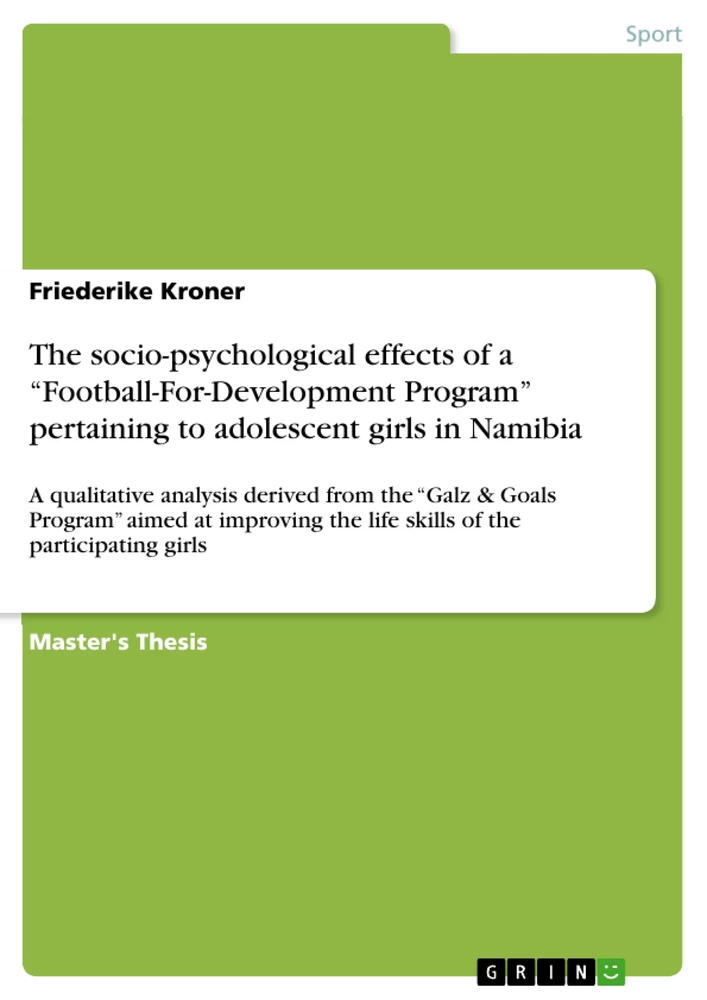
Table of Content
1 Introduction
1.1 Relevance and Research Problem
1.2 Purpose Statement and Research Questions
1.3 Theoretical Foundation and Structure
2 Theoretical Framework
2.1 Defining Personal Life Skills
2.2 Framework of Fostering Psychosocial Development
2.3 Model of Coaching Life Skills through Sport
3 Literature Review
3.1 Life Skills
3.2 Contextual Background
3.2.1 Football & Development
3.2.1.1 State of Research of Football for Development in Sub-Saharan Africa
3.2.1.2 The Relevance of Sport and Football in Namibia
3.2.2 Combating HIV/ AIDS & Development Programs
3.2.2.1 State of Research of HIV/ AIDS & Development Programs in Sub-Saharan Africa
3.2.2.2 The Situation of HIV/ AIDS in Namibia
3.2.3 Gender Equality & Sport
3.2.3.1 State of Research of Gender Equality & Sport in Sub-Saharan Africa
3.2.3.2 The Role of Girls and Women in Namibia
3.3 The Galz & Goals Program
4 Theoretical Application
5 Methodology
5.1 Research Design
5.2 Sampling
5.3 Development of the Interview Guideline
5.4 Data Collection
5.4.1 Conduction of interviews
5.4.2 Transcription
5.5 Data Analysis
5.5.1 MAXQDA
5.5.2 Defining categories
5.5.3 Qualitative content analysis
6 Findings
6.1 Experiences & Attitudes
6.1.1 Experiences through football and Galz & Goals
6.1.1.1 Positive experiences
6.1.1.2 Negative experiences
6.1.2 Attitude toward football and Galz & Goals
6.1.2.1 Positive attitude toward football
6.1.2.2 Negative attitude toward football
6.1.3 Attitude toward life skills
6.1.3.1 Positive attitude toward life skills
6.1.3.2 Negative attitude toward life skills
6.2 Knowledge
6.2.1 Knowledge about life skills
6.2.1.1 Existing knowledge about life skills
6.2.1.2 No knowledge about life skills
6.2.2 Knowledge about health
6.2.2.1 Existing knowledge about health
6.2.2.2 No knowledge about health
6.3 Influences
6.3.1 Transfer of skills
6.3.1.1 Transferred football skills
6.3.1.2 Transferred life skills
6.3.1.3 No transfer of life skills
6.3.2 Changes
6.3.2.1 Significant changes
6.3.2.2 No changes
6.4 External assets
6.4.1 Coach
6.4.1.1 Strong coach relationship
6.4.1.2 Weak coach relationship
6.4.2 Family
6.4.2.1 Supportive family
6.4.2.2 Not supportive family
6.4.3 Team members
6.4.3.1 Team members as friends
6.4.3.2 Criticism of team members
7 Discussion
7.1 Empirical Relevance
7.1.1 Experiences
7.1.2 Attitude
7.1.3 Knowledge
7.1.4 Transfer
7.1.5 Change
7.2 Theoretical Relevance
8 Conclusion and Implications
8.1 Summary
8.2 Implications and Recommendations
8.3 Limitations and Further Research
Objectives and Topics
This thesis examines the socio-psychological effects of the "Galz & Goals" football-for-development program in Namibia, specifically focusing on its impact on the development of life skills in adolescent girls.
- Qualitative evaluation of the Galz & Goals program through semi-structured interviews with participants.
- Analysis of life skills development (e.g., communication, self-confidence, goal setting) fostered through football participation.
- Examination of external assets, such as the roles of coaches and family, in shaping psychosocial outcomes.
- Investigation into the transferability of learned life skills into non-sporting life domains, including school and community.
- Evaluation of the program's effectiveness as a tool for social and behavior change, including HIV/AIDS prevention awareness.
Auszug aus dem Buch
1.1 Relevance and Research Problem
For a long time sport has been recognized as a powerful medium for many social dimensions. The United Nations (UN) Secretary-General Kofi Annan appointed Adolf Ogi as his Special Adviser on Sport for Development and Peace in 2001 (Ogi, 2006a). Concurrently, the UN Office for Sport for Development and Peace (UNOSDP) was created, which both demonstrate the importance of sport in society and is an official recognition for the field of sport in development (Schulenkorf & Adair, 2014). Two years later, the UN has acknowledged sport as “a human right and an ideal learning ground for life’s essential skills” (UNOSDP, SADC, & Swiss Federal Office of Sport, 2003, p. 1) through its Magglingen declaration. Among other things, it is recommended to combine sport with the fields of health, gender equity and education to fulfill the Millennium Development Goals (MDGs) “by implementing sports-related development and peace promotion projects” (Ogi, 2006b, p. 2). Furthermore, the General Assembly of the UN adopted several resolutions under the title Sport as a means to promote education, health, development and peace (UN, 2004). In the course of this, resolution 58/5 announced 2005 as the International Year of Sport and Physical Education (IYSPE) to “focus the world’s attention on the importance of sport in society” (UN, 2004) and to encourage governments and sport-related organizations to implement sport-based development projects. The World Health Organization (WHO) as well as the International Labour Organization (ILO) are also supporters of sport in the context of socio-economic development (di Cola, 2006; WHO, 2010).
Summary of Chapters
1 Introduction: Introduces the research topic, the relevance of sport-for-development, the program case study "Galz & Goals", and the thesis structure.
2 Theoretical Framework: Provides the scientific foundation by defining life skills and presenting frameworks for psychosocial development and coaching through sport.
3 Literature Review: Summarizes the state of research regarding life skills in sport, the context of Namibia, and specific themes like HIV/AIDS and gender equality.
4 Theoretical Application: Integrates theoretical models to visualize the relationships between external assets, program context, and desired life skills outcomes.
5 Methodology: Details the qualitative research design, the selection and sampling of participants, interview procedures, and the process of data analysis using MAXQDA.
6 Findings: Presents and discusses the analyzed data categorized into experiences/attitudes, knowledge, influences/transfer, and external assets.
7 Discussion: Critically evaluates the empirical findings against the research questions and theoretical models, highlighting outcomes and transferability.
8 Conclusion and Implications: Synthesizes the main results, offers recommendations for the program's improvement, and discusses research limitations and future study potential.
Keywords
Galz & Goals, Football for Development, Life Skills, Adolescent Girls, Namibia, Sport Psychology, Psychosocial Development, Qualitative Content Analysis, HIV/AIDS Prevention, Gender Equality, Sport-in-Development, Empowerment, Coaching, Youth Development, Social Change
Frequently Asked Questions
What is the core focus of this research?
The work investigates the socio-psychological effects of the "Galz & Goals" football-for-development program on adolescent girls in Namibia, analyzing how it contributes to their personal development and acquisition of life skills.
What are the central topics explored in the thesis?
The central topics include life skills education through sport, the impact of the program on girls' attitudes and health knowledge, the role of external assets like coaches and families, and the transfer of skills from the football field to daily life.
What is the primary research goal?
The primary goal is to evaluate the program's effectiveness in fostering life skills and to fill a research gap regarding qualitative outcome evaluations of sport-for-development initiatives in Africa.
Which methodology is employed in the study?
The researcher uses a qualitative research design, primarily conducting six semi-structured, face-to-face interviews with program participants, followed by a qualitative content analysis using the software MAXQDA.
What does the main body of the work cover?
The main body establishes a theoretical framework, reviews existing literature on sport and development, applies these theories to the specific case of Galz & Goals, outlines the methodology, and presents the findings regarding experiences, knowledge, influences, and external assets.
Which keywords characterize this thesis?
Key terms include Football for Development, Galz & Goals, Life Skills, Psychosocial Development, Qualitative Analysis, Empowerment, and Namibia.
How does the program specifically impact the participants' daily lives according to the findings?
Participants reported that the program provides structure, keeps them away from negative environments (e.g., alcohol, street life), promotes educational focus, and helps develop confidence, discipline, and emotional management.
What specific challenges do the participants report within the Galz & Goals program?
Challenges identified by the girls include insufficient equipment and field facilities, transportation issues, safety concerns when traveling, and occasional difficulties in understanding or relating to theoretical life skills content.
Ende der Leseprobe aus 157 Seiten
- nach oben
- Arbeit zitieren
- Master of Science Friederike Kroner (Autor:in), 2015, The socio-psychological effects of a “Football-For-Development Program” pertaining to adolescent girls in Namibia, München, Page::Imprint:: GRINVerlagOHG, https://www.diplomarbeiten24.de/document/316115

neugierig - aktuell - relevant
Entdecken Sie hilfreiche Tipps und Tricks rund ums Studium!

Entdecken Sie hilfreiche Tipps und Tricks rund ums Studium!
Ihre Hausarbeit / Abschlussarbeit:

- - Publikation als E-Book und Buch
- - Hohes Honorar auf die Verkäufe
- - Für Sie komplett kostenlos - mit ISBN
- - Es dauert nur 5 Minuten
- - Jede Arbeit findet Leser

- © GRIN Publishing GmbH.
- Alle Inhalte urheberrechtlich geschützt. Kopieren und verbreiten untersagt.
- info@grin.com
- AGB
- Open Publishing
Der GRIN Verlag hat sich seit 1998 auf die Veröffentlichung akademischer eBooks und Bücher spezialisiert. Der GRIN Verlag steht damit als erstes Unternehmen für User Generated Quality Content. Die Verlagsseiten GRIN.com, Hausarbeiten.de und Diplomarbeiten24 bieten für Hochschullehrer, Absolventen und Studenten die ideale Plattform, wissenschaftliche Texte wie Hausarbeiten, Referate, Bachelorarbeiten, Masterarbeiten, Diplomarbeiten, Dissertationen und wissenschaftliche Aufsätze einem breiten Publikum zu präsentieren.
Kostenfreie Veröffentlichung: Hausarbeit, Bachelorarbeit, Diplomarbeit, Dissertation, Masterarbeit, Interpretation oder Referat jetzt veröffentlichen!
Folgen Sie GRIN auf


- GRIN Verlag GmbH
-
- Nymphenburger Str. 86
- 80636
- Munich, Deutschland
- +49 89-550559-0
- +49 89-550559-10
- info@grin.com
-
