
präsentiert von

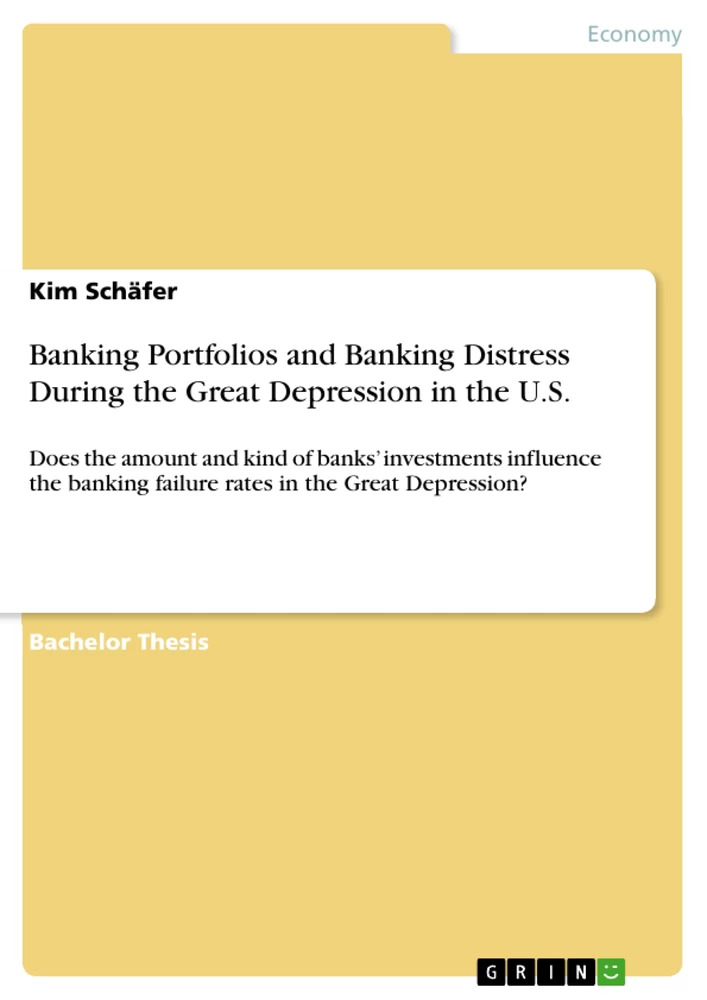
Table of Contents
1. Introduction
Literature Review
2. The American Banking System and Its Importance
3. The Financial Crisis
4. Value at Risk
Empirical Part
5. Dataset
6. Study
7. Conclusion
Research Objectives and Focus
This thesis examines the U.S. banking system during the Great Depression to determine whether banking failure rates could have been predicted through an analysis of bank balance sheets and market risk metrics. It specifically investigates the relationship between portfolio composition, Value at Risk (VaR), and systemic banking distress.
- The structure and vulnerability of the American banking system in 1929.
- Theoretical and empirical causes of bank failures during the Great Depression.
- Application of Value at Risk (VaR) as a tool for managing market risk in a historical context.
- Quantitative analysis of state-level banking failure rates relative to investment asset types.
Excerpt from the Book
3. 1 Banking Panics and Bank Runs
The definition of banking panics is mostly imprecise since a lot of researchers equalize banking panics with banking failures. There are no explicit definitions provided and therefore different happenings of the United States’ history are assigned to banking panics.
In this paper banking panics are seen as an exogenous shock caused by bank runs. They occur when a huge amount of debt holders suddenly demand cash for their debt claims. In order to talk about banking panics the demand for redemption must be to a certain extent, so that banks either cannot disburse cash anymore or have to “act collectively to avoid suspension of convertibility by issuing clearing-house loan certificates” (Calomiris & Gorton, 1991). This definition requires several additions. If depositors of only one bank demand to redeem debt for cash and the bank will result in illiquidity it will be called a bank run. For a banking panic several banks need to be involved. Even the depositor’s desires for cash need emerge suddenly as well as the volume of withdraws need to be large enough. Otherwise banks would find a different way to convert debt claims into currency. A lack of confidence in the American banking system is the main trigger leading to banking panics, which caused the Great Depression according to Friedman and Schwartz (1963).
There are two different theories explaining why debt holders want banks to substitute their debt claims into cash at a single blow, more precisely what the origins of banking panics are. For a better understanding a panic is defined as “an excessive or unreasoning feeling of alarm or fear leading to extravagant or foolish behaviour, such as that which may suddenly spread through a crowd of people” (New Shorter Oxford Dictionary, 2002). Compared to single banking failures or suspensions, a banking panic is mostly related to fear and a loss of depositor’s confidence in financial institutions (Wicker, 1996).
Summary of Chapters
1. Introduction: Outlines the economic context of the 1920s and the onset of the Great Depression, establishing the research goal of identifying predictors for banking failures.
2. The American Banking System and Its Importance: Describes the unit-banking structure of the U.S. in 1929 and the regulatory environment that influenced bank vulnerability.
3. The Financial Crisis: Analyzes various historical theories—including demand-driven and monetary approaches—regarding the causes of the Great Depression and banking panics.
4. Value at Risk: Defines VaR as a statistical risk management tool and explains its evolution in the context of the Basel Accords.
5. Dataset: Details the primary data sources used for the study, focusing on commercial bank balance sheets and banking suspension statistics at the state level.
6. Study: Presents the empirical methodology and results, testing the correlation between bank asset composition, VaR, and actual failure rates across 20 U.S. states.
7. Conclusion: Summarizes the findings, noting that while investments influenced bank outcomes, the high failure rates were not easily predictable solely through balance sheet metrics in 1929.
Keywords
Great Depression, Banking Failure, Bank Runs, Value at Risk, VaR, Financial Crisis, Monetary Policy, U.S. Banking System, Asset Portfolio, Illiquidity, Insolvency, Bank Regulation, Economic History, Financial Risk, Regression Analysis
Frequently Asked Questions
What is the primary subject of this research?
This thesis examines the financial stability of U.S. commercial banks during the Great Depression, specifically focusing on the relationship between banking portfolios and the high frequency of banking failures.
What are the key thematic areas covered?
The study covers the structure of the American banking system, the history of financial panics, the application of risk management techniques (VaR), and empirical testing of bank failure determinants.
What is the research objective of the study?
The main objective is to determine if it would have been possible to forecast banking failures during the Great Depression by analyzing bank balance sheets and investment portfolios before the crisis started.
Which scientific methodology is applied?
The research uses a quantitative empirical approach, applying a variance-covariance Value at Risk (VaR) model combined with linear regression analysis to evaluate state-level banking data.
What does the main body of the work address?
The main body reviews existing literature on financial crises, explains the methodology for calculating VaR on bank assets, and details an empirical study that correlates bank asset types with failure rates.
Which keywords characterize this work?
Key terms include Great Depression, Banking Failure, Value at Risk, Financial Crisis, and U.S. Banking System.
How is the "Value at Risk" metric specifically used in this paper?
VaR is used to quantify the potential maximum loss of different asset types (such as real estate loans and government obligations) to see if portfolios with higher risk profiles correlated with higher state-level bank failure rates.
What is the author's conclusion regarding predictability?
The author concludes that it was not possible to reliably forecast the high banking failure rates solely based on balance sheet information and equity decline in 1929, as the correlation between these variables was found to be very weak.
Ende der Leseprobe aus 49 Seiten
- nach oben
- Arbeit zitieren
- Kim Schäfer (Autor:in), 2015, Banking Portfolios and Banking Distress During the Great Depression in the U.S., München, Page::Imprint:: GRINVerlagOHG, https://www.diplomarbeiten24.de/document/316740

neugierig - aktuell - relevant
Entdecken Sie hilfreiche Tipps und Tricks rund ums Studium!

Entdecken Sie hilfreiche Tipps und Tricks rund ums Studium!
Ihre Hausarbeit / Abschlussarbeit:

- - Publikation als E-Book und Buch
- - Hohes Honorar auf die Verkäufe
- - Für Sie komplett kostenlos - mit ISBN
- - Es dauert nur 5 Minuten
- - Jede Arbeit findet Leser

- © GRIN Publishing GmbH.
- Alle Inhalte urheberrechtlich geschützt. Kopieren und verbreiten untersagt.
- info@grin.com
- AGB
- Open Publishing
Der GRIN Verlag hat sich seit 1998 auf die Veröffentlichung akademischer eBooks und Bücher spezialisiert. Der GRIN Verlag steht damit als erstes Unternehmen für User Generated Quality Content. Die Verlagsseiten GRIN.com, Hausarbeiten.de und Diplomarbeiten24 bieten für Hochschullehrer, Absolventen und Studenten die ideale Plattform, wissenschaftliche Texte wie Hausarbeiten, Referate, Bachelorarbeiten, Masterarbeiten, Diplomarbeiten, Dissertationen und wissenschaftliche Aufsätze einem breiten Publikum zu präsentieren.
Kostenfreie Veröffentlichung: Hausarbeit, Bachelorarbeit, Diplomarbeit, Dissertation, Masterarbeit, Interpretation oder Referat jetzt veröffentlichen!
Folgen Sie GRIN auf


- GRIN Verlag GmbH
-
- Nymphenburger Str. 86
- 80636
- Munich, Deutschland
- +49 89-550559-0
- +49 89-550559-10
- info@grin.com
-
