
präsentiert von

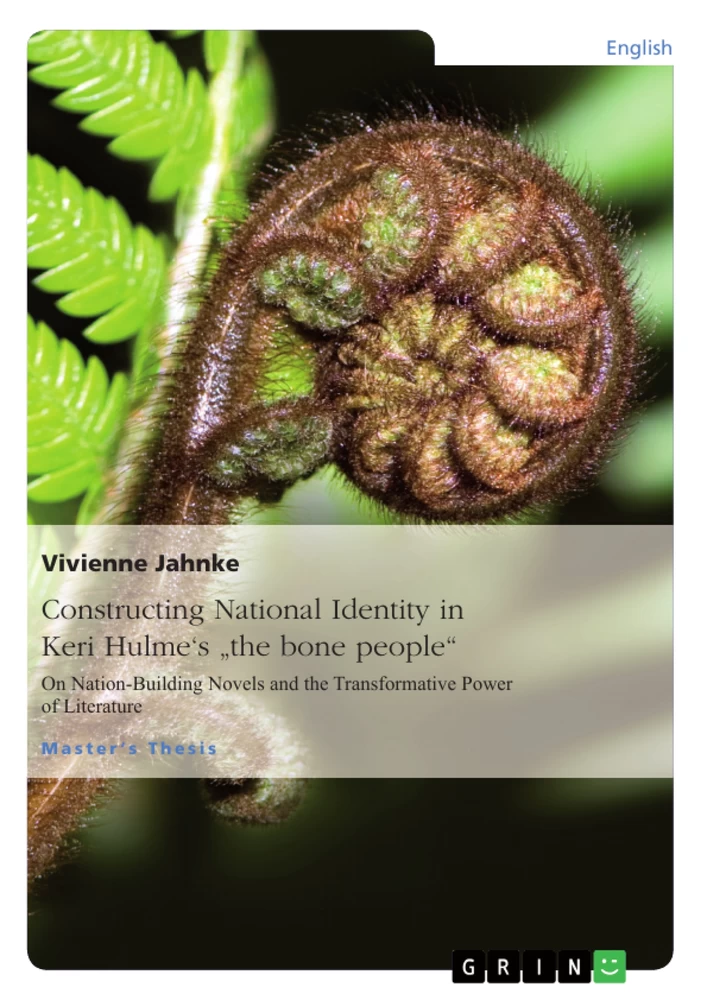
Table of Contents
I. Introduction
II. Expressing Concepts of Identity and National Identity in Postcolonial Discourse
III. Construction of National Identity in the bone people
a. Creating Controversy
b. Deconstructing New Zealand
c. Constructing Aotearoa
IV. Thirty Years Later – Placement within the New Zealand Literary Canon
a. the bone people and Witi Ihimaera’s Whanau and Whanau II
b. the bone people and Patricia Grace’s Potiki
c. the bone people and Alan Duff’s Once Were Warriors
d. the bone people and Eleanor Catton’s The Luminaries
V. Conclusion
Research Objectives and Themes
This thesis investigates Keri Hulme’s writing strategies in her novel the bone people, focusing on how she addresses postcolonial identity crises and nation-building in New Zealand. By analyzing the narrative structure and the representation of hybrid identity, the work explores whether the novel’s vision of a bicultural, inclusive society remains relevant in contemporary New Zealand.
- Postcolonial discourse and the deconstruction of binary cultural oppositions.
- The role of literature in negotiating national identity and myth-making.
- Literary representations of Maori and Pakeha hybridity and Maoritanga.
- Comparative analysis with other contemporary New Zealand literary works.
- Evaluation of the evolution of New Zealand’s societal development since the 1980s.
Excerpt from the Book
Deconstructing New Zealand
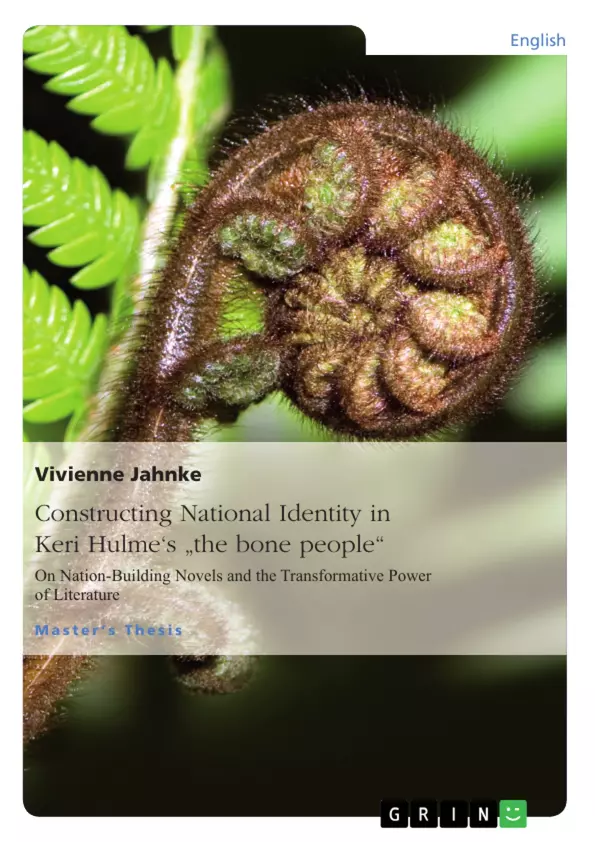
The bone people is a novel which consists of four main parts, each separated into three smaller parts again and the whole enclosed by a Pro- and Epilogue, both of which are set at the end of the story. Hulme rejects the notion that, because in her novel the end equals the beginning (545), the novel’s structure is circular. Instead, for Hulme, the novel moves in a spiral fashion, not only in form but also as the characters move towards, away from and then again towards each other. This double spiral image is crucial to her message. She states that for her a circle is inherently closed, “final.” But in a double spirals it is possible to “keep on going and going forever”, escaping the point of origin while remaining within the structure. Therefore, it is the double spiral structure of her novel that helps her characters to grow and change (Smith, “Constructing the Author” 33), without being able to fully let go of their past (Webby 19). It stays a part of their lives. Kerewin also describes the double spiral as “an old symbol of rebirth, and the outward-inward nature of things” (56), which plays a major role in the narrative of the novel.
Summary of Chapters
I. Introduction: Outlines the significance of Keri Hulme’s the bone people within the context of New Zealand's postcolonial literary landscape and introduces the research focus.
II. Expressing Concepts of Identity and National Identity in Postcolonial Discourse: Explores theoretical frameworks of postcolonial identity, binary oppositions, and the role of literature in creating national narratives.
III. Construction of National Identity in the bone people: Analyzes the novel’s reception, the structural use of the double spiral, and how Hulme employs language and characters to challenge normative colonial hierarchies.
IV. Thirty Years Later – Placement within the New Zealand Literary Canon: Provides a comparative analysis between the bone people and works by Witi Ihimaera, Patricia Grace, Alan Duff, and Eleanor Catton.
V. Conclusion: Reflects on the enduring relevance of the novel's vision and assesses the current state of biculturalism in New Zealand.
Keywords
Postcolonialism, New Zealand literature, Keri Hulme, the bone people, national identity, Maoritanga, Pakeha, biculturalism, hybridity, nation-building, Maori, social realism, magical realism, literary canon, identity construction.
Frequently Asked Questions
What is the primary subject of this research?
This research focuses on Keri Hulme's 1983 novel the bone people, examining its significance as a postcolonial work that attempts to redefine New Zealand national identity.
What are the central thematic fields?
The work covers themes of postcolonialism, biculturalism, the intersection of Maori and Pakeha cultures, and the role of literature in social change.
What is the core research question?
The thesis asks whether Hulme's novel succeeds in its nation-building project and if its vision of an inclusive, hybrid society remains pertinent to 21st-century New Zealand.
Which methodology is employed?
The author uses a postcolonial lens and a comparative literary analysis, contrasting Hulme’s strategies with those of other significant New Zealand writers.
What does the main body analyze?
The main body examines the novel’s reception, its narrative structure, the characters' hybrid identities, and the representation of spirituality versus social realism.
Which keywords best characterize the work?
Key concepts include postcolonialism, Maoritanga, hybridity, nation-building, and the specific literary modes of realism and magical realism used by the author.
How does the novel handle the depiction of domestic violence?
The research argues that Hulme uses realistic, unflinching depictions of violence to address social ills and systemic issues within New Zealand society, rather than using these scenes for mere shock value.
What is the significance of the "tricephalos" symbol?
The tricephalos (three-headed) figure symbolizes the interconnectedness of the three protagonists and their collective potential to function as progenitors of a new, unified New Zealand identity.
Does the author consider the novel a success in its bicultural mission?
The analysis suggests that while the novel provides a profound vision for change, the actual state of biculturalism in New Zealand remains a work in progress, often hindered by superficial political gestures.
Ende der Leseprobe aus 57 Seiten
- nach oben
- Arbeit zitieren
- Vivienne Jahnke (Autor:in), 2015, Constructing National Identity in Keri Hulme's "the bone people", München, Page::Imprint:: GRINVerlagOHG, https://www.diplomarbeiten24.de/document/317242

neugierig - aktuell - relevant
Entdecken Sie hilfreiche Tipps und Tricks rund ums Studium!

Entdecken Sie hilfreiche Tipps und Tricks rund ums Studium!
Ihre Hausarbeit / Abschlussarbeit:

- - Publikation als E-Book und Buch
- - Hohes Honorar auf die Verkäufe
- - Für Sie komplett kostenlos - mit ISBN
- - Es dauert nur 5 Minuten
- - Jede Arbeit findet Leser

- © GRIN Publishing GmbH.
- Alle Inhalte urheberrechtlich geschützt. Kopieren und verbreiten untersagt.
- info@grin.com
- AGB
- Open Publishing
Der GRIN Verlag hat sich seit 1998 auf die Veröffentlichung akademischer eBooks und Bücher spezialisiert. Der GRIN Verlag steht damit als erstes Unternehmen für User Generated Quality Content. Die Verlagsseiten GRIN.com, Hausarbeiten.de und Diplomarbeiten24 bieten für Hochschullehrer, Absolventen und Studenten die ideale Plattform, wissenschaftliche Texte wie Hausarbeiten, Referate, Bachelorarbeiten, Masterarbeiten, Diplomarbeiten, Dissertationen und wissenschaftliche Aufsätze einem breiten Publikum zu präsentieren.
Kostenfreie Veröffentlichung: Hausarbeit, Bachelorarbeit, Diplomarbeit, Dissertation, Masterarbeit, Interpretation oder Referat jetzt veröffentlichen!
Folgen Sie GRIN auf


- GRIN Verlag GmbH
-
- Nymphenburger Str. 86
- 80636
- Munich, Deutschland
- +49 89-550559-0
- +49 89-550559-10
- info@grin.com
-
