
präsentiert von

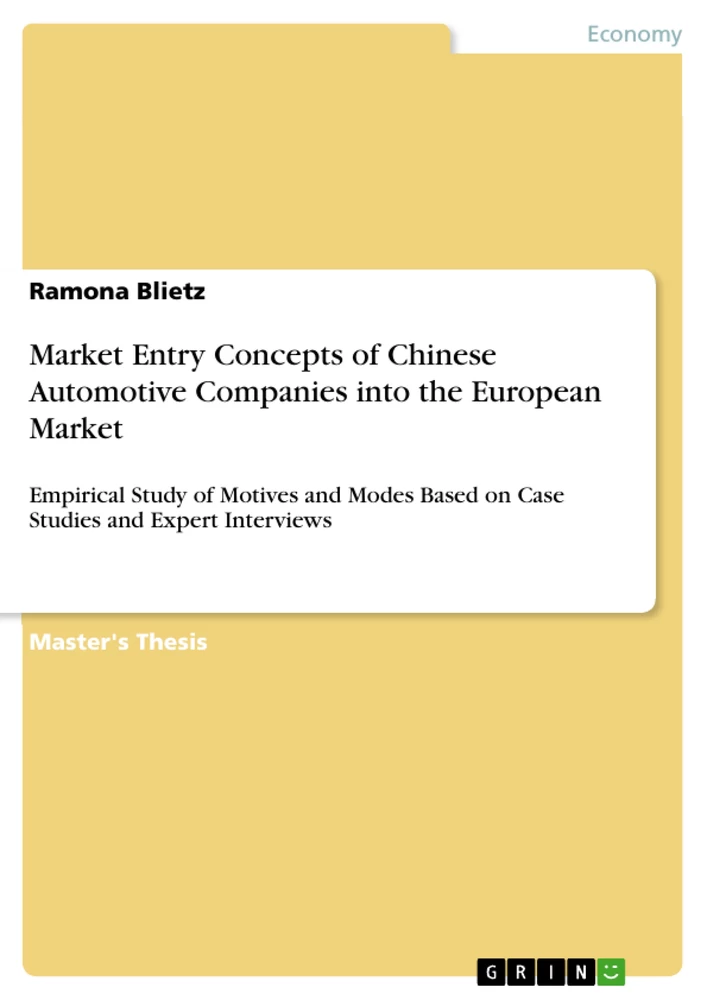
Table of Content
1. INTRODUCTION
2. LITERATURE REVIEW
2.1. Explanations of international activities
2.2. Competitive advantages according to Dunning’s OLI paradigm
2.3. Weaknesses and extensions of the eclectic paradigm
2.4. Internationalisation motives
2.5. Market entry modes
2.5.1. Exports
2.5.2. Foreign direct investment
3. METHODOLOGY
4. EMPIRICAL STUDY OF CHINESE AUTOMOTIVE COMPANIES’ INTERNATIONALISATION
4.1. Introduction to regions and industry dynamics
4.1.1. China
4.1.1.1. OFDI development and motives
4.1.1.2. Preconditions on home market
4.1.1.3. Domestic automotive industry
4.1.2. Europe
4.2. Company case studies of BYD, Geely and SAIC
4.2.1. Competitive advantages of Chinese automotive companies
4.2.2. Reasons of Chinese automotive companies to venture abroad
4.2.3. Dominant market entry modes
4.2.3.1. Exports
4.2.3.2. Foreign direct investment
4.2.4. Obstacles and entry barriers
4.3. Conclusion
Research Objectives and Thematic Focus
This thesis examines the internationalisation strategies of Chinese automotive companies as they attempt to enter the European market, utilizing Dunning’s eclectic paradigm to analyse their motives and market entry modes. It investigates why these companies have struggled to establish a significant presence in Europe and explores whether they can overcome technological and branding deficiencies to become competitive global players.
- Analysis of internationalisation theories (Dunning’s OLI paradigm) in the context of the Chinese automotive industry.
- Investigation of market entry modes including exports, joint ventures, and direct investments.
- Evaluation of competitive advantages and obstacles for Chinese automakers.
- Case studies of major Chinese players: BYD, Geely, and SAIC.
- Examination of the impact of the Chinese government on outward foreign direct investment (OFDI).
Extract from the Book
Ownership-specific advantages
According to Dunning’s theory companies should possess ownership-specific advantages in order to internationalise (Dunning 1993). It is assumed, that companies from emerging economies like China do usually not own particular resources but rather utilise their L advantages with international activities in developed countries to offset these handicaps and build up competitive strength (Voss 2011: 34). Voss (2011:35) adds that although Chinese lack O advantages to internationalise, they yet internationalise exactly because of this perceived disadvantages hoping to offset them when venturing abroad. With regard to Chinese car manufacturers and their current position on the global industry playfield there are several characteristics which could give them advantages when engaging in exports or FDI.
First, technology can be regarded as one of the most crucial assets (Dunning 1980: 13). Patents and utility model applications are one indicator to measure whether a company possesses inimitable assets. Those assets of BYD, fore example, are high in numbers relative to other Chinese automotive companies and are applied for in different countries others than China. Yet, they include patent applications in the solar energy segment as well (Munich Innovation Group, T.U.M. 2014: 21) In contrast, DPMA (2014) announced, that in Germany in 2013 Daimler AG filed 1,854, BMW 1,182, Audi 1,027 and VW 836 patent applications. BYD claims to be the only company in the world to possess both, battery and automotive business and thus leads new energy vehicle technology, “setting a global record with longest mileage of electric vehicles” (BYD 2013: 10, 20). BYD adds, that they have gained first-mover advantages in electric cars and buses on markets they are active in and consequently locked in customers very early (BYD 2013: 20).
Summary of Chapters
1. INTRODUCTION: Provides an overview of the Chinese automotive industry's development, the global economic context, and the research gap regarding Chinese internationalisation.
2. LITERATURE REVIEW: Explains the theoretical foundations of internationalisation, specifically focusing on John H. Dunning’s OLI paradigm, internationalisation motives, and market entry modes.
3. METHODOLOGY: Describes the qualitative research approach, the selection of representative company case studies, and the design of expert interviews used for the study.
4. EMPIRICAL STUDY OF CHINESE AUTOMOTIVE COMPANIES’ INTERNATIONALISATION: Analyses the dynamics of the Chinese and European automotive sectors, details case studies (BYD, Geely, SAIC), identifies competitive advantages and barriers, and provides final conclusions.
Keywords
China, Chinese automotive industry, internationalisation motives, market entry, Dunning’s OLI paradigm, FDI, OFDI, joint ventures, exports, competitive advantages, automotive technology, global market, brand reputation, qualitative research, strategic management.
Frequently Asked Questions
What is the core focus of this master’s thesis?
The thesis investigates the internationalisation activities of Chinese automotive companies as they attempt to enter the European market, using Dunning’s eclectic (OLI) paradigm as the primary academic framework.
What are the central themes discussed in the paper?
The central themes include the evolution of the Chinese automotive industry, the motives for internationalisation (resource-seeking, market-seeking), preferred entry modes (exports, FDI, joint ventures), and the role of government influence.
What is the primary research question?
The main research questions are: What are the primary drivers for Chinese car manufacturers to internationalise to Europe, and what are their preferred modes of market penetration to achieve these targets?
Which research methodology is employed?
The author uses a qualitative research approach, combining an extensive literature review with representative case studies and eight expert interviews from the European automotive sector to compensate for data limitations.
What does the main body of the work cover?
The main body covers a comprehensive literature review on internationalisation, a detailed empirical study of the Chinese domestic industry, specific case studies of BYD, Geely, and SAIC, and an analysis of obstacles and entry barriers in the European market.
How are the keywords defined for this research?
The work is characterised by terms related to Chinese industrial policy, the automotive sector, international business theories (OLI), and market entry strategies such as exports and foreign direct investment.
Why is China’s automotive industry considered "young" in the context of this study?
The industry is considered young because the Chinese economy only gradually liberalised after 1978, and significant outward internationalisation efforts have only been pursued in the last 12-15 years.
Does the research conclude that Chinese manufacturers will successfully enter Europe soon?
No, the interviewed experts do not expect a noticeable market entry with significant sales volume within the next ten years, citing technological gaps and branding challenges as major hurdles.
What role did acquisitions play in the internationalisation strategies of Chinese firms?
Acquisitions are seen as a "shortcut" for Chinese firms to gain established brand reputation and foreign technology, as exemplified by Geely’s acquisition of Volvo and SAIC’s involvement with MG Rover.
What is the "bottom-up strategy" mentioned in the research?
The bottom-up strategy refers to Chinese automakers initially focusing on lower-end segments or developing countries to gain experience before eventually attempting to climb the ladder into developed, premium-segment markets like Europe.
Ende der Leseprobe aus 90 Seiten
- nach oben
- Arbeit zitieren
- Ramona Blietz (Autor:in), 2015, Market Entry Concepts of Chinese Automotive Companies into the European Market, München, Page::Imprint:: GRINVerlagOHG, https://www.diplomarbeiten24.de/document/319841

neugierig - aktuell - relevant
Entdecken Sie hilfreiche Tipps und Tricks rund ums Studium!

Entdecken Sie hilfreiche Tipps und Tricks rund ums Studium!
Ihre Hausarbeit / Abschlussarbeit:

- - Publikation als E-Book und Buch
- - Hohes Honorar auf die Verkäufe
- - Für Sie komplett kostenlos - mit ISBN
- - Es dauert nur 5 Minuten
- - Jede Arbeit findet Leser

- © GRIN Publishing GmbH.
- Alle Inhalte urheberrechtlich geschützt. Kopieren und verbreiten untersagt.
- info@grin.com
- AGB
- Open Publishing
Der GRIN Verlag hat sich seit 1998 auf die Veröffentlichung akademischer eBooks und Bücher spezialisiert. Der GRIN Verlag steht damit als erstes Unternehmen für User Generated Quality Content. Die Verlagsseiten GRIN.com, Hausarbeiten.de und Diplomarbeiten24 bieten für Hochschullehrer, Absolventen und Studenten die ideale Plattform, wissenschaftliche Texte wie Hausarbeiten, Referate, Bachelorarbeiten, Masterarbeiten, Diplomarbeiten, Dissertationen und wissenschaftliche Aufsätze einem breiten Publikum zu präsentieren.
Kostenfreie Veröffentlichung: Hausarbeit, Bachelorarbeit, Diplomarbeit, Dissertation, Masterarbeit, Interpretation oder Referat jetzt veröffentlichen!
Folgen Sie GRIN auf


- GRIN Verlag GmbH
-
- Nymphenburger Str. 86
- 80636
- Munich, Deutschland
- +49 89-550559-0
- +49 89-550559-10
- info@grin.com
-
