
präsentiert von

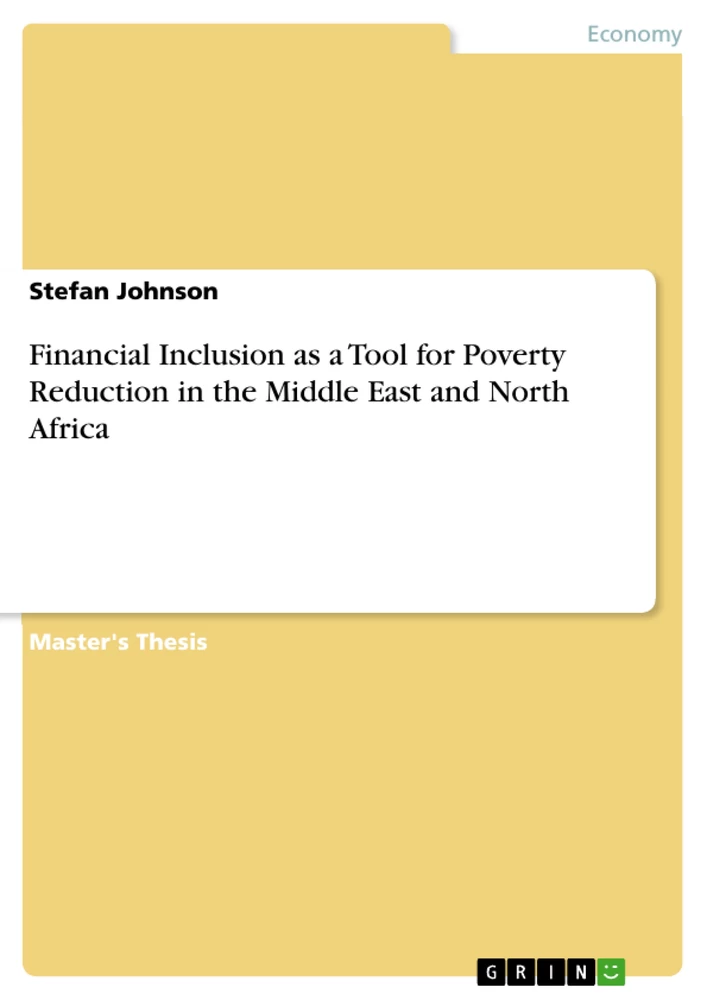
Table of Contents
CHAPTER 1 INTRODUCTION
CHAPTER 2 BACKGROUND
2.1 PEOPLE’S DEMOCRATIC REPUBLIC OF ALGERIA
2.2 ARAB REPUBLIC OF EGYPT
2.3 REPUBLIC OF IRAQ
2.4 HASHEMITE KINGDOM OF JORDAN
2.5 LEBANESE REPUBLIC
2.6 KINGDOM OF MOROCCO
2.7 REPUBLIC OF YEMEN
CHAPTER 3 LITERATURE REVIEW
CHAPTER 4 METHODOLOGY
4.1 APPROACH
4.2 DATA GATHERING METHOD
4.3 DATABASE OF STUDY
4.4 VALIDITY OF DATA
4.5 ORIGINALITY AND LIMITATIONS
4.6 SUMMARY
CHAPTER 5 CORRELATIVE TEST HYPOTHESES
CHAPTER 6 RESULTS
6.1 QUALITATIVE DATA RESULTS
6.2 QUANTITATIVE DATA RESULTS
6.2.1 HYPOTHESES RESULTS
6.3 SUMMARY OF RESULTS
CHAPTER 7 CONCLUSION
Research Objectives and Key Topics
This master dissertation investigates whether Financial Inclusion can function as an effective tool for poverty reduction within the Middle East and North Africa (MENA) region. The study aims to bridge the gap in existing research by examining the relationship between financial inclusion, economic development, and cultural/religious factors in seven selected nations, testing whether current banking frameworks serve as conduits for poverty alleviation or if significant structural barriers persist.
- The role of Financial Inclusion as a mechanism for poverty reduction in the MENA region.
- Barriers to banking participation, including income disparities, religious dispositions, and financial literacy.
- Analysis of formal versus informal lending practices (e.g., microfinance, borrowing from friends and family).
- The impact of national economic indicators, such as GDP per capita and commercial lending rates, on banking accessibility.
- Evaluation of the effectiveness of existing banking policies and the necessity for government commitment to structural reforms.
Excerpt from the Book
Chapter 1 Introduction
Financial Inclusion (FI), in general terms, is the practice of including individuals into the banking sector. The sector includes, but is not limited to, formal savings institutions, Micro-Financing Institutions (MFI), Credit Institutions, and the finance sector as a whole. Under some definitions, financial inclusion also includes the Agent Banking industry; however, for the purpose of this document, they will be excluded.
The World Bank and the United Nations (UN) have agreed that Financial Inclusion is a means of growth in prosperity within many nations as well as a means to reduce poverty worldwide. In essence, the UN has identified financial inclusion as a conduit for poverty reduction globally. The United Nations Commission on International Trade Law (UNCITRAL), identified that Financial Inclusion is an integral part of reaching individuals in absolute poverty, and helping alleviate that poverty (Kashyap, 2011). At this time, outside of a few regions, this comes as an incredible challenge. This paper aims to identify that Financial Inclusion is not yet a practical Tool for Poverty Reduction in the Middle East and North Africa.
Summary of Chapters
CHAPTER 1 INTRODUCTION: Outlines the definition of financial inclusion and presents the core research objective regarding its current limitations in the MENA region.
CHAPTER 2 BACKGROUND: Provides a comprehensive socio-economic and demographic overview of the seven selected MENA countries, highlighting income disparities and the religious context of their financial systems.
CHAPTER 3 LITERATURE REVIEW: Examines global research on financial inclusion, the Millennium Development Goals, and existing studies on Islamic finance and poverty in the region.
CHAPTER 4 METHODOLOGY: Details the mixed-methods research design, including data gathering from the World Bank FINDEX and other secondary sources, and explains the chosen correlative testing approach.
CHAPTER 5 CORRELATIVE TEST HYPOTHESES: Defines the six specific hypotheses aimed at testing the relationship between income levels, banking participation, lending rates, and religious factors.
CHAPTER 6 RESULTS: Presents and interprets both qualitative and quantitative research findings, comparing expected outcomes from literature with observed data from the FINDEX datasets.
CHAPTER 7 CONCLUSION: Summarizes findings and asserts that while financial inclusion has potential, it is currently limited in MENA due to deeper structural, political, and economic barriers.
Keywords
Financial Inclusion, Poverty Reduction, MENA, World Bank, FINDEX, Microfinance, Islamic Banking, Sharia, Economic Development, Banking Accessibility, Income Disparity, Quantitative Research, Lending Rates, Financial Literacy, Socio-economic barriers.
Frequently Asked Questions
What is the core focus of this research?
The research examines whether financial inclusion serves as a practical tool for reducing poverty in the Middle East and North Africa, given the region's unique socio-economic and religious landscape.
What are the central themes covered in this paper?
The central themes include the accessibility of formal banking, the role of Islamic law in financial decision-making, the impact of income disparity, and the prevalence of informal borrowing methods.
What is the primary objective of this dissertation?
The primary objective is to test whether higher income levels or specific economic policies correlate with higher banking participation rates in seven selected MENA nations.
Which research methodology does the author employ?
The author uses a mixed-methods approach, combining qualitative analysis of literature with quantitative correlative testing of World Bank FINDEX data using Pearson’s r-test.
What is discussed in the main body of the work?
The main body evaluates regional background, literature, specific methodologies for data analysis, and the results of various hypothesis tests related to banking and borrowing behavior.
Which keywords define the scope of this study?
Keywords include Financial Inclusion, Poverty Reduction, MENA, Islamic Banking, Microfinance, and economic development factors like income disparity and banking policy.
How does the author define the "MENA" region in this context?
The author identifies the region as comprising 19 nations but focuses specifically on seven countries—Algeria, Egypt, Iraq, Jordan, Lebanon, Morocco, and Yemen—that fall below the median regional GDP per capita.
What is the significance of the "Agent Banking" exclusion mentioned?
The author excludes agent banking from the study's definition of formal financial inclusion to maintain a strict focus on savings at formal financial institutions.
What is the role of the FINDEX dataset in this study?
FINDEX is the primary dataset used to analyze financial behavior, including why individuals remain unbanked and their methods for borrowing money.
What conclusion does the author draw about the future of financial inclusion in MENA?
The author concludes that financial inclusion is currently limited in MENA and requires a philosophical change from governments, increased commitment to policy, and improvements in education before it can be truly effective.
Ende der Leseprobe aus 103 Seiten
- nach oben
- Arbeit zitieren
- Stefan Johnson (Autor:in), 2014, Financial Inclusion as a Tool for Poverty Reduction in the Middle East and North Africa, München, Page::Imprint:: GRINVerlagOHG, https://www.diplomarbeiten24.de/document/334694

neugierig - aktuell - relevant
Entdecken Sie hilfreiche Tipps und Tricks rund ums Studium!

Entdecken Sie hilfreiche Tipps und Tricks rund ums Studium!
Ihre Hausarbeit / Abschlussarbeit:

- - Publikation als E-Book und Buch
- - Hohes Honorar auf die Verkäufe
- - Für Sie komplett kostenlos - mit ISBN
- - Es dauert nur 5 Minuten
- - Jede Arbeit findet Leser

- © GRIN Publishing GmbH.
- Alle Inhalte urheberrechtlich geschützt. Kopieren und verbreiten untersagt.
- info@grin.com
- AGB
- Open Publishing
Der GRIN Verlag hat sich seit 1998 auf die Veröffentlichung akademischer eBooks und Bücher spezialisiert. Der GRIN Verlag steht damit als erstes Unternehmen für User Generated Quality Content. Die Verlagsseiten GRIN.com, Hausarbeiten.de und Diplomarbeiten24 bieten für Hochschullehrer, Absolventen und Studenten die ideale Plattform, wissenschaftliche Texte wie Hausarbeiten, Referate, Bachelorarbeiten, Masterarbeiten, Diplomarbeiten, Dissertationen und wissenschaftliche Aufsätze einem breiten Publikum zu präsentieren.
Kostenfreie Veröffentlichung: Hausarbeit, Bachelorarbeit, Diplomarbeit, Dissertation, Masterarbeit, Interpretation oder Referat jetzt veröffentlichen!
Folgen Sie GRIN auf


- GRIN Verlag GmbH
-
- Nymphenburger Str. 86
- 80636
- Munich, Deutschland
- +49 89-550559-0
- +49 89-550559-10
- info@grin.com
-
