
präsentiert von

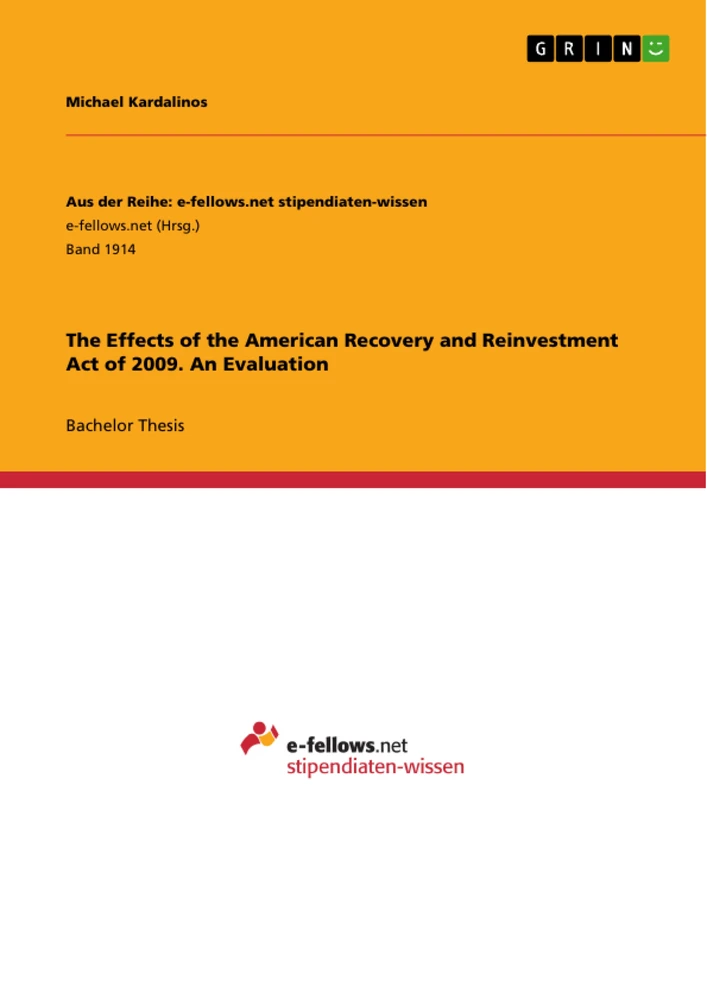
Table of Contents
1. Introduction
2. Analysis of the ARRA purposes
2.1 Job Creation and Promotion of Economic Recovery
2.2 Assisting Those Most Impacted by the Recession
2.3 State and Local Government Budget Stabilization
2.4 Long-term Investments to Increase Economic Efficiency
3. Conclusion
Objectives and Research Themes
This thesis examines the effectiveness of the American Recovery and Reinvestment Act (ARRA) of 2009 in responding to the global financial crisis, specifically evaluating whether the stimulus fulfilled its stated economic purposes and served as an appropriate crisis management tool.
- Analysis of job creation metrics and Keynesian multipliers.
- Evaluation of poverty reduction efforts and impact on income inequality.
- Assessment of state and local government budget stabilization.
- Review of structural long-term investments in infrastructure and technology.
- Critical comparison of different economic research methodologies regarding stimulus outcomes.
Extract from the Book
2.1 Job Creation and Promotion of Economic Recovery
The measurement of job creation and economic recovery is probably the most important criterion to evaluate the effectiveness of the ARRA. In economic research this has been done by estimating the amount of jobs created due to the American Recovery and Reinvestment Act, the cost per job and the GDP growth with and without ARRA. Since the announcement of the Stimulus Package extensive studies have been done on this topic.
In this paper the focus will lie mostly on the cost per job since this indicator seems to be the easiest to compare across time spans and methods used. However, Keynesian multipliers and GDP growth will also discussed briefly, when applicable.
One of the earlier papers on this issue had been published by Zacharias, Masterson and Kim just a few month after the introduction of the ARRA. Since no past data on the effects of the ARRA had been available they used a microsimulation approach based on a self-constructed baseline scenario of what would have happened without Keynesian government intervention and an analysis of the total budgetary costs split into the categories of tax cuts, transfers and subsidies. In total, they tested four different scenarios that estimate job gains of 6.1 million to 8.8 million (Zacharias et al., 2009).
Chapter Summaries
1. Introduction: This chapter provides the historical context of the 2007-08 financial crisis and the shift back to Keynesian economic policies, introducing the ARRA as the primary US response.
2. Analysis of the ARRA purposes: This section categorizes the official goals of the Act into cyclical stabilization measures and structural long-term investments.
2.1 Job Creation and Promotion of Economic Recovery: An analysis of various studies estimating the cost per job, job creation numbers, and the overall impact of the stimulus on GDP growth.
2.2 Assisting Those Most Impacted by the Recession: A review of targeted support programs, such as the Earned Income Tax Credit, and their distributive effects on disadvantaged demographics.
2.3 State and Local Government Budget Stabilization: An exploration of how federal transfers helped prevent layoffs and service cuts at the state level during the economic downturn.
2.4 Long-term Investments to Increase Economic Efficiency: An evaluation of strategic investments in infrastructure, technology, and health, and the trade-offs made between long-term efficacy and rapid project execution.
3. Conclusion: A final synthesis that confirms the ARRA’s overall success in aiding economic recovery despite minor distributional weaknesses and execution trade-offs.
Keywords
American Recovery and Reinvestment Act, ARRA, Keynesian economics, stimulus package, job creation, economic recession, fiscal policy, income inequality, budget stabilization, structural investment, economic recovery, cost per job, government spending, financial crisis, GDP growth.
Frequently Asked Questions
What is the core subject of this thesis?
The thesis evaluates the American Recovery and Reinvestment Act (ARRA) of 2009, analyzing its success as a crisis response to the global financial recession.
What are the central thematic areas?
The paper focuses on job creation, poverty reduction, state and local government fiscal stability, and structural long-term investments.
What is the primary objective of the research?
The primary goal is to determine if the ARRA was an appropriate and effective crisis response by measuring how well it achieved its five official stated purposes.
Which scientific methodology is applied?
The author uses a meta-analytical approach, reviewing and critically comparing diverse economic studies, microsimulations, and regression analyses conducted by various researchers and institutions.
What does the main body cover?
The main body breaks down the ARRA's performance across different policy sectors, contrasting short-term stabilization goals with long-term structural objectives.
How is the paper characterized by its keywords?
The paper is defined by terms relating to Keynesian intervention, fiscal stimulus evaluation, and economic distributive impact.
How did researchers calculate the cost per job?
Researchers used varying methodologies, including microsimulation, cross-sectional analysis of geographic variation in spending, and input-output modeling to estimate the financial efficiency of job creation.
What was the outcome regarding income inequality?
The findings suggest that while the ARRA provided some relief to disadvantaged groups, its overall distributive impact in closing the income gap between the wealthy and the poor was negligible.
Why did some long-term investments underperform?
The thesis identifies a trade-off where the priority of "shovel-ready" projects for fast job creation led to less optimal results in sectors like telecommunications that required longer planning horizons.
Ende der Leseprobe aus 24 Seiten
- nach oben
- Arbeit zitieren
- Michael Kardalinos (Autor:in), 2016, The Effects of the American Recovery and Reinvestment Act of 2009. An Evaluation, München, Page::Imprint:: GRINVerlagOHG, https://www.diplomarbeiten24.de/document/335093

neugierig - aktuell - relevant
Entdecken Sie hilfreiche Tipps und Tricks rund ums Studium!

Entdecken Sie hilfreiche Tipps und Tricks rund ums Studium!
Ihre Hausarbeit / Abschlussarbeit:

- - Publikation als E-Book und Buch
- - Hohes Honorar auf die Verkäufe
- - Für Sie komplett kostenlos - mit ISBN
- - Es dauert nur 5 Minuten
- - Jede Arbeit findet Leser

- © GRIN Publishing GmbH.
- Alle Inhalte urheberrechtlich geschützt. Kopieren und verbreiten untersagt.
- info@grin.com
- AGB
- Open Publishing
Der GRIN Verlag hat sich seit 1998 auf die Veröffentlichung akademischer eBooks und Bücher spezialisiert. Der GRIN Verlag steht damit als erstes Unternehmen für User Generated Quality Content. Die Verlagsseiten GRIN.com, Hausarbeiten.de und Diplomarbeiten24 bieten für Hochschullehrer, Absolventen und Studenten die ideale Plattform, wissenschaftliche Texte wie Hausarbeiten, Referate, Bachelorarbeiten, Masterarbeiten, Diplomarbeiten, Dissertationen und wissenschaftliche Aufsätze einem breiten Publikum zu präsentieren.
Kostenfreie Veröffentlichung: Hausarbeit, Bachelorarbeit, Diplomarbeit, Dissertation, Masterarbeit, Interpretation oder Referat jetzt veröffentlichen!
Folgen Sie GRIN auf


- GRIN Verlag GmbH
-
- Nymphenburger Str. 86
- 80636
- Munich, Deutschland
- +49 89-550559-0
- +49 89-550559-10
- info@grin.com
-
