
präsentiert von

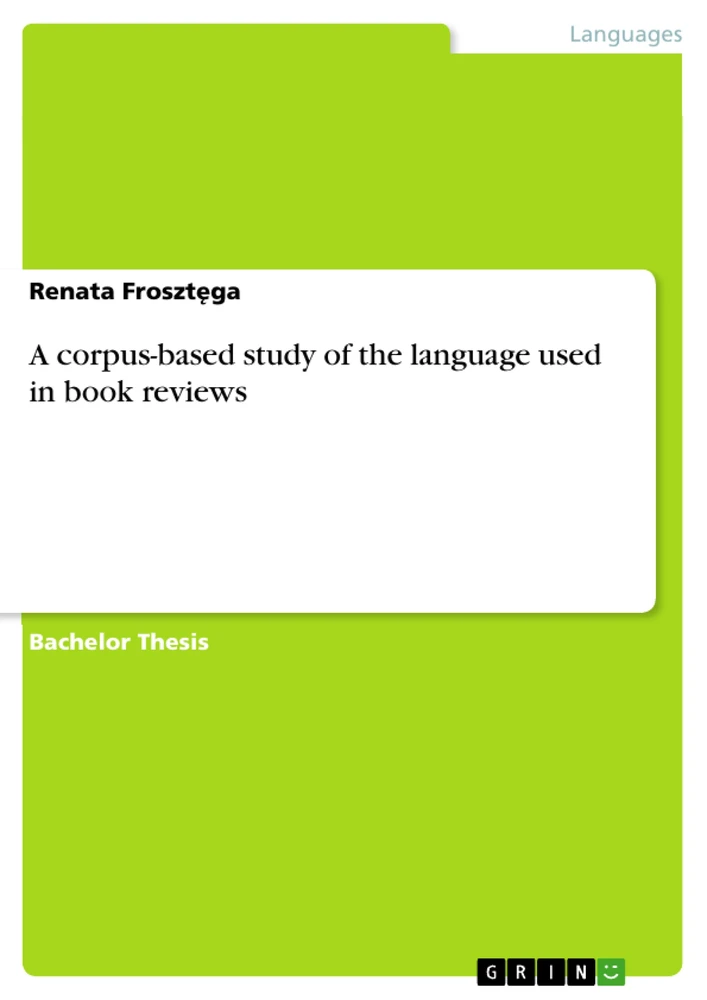
Table of Contents
1 THE THEORETICAL BACKGROUND OF THE CORPUS LINGUISTICS
1.1 Corpus linguistics - historical sketch and scope of interest
1.1.1 The definition and area of interest
1.1.2 The historical background of corpus linguistics
1.2 The idea of corpus
1.2.1 Defining the term
1.2.2 Major electronic corpora
1.2.2.1 The COBUILD Bank of English
1.2.2.2 The British National Corpus
1.2.2.3 Other important corpora of English
1.2.2.4 Corpora for special purposes
1.2.3 Issues in compilation and corpus design
1.2.3.1 Criteria for corpus design
1.2.3.2 Size
1.2.3.3 Representativeness
1.2.4 Basic procedures used in corpus analysis
1.2.4.1 Frequency list
1.2.4.2 Concordances
2 INFORMATION CONNECTED WITH THE GENRE OF REVIEWS
2.1 Main characteristic of the press
2.1.1 Press genres
2.2 Main characteristic of reviews
2.2.1 Book reviews
2.2.1.1 Book review vocabulary
3 A CORPUS-BASED RESEARCH INTO BOOKS’ REVIEWS
3.1 Compilation of the DIY Book Review Corpus – basic information
3.2 Frequency of words
3.2.1 General versus specialized vocabulary
3.2.2 Findings concerning the frequency list of book review terms
3.3 Concordance analyses of selected terms
3.3.1 The noun reader
3.3.2 The noun book
3.3.3 The noun novel
3.3.4 The noun plot
3.3.5 The noun character
3.3.6 The noun story
3.3.7 Synonyms writer and author
Research Objectives and Themes
The thesis aims to analyze the language of book reviews as a specialized register, emphasizing the necessity of using corpus-based methodologies to identify characteristic vocabulary and phrases that are more prevalent in this genre compared to others. It explores how corpus linguistics can improve the understanding of specialized language and overcome the limitations of relying solely on intuition when studying specific text types.
- Corpus-based approach to linguistic analysis
- Register analysis of the book review genre
- Construction and utilization of a specialized DIY corpus
- Frequency analysis and its role in identifying specialized vocabulary
- Contextual study through concordance analysis
Excerpt from the Book
3.3.1 The noun reader
The noun reader is mainly used here to signify “a person who reads, especially one who reads a lot or in a particular way”69. There are two instances constituting an exception, in which it means a special device called electricity meter reader. Reader occurs more frequently in the singular than in the plural. This lexical item is one of the most popular specialized terms (ranked 7th in Table 3. 2) and can be regarded as the most important one in the DIY BRC as far as the nouns referring to persons mentioned in book reviews are concerned. Still books and book reviews are written for the reader, not for writers or critics. The linguistic data gathered in the DIY BRC and concordance lines presented below show how the lemma reader has been used by book review writers.
The lemma reader tends to be modified by some adjectives such as devoted, mildest, ordinary, privileged, unknown, young, delighted or regular. It is also preceded by words referring to reader’s nationality, name of a newspaper, name of an author, or other words like many, every, his, etc. However, it should be emphasized, that review authors in majority of cases (45 out of 111 instances) refer to this lexical item simply as the reader with no additional words in between.
Summary of Chapters
CHAPTER ONE: This chapter establishes the theoretical foundation of corpus linguistics, covering its definitions, history, major electronic corpora, and the technical procedures used in corpus analysis.
CHAPTER TWO: This chapter examines the nature of the book review as a press genre, discussing the characteristics of press and review genres, and concludes with a researcher-compiled glossary of terms.
CHAPTER THREE: This chapter presents the corpus-based research, detailing the DIY BRC compilation, performing frequency counts of words, and conducting concordance analyses on selected central terms to identify contextual usage patterns.
Keywords
Corpus linguistics, Book reviews, DIY BRC, WordSmith Tools, Frequency list, Concordance, Register analysis, Specialized language, Lexical analysis, Thematic vocabulary, Genre analysis, Reader, Author, Writer, Novel
Frequently Asked Questions
What is the primary focus of this research?
The research focuses on the linguistic characteristics of book reviews by analyzing a specialized corpus of reviews collected from popular British and American newspapers.
What are the central themes discussed in the work?
The work covers the theory of corpus linguistics, the genre characteristics of book reviews in journalism, and the empirical analysis of specific vocabulary within that genre.
What is the primary research goal?
The goal is to demonstrate that book reviewing constitutes a specialized register characterized by specific vocabulary, and to prove the efficacy of using a corpus-based approach to study this genre.
Which scientific methodology is employed?
The study uses corpus linguistics, specifically compiling a "Do-It-Yourself" (DIY) corpus and utilizing WordSmith Tools to generate frequency lists and concordance lines for analysis.
What topics are covered in the main body?
The main body covers the theoretical background of corpora, the journalistic context of reviews, and a detailed corpus-based study including frequency analysis and concordancing of key terms like "reader," "book," "novel," and "author."
How would you characterize the keywords of this thesis?
The keywords relate to the methodology of corpus linguistics and the specific content of the study, focusing on literary and journalistic terminology used in book reviews.
Why did the researcher decide to compile her own corpus?
Because there was insufficient comprehensive linguistic material specifically devoted to the language of book reviews, necessitating a new collection for the purpose of this analysis.
What is the importance of the term "book" in the findings?
The analysis reveals that "book" is the most frequent non-function word, confirming its role as the central and most significant lexical item in the book review register.
How does the corpus-based approach compare to the intuitive approach mentioned in the study?
The study shows that the corpus-based approach provides more reliable and comprehensive results compared to intuitive selection, which often omits crucial terms and overestimates others.
What distinction is made between "writer" and "author" in the research?
The study uses concordance analysis to show that these synonyms have different frequency levels and distinct contextual patterns of usage within the collected reviews.
Ende der Leseprobe aus 53 Seiten
- nach oben
- Arbeit zitieren
- Renata Frosztęga (Autor:in), 2014, A corpus-based study of the language used in book reviews, München, Page::Imprint:: GRINVerlagOHG, https://www.diplomarbeiten24.de/document/337151

neugierig - aktuell - relevant
Entdecken Sie hilfreiche Tipps und Tricks rund ums Studium!

Entdecken Sie hilfreiche Tipps und Tricks rund ums Studium!
Ihre Hausarbeit / Abschlussarbeit:

- - Publikation als E-Book und Buch
- - Hohes Honorar auf die Verkäufe
- - Für Sie komplett kostenlos - mit ISBN
- - Es dauert nur 5 Minuten
- - Jede Arbeit findet Leser

- © GRIN Publishing GmbH.
- Alle Inhalte urheberrechtlich geschützt. Kopieren und verbreiten untersagt.
- info@grin.com
- AGB
- Open Publishing
Der GRIN Verlag hat sich seit 1998 auf die Veröffentlichung akademischer eBooks und Bücher spezialisiert. Der GRIN Verlag steht damit als erstes Unternehmen für User Generated Quality Content. Die Verlagsseiten GRIN.com, Hausarbeiten.de und Diplomarbeiten24 bieten für Hochschullehrer, Absolventen und Studenten die ideale Plattform, wissenschaftliche Texte wie Hausarbeiten, Referate, Bachelorarbeiten, Masterarbeiten, Diplomarbeiten, Dissertationen und wissenschaftliche Aufsätze einem breiten Publikum zu präsentieren.
Kostenfreie Veröffentlichung: Hausarbeit, Bachelorarbeit, Diplomarbeit, Dissertation, Masterarbeit, Interpretation oder Referat jetzt veröffentlichen!
Folgen Sie GRIN auf


- GRIN Verlag GmbH
-
- Nymphenburger Str. 86
- 80636
- Munich, Deutschland
- +49 89-550559-0
- +49 89-550559-10
- info@grin.com
-
