
präsentiert von

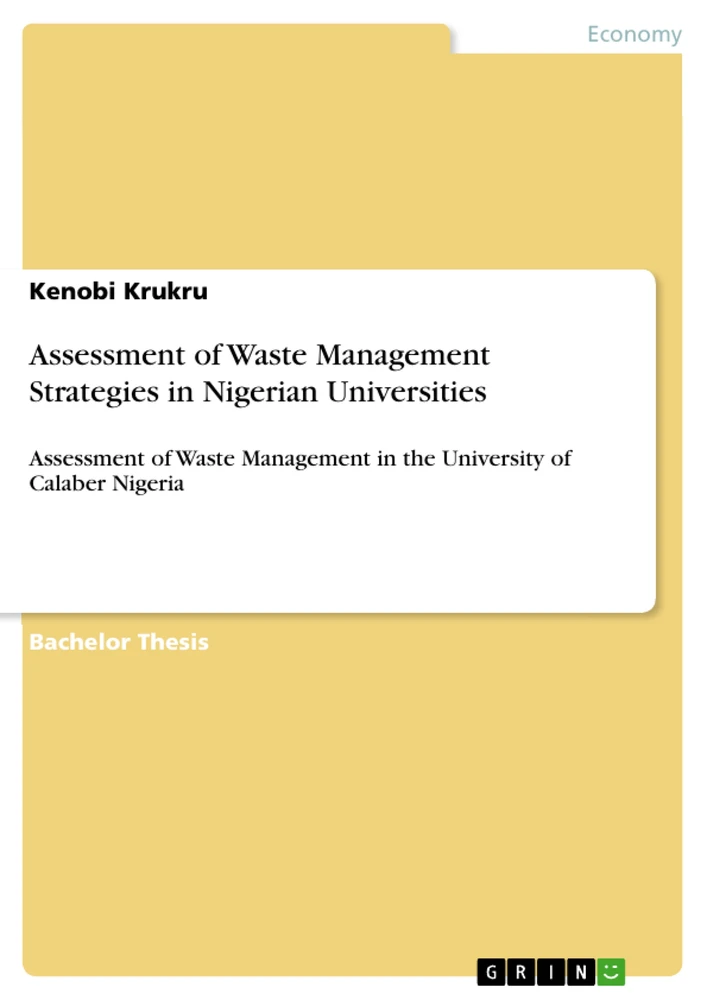
Table of Contents
1.1 Background of study
1.2 Statement of the problem
1.3 Aims and objectives of study
1.4 Significance of the study
1.5 Research hypothesis
1.6 Study area
1.7 Scope of study
2.1 Introduction
2.2 Conceptual framework
2.3 Methods of solid waste management in the University of Calabar
2.4 Problems of waste management in the University of Calabar
3.1 Introduction
3.2 Types of data
3.3 Sources of data
3.3.1 Primary data
3.3.2 Secondary data
3.4 Sampling technique
3.5 Population of study
3.6 Research design
3.7 Instrumentation
3.8 Procedure for data collection
3.9 Procedure for data analysis
4.1 Introduction
4.2 Presentation of data
4.3 Test of hypothesis
4.4 Interpretation of results
5.1 Summary
5.2 Conclusion
5.3 Recommendations
Objectives and Themes
This study aims to evaluate the current solid waste management strategies employed within the University of Calabar to identify existing challenges and provide data-driven recommendations for environmental improvement.
- Analysis of waste generation components and disposal patterns.
- Assessment of the effectiveness of existing waste management practices.
- Evaluation of health and environmental impacts of improper waste handling.
- Development of strategic recommendations for sustainable waste management.
Excerpt from the Book
1.1 Background of study
According to the Oxford English Dictionary, waste is any item that is longer in use or cannot be used for any good purpose. Solid waste has been defined as any useless, unwanted or discarded material (American Public Work Association, 1975) with insufficient liquid content to be free-flowing. Solid waste is sticky and weighty in nature and therefore has the capacity of accumulating and defacing the physical environment if not well managed (Sada and Odemoerho, 1988).
Solid waste is any moveable solid object which the owner wishes to dispose if it is no longer useful to the immediate owner. Solid wastes are non-soluble materials ranging from municipal garbage to industrial wastes containing complex and sometimes hazardous substances. Man’s activities today generates tons of thousands of refuse which are seen littered everywhere causing diverse environmental problems. This calls for urgent expertise in waste management as the importance of a healthy environment for meaningful and productive work is tied to proper waste management. Waste is everybody’s business as we all generate waste in nearly everything we do.
Summary of Chapters
CHAPTER ONE INTRODUCTION: Provides the definition of solid waste, discusses its environmental impact, and outlines the objectives and scope of the research within the University of Calabar.
CHAPTER TWO REVIEW OF RELATED LITERATURE: Examines various global and local perspectives on solid waste management, classification methods, and common disposal strategies like landfills and incineration.
CHAPTER THREE METHODOLOGY OF STUDY: Details the research design, data sources, and statistical techniques used, including the Pearson product moment correlation and t-test.
CHAPTER FOUR DATA ANALYSIS, PRESENTATION AND INTERPRETATION: Presents the gathered empirical data and tests the research hypothesis regarding the efficiency of waste management at the university.
CHAPTER FIVE SUMMARY, CONCLUSION AND RECOMMENDATION: Summarizes findings and provides concrete recommendations for institutional authorities to improve waste disposal and environmental safety.
Keywords
Solid Waste, Waste Management, University of Calabar, Environmental Sanitation, Disposal Methods, Sanitary Landfill, Waste Collection, Pollution, Sustainability, Population Growth, Waste Generation, Environmental Health, Infrastructure, Waste Strategy, Data Analysis.
Frequently Asked Questions
What is the core focus of this research?
The research focuses on assessing the current solid waste management strategies within the University of Calabar to evaluate their efficiency and identify areas for improvement.
What are the central themes of the work?
The study revolves around waste generation, disposal patterns, health and environmental impacts, and the effectiveness of current management practices by the university's sanitation unit.
What is the primary objective of this study?
The primary objective is to determine major waste components, assess management efficiency, and propose actionable recommendations to create a cleaner campus environment.
Which scientific method is utilized in the study?
The research employs a descriptive design, gathering data through structured questionnaires and utilizing the Pearson product moment correlation and the student t-test for hypothesis testing.
What topics are covered in the main body?
The main body covers a thorough literature review, detailed methodology, presentation of field data regarding waste collection and disposal, and a statistical analysis of the effectiveness of these practices.
Which keywords best characterize this work?
Key terms include Solid Waste, Waste Management, University of Calabar, Environmental Sanitation, and Sustainable Disposal Methods.
How is waste collected at the University of Calabar?
Waste is primarily collected using waste baskets and bins placed at strategic points, which are then emptied into central depots and subsequently burned or disposed of in open pits.
What is the impact of population growth on waste management?
The study finds that increasing population leads to higher consumption of papers, plastics, and canned goods, which increases waste generation faster than the university's capacity to manage it.
What are the key recommendations for improvement?
Recommendations include providing more bins in offices and canteens, improving funding for the sanitation unit, enforcing environmental codes, and stopping indiscriminate hawking.
Ende der Leseprobe aus 43 Seiten
- nach oben
- Arbeit zitieren
- Kenobi Krukru (Autor:in), 2015, Assessment of Waste Management Strategies in Nigerian Universities, München, Page::Imprint:: GRINVerlagOHG, https://www.diplomarbeiten24.de/document/337207

neugierig - aktuell - relevant
Entdecken Sie hilfreiche Tipps und Tricks rund ums Studium!

Entdecken Sie hilfreiche Tipps und Tricks rund ums Studium!
Ihre Hausarbeit / Abschlussarbeit:

- - Publikation als E-Book und Buch
- - Hohes Honorar auf die Verkäufe
- - Für Sie komplett kostenlos - mit ISBN
- - Es dauert nur 5 Minuten
- - Jede Arbeit findet Leser

- © GRIN Publishing GmbH.
- Alle Inhalte urheberrechtlich geschützt. Kopieren und verbreiten untersagt.
- info@grin.com
- AGB
- Open Publishing
Der GRIN Verlag hat sich seit 1998 auf die Veröffentlichung akademischer eBooks und Bücher spezialisiert. Der GRIN Verlag steht damit als erstes Unternehmen für User Generated Quality Content. Die Verlagsseiten GRIN.com, Hausarbeiten.de und Diplomarbeiten24 bieten für Hochschullehrer, Absolventen und Studenten die ideale Plattform, wissenschaftliche Texte wie Hausarbeiten, Referate, Bachelorarbeiten, Masterarbeiten, Diplomarbeiten, Dissertationen und wissenschaftliche Aufsätze einem breiten Publikum zu präsentieren.
Kostenfreie Veröffentlichung: Hausarbeit, Bachelorarbeit, Diplomarbeit, Dissertation, Masterarbeit, Interpretation oder Referat jetzt veröffentlichen!
Folgen Sie GRIN auf


- GRIN Verlag GmbH
-
- Nymphenburger Str. 86
- 80636
- Munich, Deutschland
- +49 89-550559-0
- +49 89-550559-10
- info@grin.com
-
