
präsentiert von

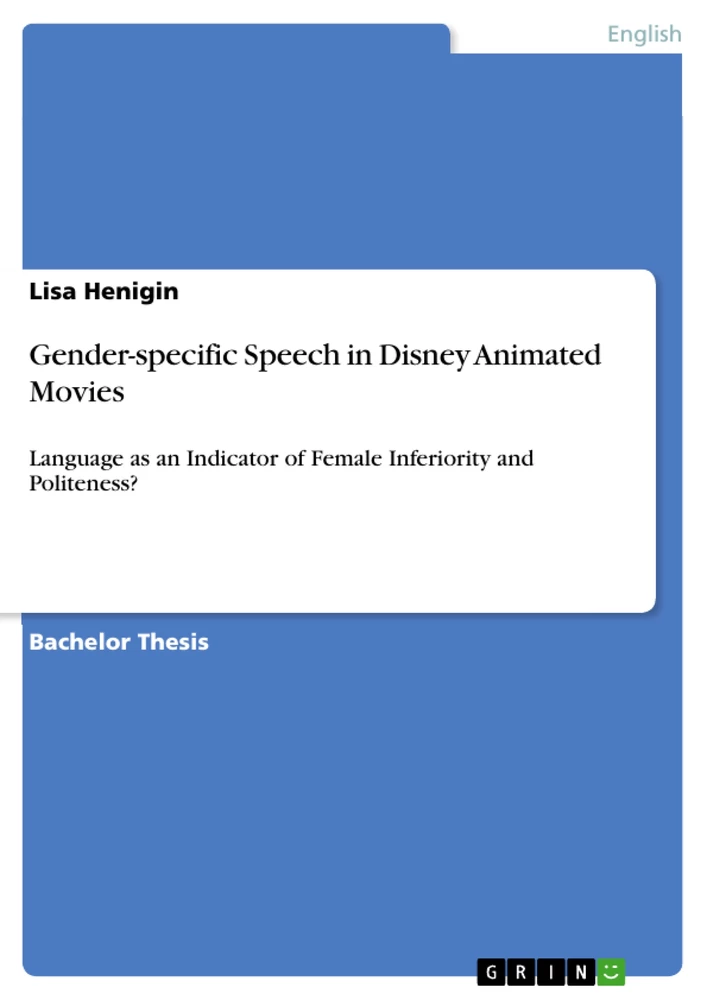
Table of Contents
1. Introduction
1.1. Aim
2. Background
2.1 What is ‘Gender’?
2.2 Previous research: Disney’s portrayal of gender roles
2.3 Gender linguistics
2.4 ‘ Genderlects’
2.5 Politeness, Inferiority and their Relationship
3. Gender-specific speech in Disney animated movies
3.1 Method and materials
3.2 Hypothesis
3.3. Results
3.3.1 The Little Mermaid
3.3.1.1 Interruptions
3.3.1.2 Tag Questions
3.3.1.3 Compliments
3.3.1.4 Apologies
3.3.1.5 Please
3.3.2 FINDING NEMO
3.3.2.1 Interruptions
3.3.2.2 Tag Questions
3.3.2.3 Compliments
3.3.2.4 Apologies
3.3.2.5 Please
3.3.3 Tangled
8.3.3.1 Interruptions
3.3.3.2 Tag Questions
8.3.3.3 Compliments
3.3.3.4 Apologies
3.3.3.5 Please
3.3.4 Not using specific lexical features
3.4 Summary and discussion
3.5 Conclusion
Objectives & Key Themes
This thesis investigates gender-specific linguistic features in Disney animated movies to determine how female characters are portrayed in relation to their male counterparts. The research explores whether the language used in these films reinforces stereotypes of female submissiveness, inferiority, and politeness by analyzing conversational markers in selected Disney productions.
- Gender linguistics and the theory of ‘Genderlects’
- Linguistic politeness strategies vs. conversational dominance
- Analysis of speech patterns in The Little Mermaid, Finding Nemo, and Tangled
- Representation of female role models in popular children's media
- The connection between power, inferiority, and language usage
Excerpt from the Book
2.3 Gender linguistics
Gender linguistics, also called feminist linguistics, is a sub discipline of sociolinguistics and deals with the relationship between language and gender. Subject areas aside from the way men and women talk are also the way society is talking about them, so how they are linguistically referred to (Bochenek 8).
According to many feminists, most languages, including the English language as well, are discriminatory and sexist for several reasons. Examples are the generic he, that there are only few lexical resources to refer to women and their experiences, or that women are mostly discussed regarding their appearance, whereas men are discussed in terms of their actions (Weatherall 17-19). Another claim by feminists is that the English language has an underlying pattern by which male is positive and female negative, which is automatically and probably unconsciously transferred from language use to everyday life and that language mostly presents a masculine viewpoint on our world. There are, for example, many more insulting words for women, than for men. Inequality can be found everywhere, even the terms ‘Mr.’ for Mister and ‘Mrs.’ for Misses are unequal, since the relationship status of the male ‘Mister’ is not divulged, while the female term ‘Misses’ marks the woman as married and ‘Miss’ as unmarried (Cameron 9-10).
The claims made by gender linguistics show that gender linguistics not only describe language and language use, it also practices language criticism to a high degree.
Summary of Chapters
1. Introduction: This chapter introduces the field of gender linguistics and outlines the thesis's focus on communicative behavior in Disney movies, establishing the research aim.
2. Background: This chapter defines the term gender and provides a literature review on Disney’s portrayal of gender roles, gender linguistics, and the relationship between politeness and inferiority.
3. Gender-specific speech in Disney animated movies: This chapter details the methodology, results, and discussion regarding the linguistic analysis of three specific Disney movies, concluding with a final assessment of the findings.
Keywords
Gender linguistics, sociolinguistics, Disney, gender roles, politeness strategies, conversational dominance, tag questions, interruptions, apologies, female representation, speech behavior, language and gender, stereotypes, animation, genderlects.
Frequently Asked Questions
What is the core focus of this thesis?
The thesis examines the communicative behavior of men and women within Disney animated movies, specifically analyzing whether female characters are depicted as linguistically inferior and politer than their male counterparts.
What are the primary thematic areas?
The research focuses on gender linguistics, sociolinguistic theories of politeness, the construction of gender roles in media, and the empirical analysis of specific speech features like interruptions, tag questions, and compliments.
What is the primary research goal?
The goal is to determine what kind of female role models young children, particularly girls, are exposed to via the language used by characters in Disney movies.
Which scientific methods are employed?
The author uses a qualitative and quantitative analysis of dialogue from three chosen Disney movies, comparing specific speech patterns to established gender linguistics theories.
What does the main part of the thesis cover?
The main part analyzes three films (The Little Mermaid, Finding Nemo, and Tangled), cataloging instances of interruptions, tag questions, compliments, and apologies, and discussing the findings in the context of gendered power dynamics.
Which keywords characterize this work?
Key terms include gender linguistics, politeness strategies, conversational dominance, and the analysis of gender-specific speech patterns in popular media.
How does the representation of female villains compare to heroines in these movies?
The analysis reveals that while protagonists often use "powerless" language, female antagonists frequently employ more dominant, impolite, and powerful language, suggesting that cinematic depictions often correlate dominant behavior with "evil" qualities.
Did the research confirm the initial hypothesis?
The initial hypothesis—that younger movies would show fewer signs of linguistic inferiority in women—was not supported; instead, the findings suggest that character role (protagonist vs. antagonist) and social status heavily influence the language used.
Ende der Leseprobe aus 72 Seiten
- nach oben
- Arbeit zitieren
- Lisa Henigin (Autor:in), 2016, Gender-specific Speech in Disney Animated Movies, München, Page::Imprint:: GRINVerlagOHG, https://www.diplomarbeiten24.de/document/338081

neugierig - aktuell - relevant
Entdecken Sie hilfreiche Tipps und Tricks rund ums Studium!

Entdecken Sie hilfreiche Tipps und Tricks rund ums Studium!
Ihre Hausarbeit / Abschlussarbeit:

- - Publikation als E-Book und Buch
- - Hohes Honorar auf die Verkäufe
- - Für Sie komplett kostenlos - mit ISBN
- - Es dauert nur 5 Minuten
- - Jede Arbeit findet Leser

- © GRIN Publishing GmbH.
- Alle Inhalte urheberrechtlich geschützt. Kopieren und verbreiten untersagt.
- info@grin.com
- AGB
- Open Publishing
Der GRIN Verlag hat sich seit 1998 auf die Veröffentlichung akademischer eBooks und Bücher spezialisiert. Der GRIN Verlag steht damit als erstes Unternehmen für User Generated Quality Content. Die Verlagsseiten GRIN.com, Hausarbeiten.de und Diplomarbeiten24 bieten für Hochschullehrer, Absolventen und Studenten die ideale Plattform, wissenschaftliche Texte wie Hausarbeiten, Referate, Bachelorarbeiten, Masterarbeiten, Diplomarbeiten, Dissertationen und wissenschaftliche Aufsätze einem breiten Publikum zu präsentieren.
Kostenfreie Veröffentlichung: Hausarbeit, Bachelorarbeit, Diplomarbeit, Dissertation, Masterarbeit, Interpretation oder Referat jetzt veröffentlichen!
Folgen Sie GRIN auf


- GRIN Verlag GmbH
-
- Nymphenburger Str. 86
- 80636
- Munich, Deutschland
- +49 89-550559-0
- +49 89-550559-10
- info@grin.com
-
