
präsentiert von

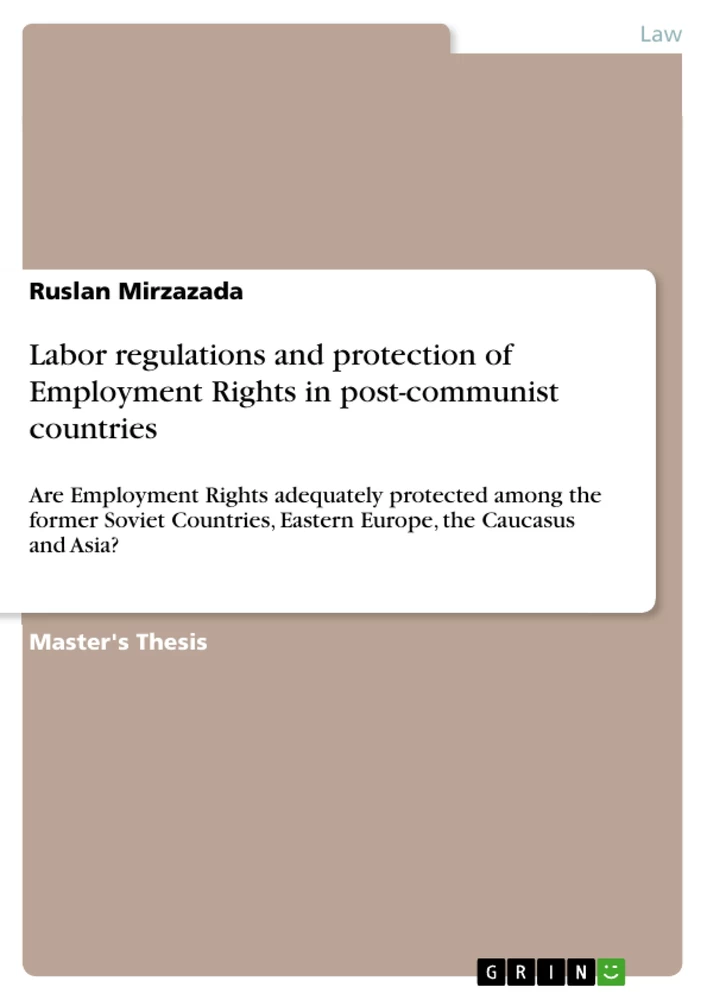
Table of Contents
Introduction
Chapter 1. Impact of the Legal and Economic Systems in the Union of Soviet Socialist Republics on Labor Market of the Former Soviet Countries.
Chapter 2. Protection of employment rights among the Eastern European countries.
Chapter 3. Protection of employment rights in the Caucasus: Azerbaijan, Georgia and Armenia.
Chapter 4. Protection of employment rights in Asia (Central Asia).
Chapter 5. Comparison of specific violations of employment rights in post-communist countries.
1. Conclusion and Recommendations
Research Objectives and Focus
This master thesis provides a comprehensive comparative analysis of employment rights regulations within post-Soviet countries, specifically examining how legacies of the Soviet system, economic transitions, and political environments have shaped labor market challenges and the protection of workers' rights.
- Comparative analysis of labor market regulations in Eastern European, Caucasian, and Central Asian states.
- Identification of systemic employment rights violations such as illegal employment, discrimination, and lack of safety standards.
- Evaluation of the impact of Soviet-era bureaucratic legacies on modern independent labor markets.
- Assessment of the role of political and economic reforms in protecting or undermining employee rights.
- Development of analytical recommendations for legislative and institutional improvements.
Excerpt from the Book
PROTECTION OF EMPLOYMENT RIGHTS AMONG THE EASTERN EUROPEAN COUNTRIES
In this master thesis, it is considered to analyze Eastern European countries in accordance of the United Nations Statistics Division which includes Belarus, Bulgaria, Czech Republic, Hungary, Moldova, Poland, Romania, Russia, Slovakia, and Ukraine.
Poland. The fundamental employment document in Poland is the Labor Code which was approved on 26th June 1974. The importance of this Code was that regarding to this; it was declared rights and obligations of the two parts of the employment: employees and employers. However, after a few years later, it was really clear that the reality and legislation were different and there was a visible incompatibility between the expectations of the employers and employees. So, in fact, nearly ¾ of employers have now difficulties with finding candidates corresponding with their requirements. Employment agencies don’t work adequately and most of the employers could not demonstrate compatible skills or reasonable competence for the required vacancies.
Summary of Chapters
Introduction: Outlines the research scope, objectives, and the historical and statistical methods used to analyze labor conditions in post-Soviet states.
Chapter 1. Impact of the Legal and Economic Systems in the Union of Soviet Socialist Republics on Labor Market of the Former Soviet Countries.: Examines the long-term negative effects of the Soviet command economy on labor market institutions and the resulting challenges for independent states.
Chapter 2. Protection of employment rights among the Eastern European countries.: Investigates labor regulation in Poland, the Czech Republic, Hungary, Slovakia, Romania, Belarus, Bulgaria, Moldova, Ukraine, and the Russian Federation, highlighting issues with fake employment agencies and discrimination.
Chapter 3. Protection of employment rights in the Caucasus: Azerbaijan, Georgia and Armenia.: Analyzes the specific labor market struggles in the Caucasus, focusing on informal employment, safety violations, and corruption.
Chapter 4. Protection of employment rights in Asia (Central Asia).: Discusses the transition challenges in Kazakhstan, Kyrgyzstan, Tajikistan, Turkmenistan, and Uzbekistan, where low education levels and systemic bureaucracy exacerbate employment rights violations.
Chapter 5. Comparison of specific violations of employment rights in post-communist countries.: Provides a comparative synthesis of labor rights violations across the studied regions, identifying a correlation between proximity to Western influence and the effectiveness of reform.
1. Conclusion and Recommendations: Summarizes the key findings and proposes urgent institutional reforms, including better state control over employment agencies and enhanced worker training.
Keywords
Labor rights, post-communist countries, employment law, Soviet legacy, Eastern Europe, Caucasus, Central Asia, labor market, discrimination, informal employment, wage protection, trade unions, job security, workplace safety, economic transition.
Frequently Asked Questions
What is the primary focus of this master thesis?
The thesis analyzes the regulation of employment rights and the systemic problems arising in post-communist countries across Eastern Europe, the Caucasus, and Central Asia.
What are the central themes of the research?
The research explores the impact of historical Soviet economic systems, modern labor market challenges, and the effectiveness of legal protections for employees in transitioning economies.
What is the primary research objective?
The goal is to conduct a comparative analysis of employment rights regulations to identify widespread violations and define problems arising from insufficient protection in these regions.
Which methodology does the author use?
The thesis employs a combination of historical analysis, statistical data comparison, and case study assessments of labor codes and government practices.
What does the main body of the work cover?
It covers individual country analyses grouped by region, examining specific legal and practical labor market issues ranging from fake employment agencies to human rights and gender discrimination.
Which keywords best characterize this work?
The work is defined by terms such as labor rights, post-Soviet transitions, informal employment, labor market reform, and legal protections.
Why is the "Russian effect" mentioned in the context of Central Asian labor markets?
The author discusses the "Russian effect" or "Russian wrath" as a factor that may influence political and legal administration, creating challenges for independent development in former Soviet territories.
How does the author characterize the role of employment agencies in these regions?
The author frequently identifies "fake employment agencies" as a major systemic problem that exploits job seekers, particularly in the Caucasus and Central Asian regions.
Ende der Leseprobe aus 44 Seiten
- nach oben
- Arbeit zitieren
- Ruslan Mirzazada (Autor:in), 2016, Labor regulations and protection of Employment Rights in post-communist countries, München, Page::Imprint:: GRINVerlagOHG, https://www.diplomarbeiten24.de/document/338592

neugierig - aktuell - relevant
Entdecken Sie hilfreiche Tipps und Tricks rund ums Studium!

Entdecken Sie hilfreiche Tipps und Tricks rund ums Studium!
Ihre Hausarbeit / Abschlussarbeit:

- - Publikation als E-Book und Buch
- - Hohes Honorar auf die Verkäufe
- - Für Sie komplett kostenlos - mit ISBN
- - Es dauert nur 5 Minuten
- - Jede Arbeit findet Leser

- © GRIN Publishing GmbH.
- Alle Inhalte urheberrechtlich geschützt. Kopieren und verbreiten untersagt.
- info@grin.com
- AGB
- Open Publishing
Der GRIN Verlag hat sich seit 1998 auf die Veröffentlichung akademischer eBooks und Bücher spezialisiert. Der GRIN Verlag steht damit als erstes Unternehmen für User Generated Quality Content. Die Verlagsseiten GRIN.com, Hausarbeiten.de und Diplomarbeiten24 bieten für Hochschullehrer, Absolventen und Studenten die ideale Plattform, wissenschaftliche Texte wie Hausarbeiten, Referate, Bachelorarbeiten, Masterarbeiten, Diplomarbeiten, Dissertationen und wissenschaftliche Aufsätze einem breiten Publikum zu präsentieren.
Kostenfreie Veröffentlichung: Hausarbeit, Bachelorarbeit, Diplomarbeit, Dissertation, Masterarbeit, Interpretation oder Referat jetzt veröffentlichen!
Folgen Sie GRIN auf


- GRIN Verlag GmbH
-
- Nymphenburger Str. 86
- 80636
- Munich, Deutschland
- +49 89-550559-0
- +49 89-550559-10
- info@grin.com
-
