
präsentiert von

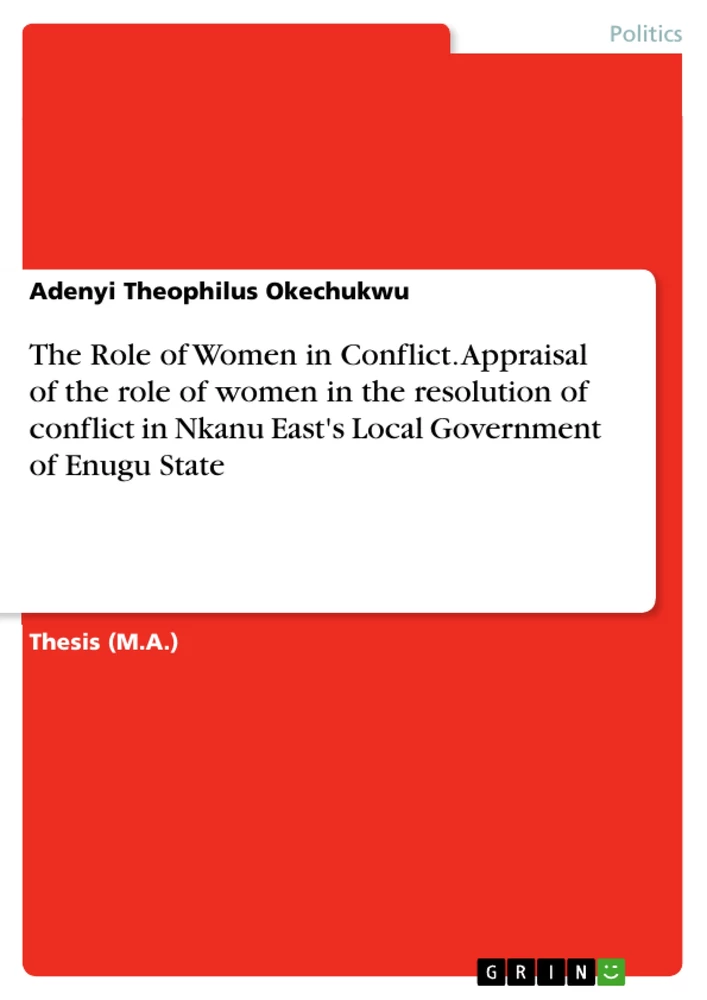
Table of Contents
Chapter One: Introduction
1.1 Background of the study
1.2 Statement of the Problem
1.3 Research Questions
1.4 Objective/ Purpose of the Study
1.5 Hypothesis
1.6 Significance of the Study
1.7 Scope of the Study
1.8 Definition of terms
Chapter Two: Literature Review
2.1 Introduction
2.2 Conceptual Framework
2.2.1 Concept of Conflict
2.2.2 Concept of Conflict Resolution
2.2.3 Concept of Gender equality
2.2.4 Concept of Peacebuilding
2.2.5 The role of Women in Peacebuilding
2.2.6 The Traditional Roles of African Women in peace Making and Peace Building
2.2.7 Te Role of African Women in Peace Building and Conflict Resolution: The Case of Burundi
2.2 Theoretical Framework
2.3 Summary
Chapter Three: Methodology
3.1 Area of Study
3.2 Research design
3.3 Sources of Data
3.4 Method of Data Collection
3.5 Sampling Techniques
3.6 Instrumentation
3.7 Method of Data Analysis
Chapter Four: Data Presentation, Analysis and Discussion
4.1 Data Presentation
4.1.1 Demographic Distribution of the Respondents/Interviewee
4.1.2 Analysis of Responses from Research Question
4.2 Findings of the Study
4.3 Discussion on the findings
Chapter Five: Conclusion and Recommendation
5.1 Conclusion
5.2 Recommendations
Research Objectives and Themes
This study aims to appraise the role of women in conflict resolution within the Nkanu East Local Government Area of Nigeria. The primary research objective is to investigate the extent to which women participate in conflict resolution processes, identify cultural barriers impeding their involvement, evaluate the strategies they utilize to foster peace, and determine their level of integration into local decision-making institutions in alignment with international standards.
- Participation of women in traditional conflict resolution institutions.
- Cultural barriers and social restrictions affecting women's peacebuilding roles.
- Traditional and contemporary strategies used by women to mitigate community conflicts.
- The status of gender mainstreaming and political representation of women in local governance.
Excerpt from the Book
1.1 Background of the study
Women’s role in conflict resolution and prevention, peacebuilding, peacemaking and reconciliation cannot be over-estimated or overemphasized. This is because apart from performing their biological and social activities of caring, giving birth, and bringing up humans as mothers, women also have the potentials of partaking in activities that is geared towards peaceful resolution of conflict as well as well in peacebuilding. Equally women have been at the forefront of efforts to build peace across the world. According to (Lute 2002:15) women are often the stabilizing force in the societies in which they exist. This is certainly true in post conflict settings where women represents essentially, the backbone of reconstruction and rehabilitation as well as the re-integration of former combatants and the re-emergence of basic economic activities in a society which is a war torn society , once peace has been achieved.
Long before the recognition of the role of women in peacebuilding process, they had already been very much involved in such activity. As a social group, women have been suitably identified as being pro-peace. Women have been highly visible in the forefront of movements for non violence and peace worldwide. Women usually assume the roles of peacemakers in families, in communities and in society even though they have often been victims (Agbu, Anike-Nweze , Idachaba and Durojaye 2006:96).
Summary of Chapters
Chapter One: Introduction: Outlines the significance of women in global peace efforts and introduces the study's specific focus on Nkanu East Local Government Area.
Chapter Two: Literature Review: Provides a theoretical foundation by exploring concepts of conflict, conflict resolution, gender equality, and peacebuilding while reviewing previous academic contributions.
Chapter Three: Methodology: Details the research design, survey methods, sampling techniques, and data collection tools employed in the study.
Chapter Four: Data Presentation, Analysis and Discussion: Presents the empirical data gathered from respondents, offering a detailed analysis of findings regarding women's roles and challenges.
Chapter Five: Conclusion and Recommendation: Summarizes the study's findings and offers policy recommendations for enhancing women's inclusion in conflict resolution and political decision-making.
Keywords
Conflict, Gender Equality, Conflict Prevention, Conflict Resolution, Peacemaking, Peacebuilding, Reconciliation, Nkanu East, Women's Roles, Local Governance, Umuada, Tradition, Resolution 1325, Nigeria, Community Development
Frequently Asked Questions
What is the core focus of this research?
The research focuses on appraising the involvement of women in conflict resolution, peacebuilding, and peacemaking efforts within the Nkanu East Local Government Area of Enugu State, Nigeria.
What are the primary themes addressed in the study?
The study covers the participation of women in local institutions, the impact of cultural and traditional barriers, the specific strategies women use for resolution, and their integration into elective and appointive political offices.
What is the main objective of this work?
The objective is to verify women's current participation levels, identify barriers to their involvement, explore their resolution strategies, and assess if their integration meets the standards of the UN Security Council Resolution 1325.
What research methodology was employed?
The study utilizes a quantitative research design, specifically a survey method, involving questionnaires and oral interviews with 200 respondents to gather primary data.
What topics are discussed in the main body?
The main body provides an extensive literature review on conflict and gender, a detailed description of the Nkanu East study area, and a robust presentation and analysis of field data.
Which keywords best characterize this work?
Key terms include Conflict, Gender Equality, Conflict Resolution, Peacemaking, Peacebuilding, Reconciliation, Nkanu East, and traditional institutions like Umuada.
What is the Difference Feminist theory's relevance here?
This theory is adopted to support the view that women possess unique, nurturing, and patient qualities that make them potentially more effective in conflict resolution and mediation compared to traditional male-dominated approaches.
How do traditional women's groups contribute to local peace?
Groups like Umuada, Christian Mothers Union, and Extended Family Wives Associations serve as vital, respected, and recognized bodies that facilitate arbitration and mediation in marital, family, and communal disputes.
What are the identified cultural barriers?
Key barriers include the exclusion of women from the Council of Elders and Traditional Rulers Cabinet, restrictions from participating in secret societies and masquerade activities, and taboos against women attending certain community General Assembly meetings.
What is the primary policy recommendation?
The study strongly recommends abolishing cultural barriers that limit women's membership in key community decision-making bodies and implementing a 35% quota for women in appointive and elective positions to align with international gender mainstreaming commitments.
Ende der Leseprobe aus 103 Seiten
- nach oben
- Arbeit zitieren
- Adenyi Theophilus Okechukwu (Autor:in), 2015, The Role of Women in Conflict. Appraisal of the role of women in the resolution of conflict in Nkanu East's Local Government of Enugu State, München, Page::Imprint:: GRINVerlagOHG, https://www.diplomarbeiten24.de/document/338735

neugierig - aktuell - relevant
Entdecken Sie hilfreiche Tipps und Tricks rund ums Studium!

Entdecken Sie hilfreiche Tipps und Tricks rund ums Studium!
Ihre Hausarbeit / Abschlussarbeit:

- - Publikation als E-Book und Buch
- - Hohes Honorar auf die Verkäufe
- - Für Sie komplett kostenlos - mit ISBN
- - Es dauert nur 5 Minuten
- - Jede Arbeit findet Leser

- © GRIN Publishing GmbH.
- Alle Inhalte urheberrechtlich geschützt. Kopieren und verbreiten untersagt.
- info@grin.com
- AGB
- Open Publishing
Der GRIN Verlag hat sich seit 1998 auf die Veröffentlichung akademischer eBooks und Bücher spezialisiert. Der GRIN Verlag steht damit als erstes Unternehmen für User Generated Quality Content. Die Verlagsseiten GRIN.com, Hausarbeiten.de und Diplomarbeiten24 bieten für Hochschullehrer, Absolventen und Studenten die ideale Plattform, wissenschaftliche Texte wie Hausarbeiten, Referate, Bachelorarbeiten, Masterarbeiten, Diplomarbeiten, Dissertationen und wissenschaftliche Aufsätze einem breiten Publikum zu präsentieren.
Kostenfreie Veröffentlichung: Hausarbeit, Bachelorarbeit, Diplomarbeit, Dissertation, Masterarbeit, Interpretation oder Referat jetzt veröffentlichen!
Folgen Sie GRIN auf


- GRIN Verlag GmbH
-
- Nymphenburger Str. 86
- 80636
- Munich, Deutschland
- +49 89-550559-0
- +49 89-550559-10
- info@grin.com
-
