
präsentiert von

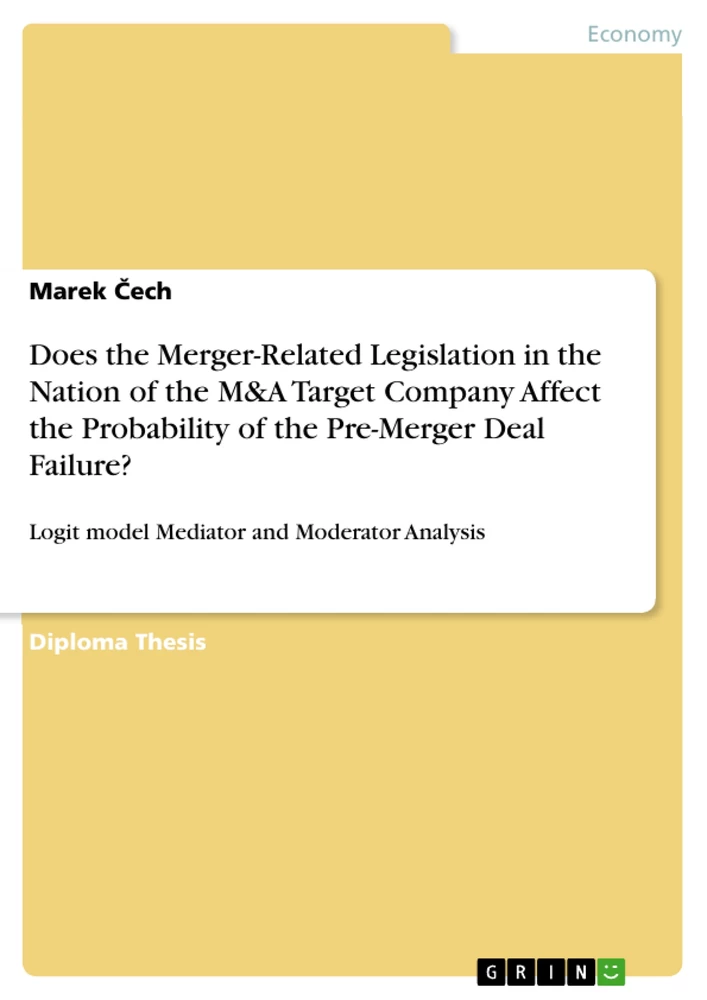
Table of Contents
1 Introduction
2 Literature Review
3 Merger Regulation
3.1 Antitrust Laws in the USA
3.1.1 The Sherman Act
3.1.2 The Federal Trade Commission Act
3.1.3 The Clayton Act
3.1.4 Federal Trade Commission Cases and Proceedings
3.2 Merger Regulation in the EU
3.2.1 Criteria for the EU Merger Regulation to Apply
3.2.2 The EU Merger Regulation Notification, Investigation and Penalties
3.2.3 The EU Merger Regulation Statistics
3.3 Comparison of the EU and US Merger Control Mechanisms
4 Takeover Defense Tactics
4.1 Dual-class Shares
4.2 ESOP
4.3 Poison Pills
4.4 Golden Parachute
4.5 Staggered Board Amendments
4.6 Greenmail
4.7 Comparison of the US, UK and Dutch Defense Tactics
5 Hypotheses Formulation
6 Logit Model Analysis
6.1 Methodology
6.1.1 Basic Assumptions of the Logit Model
6.2 Data Structure and Model Variables
6.2.1 The Dependent and Independent Variables
6.2.2 The Mediator Variables
6.2.3 The Moderator Variable
6.2.4 Descriptive Statistics
6.3 Logistic Regression Analysis
6.3.1 Hypothesis Testing
7 Robustness Test: Probit Model Analysis
8 Conclusion and Discussion
Research Objectives and Focus
This thesis investigates the impact of merger-related legislation in the nation of a target company on the likelihood of pre-merger deal failure. By analyzing 1,560 transactions proposed by Dutch bidders between 2003 and 2015, the study identifies country-specific legislative and administrative factors that mediate the relationship between the target nation and the probability of a deal being successfully completed.
- Empirical analysis of the impact of US and EU merger control mechanisms on deal outcomes.
- Evaluation of country-specific legal factors, including contract enforcement complexity and government effectiveness.
- Investigation of the influence of merger waves on deal completion probability.
- Assessment of the role of various takeover defense tactics as barriers to successful M&A.
Excerpt from the Book
3.1 Antitrust Laws in the USA
Since 1890, the United States Congress has passed three antitrust laws, namely the Sherman Act, the Federal Trade Commission Act, and the Clayton Act. After some revisions and amendments, all of them are currently still in effect. The main purpose of the US antitrust laws is to prohibit unlawful mergers, acquisitions and business practices in general. In order to spot and inspect such transactions, the laws have set fundamental rules and benchmarks for fair competition within firms whose activities and operations are in any way affecting the US economy. Since the antitrust laws define unlawful M&A and business practices in relatively general terms, the authorized courts then have to decide which of the transactions and activities are illegal based on the specific characteristics of each case. Yet, the basic objective of the law does not change. Every antitrust legal proceeding aims to protect competition in the relevant market for the customers’ benefit, making sure that businesses have strong incentives to operate efficiently and keep quality of their products up without increasing their prices (Federal Trade Commission, 2016).
Summary of Chapters
1 Introduction: Provides an overview of global M&A activity, trends, and the motivation behind investigating deal failures during the pre-merger phase.
2 Literature Review: Synthesizes existing academic work on reasons for M&A failure, focusing on cross-border challenges, regulatory environments, and takeover defense strategies.
3 Merger Regulation: Details US and EU antitrust laws and regulations, comparing their restrictiveness and enforcement mechanisms.
4 Takeover Defense Tactics: Describes common legal strategies utilized by company management to prevent hostile takeovers and their varying legal status across the US, UK, and the Netherlands.
5 Hypotheses Formulation: Defines the three main hypotheses regarding the negative impact of US-based legislative environments and merger wave stages on deal completion.
6 Logit Model Analysis: Conducts the empirical research using a logistic regression model, outlining the methodology, variables, and testing of mediators and moderators.
7 Robustness Test: Probit Model Analysis: Validates the consistency of the logit model results by replicating the empirical analysis using a probit regression approach.
8 Conclusion and Discussion: Summarizes the study's findings, acknowledges the limitations of the model, and suggests areas for future academic research.
Keywords
Mergers and Acquisitions, M&A, Deal Failure, Pre-merger, Merger Regulation, Logit Model, Antitrust Laws, Takeover Defense, US Federal Trade Commission, EU Merger Regulation, Mediation Analysis, Contract Enforcement, Government Effectiveness, Merger Waves, Corporate Governance
Frequently Asked Questions
What is the core focus of this research?
The research explores how the legal and regulatory environment in a target company's country influences whether an announced merger or acquisition successfully proceeds to completion or fails during the pre-merger negotiation stage.
What are the primary themes discussed in the paper?
The work focuses on merger control mechanisms (antitrust laws), the role of government effectiveness in policy implementation, contract enforcement procedures, and the influence of popular takeover defense tactics such as poison pills and golden parachutes.
What is the primary research question?
The study specifically asks: "Does the merger-related legislation in the nation of the M&A target company affect the probability of the pre-merger deal failure?"
Which scientific methodology is employed?
The author uses a quantitative approach, specifically a logistic regression (logit model) analysis, supplemented by a mediation and moderation analysis to identify the drivers of deal failure. A probit model is also used as a robustness check.
What topics are covered in the main section?
The main part of the thesis details the US and EU legal systems, presents a comparison of their respective regulatory restrictiveness, explains takeover defense strategies, and empirically tests hypotheses using a dataset of 1,560 M&A transactions.
Which keywords define this thesis?
The paper is characterized by terms such as M&A, deal failure, antitrust law, logit model, and merger control, among others.
How do US and EU regulations compare in terms of their impact on M&A?
The research finds that US merger regulation is significantly more restrictive than that of the EU, which contributes to a higher probability of pre-merger deal failure for transactions involving US target companies.
What did the analysis reveal about merger waves?
The analysis showed that during the end of a merger wave, the percentage of incomplete transactions was significantly higher; however, the hypothesis that a merger wave has a specific "moderating effect" on US-target deals could not be statistically confirmed.
Ende der Leseprobe aus 55 Seiten
- nach oben
- Arbeit zitieren
- Bc Marek Čech (Autor:in), 2016, Does the Merger-Related Legislation in the Nation of the M&A Target Company Affect the Probability of the Pre-Merger Deal Failure?, München, Page::Imprint:: GRINVerlagOHG, https://www.diplomarbeiten24.de/document/342294

neugierig - aktuell - relevant
Entdecken Sie hilfreiche Tipps und Tricks rund ums Studium!

Entdecken Sie hilfreiche Tipps und Tricks rund ums Studium!
Ihre Hausarbeit / Abschlussarbeit:

- - Publikation als E-Book und Buch
- - Hohes Honorar auf die Verkäufe
- - Für Sie komplett kostenlos - mit ISBN
- - Es dauert nur 5 Minuten
- - Jede Arbeit findet Leser

- © GRIN Publishing GmbH.
- Alle Inhalte urheberrechtlich geschützt. Kopieren und verbreiten untersagt.
- info@grin.com
- AGB
- Open Publishing
Der GRIN Verlag hat sich seit 1998 auf die Veröffentlichung akademischer eBooks und Bücher spezialisiert. Der GRIN Verlag steht damit als erstes Unternehmen für User Generated Quality Content. Die Verlagsseiten GRIN.com, Hausarbeiten.de und Diplomarbeiten24 bieten für Hochschullehrer, Absolventen und Studenten die ideale Plattform, wissenschaftliche Texte wie Hausarbeiten, Referate, Bachelorarbeiten, Masterarbeiten, Diplomarbeiten, Dissertationen und wissenschaftliche Aufsätze einem breiten Publikum zu präsentieren.
Kostenfreie Veröffentlichung: Hausarbeit, Bachelorarbeit, Diplomarbeit, Dissertation, Masterarbeit, Interpretation oder Referat jetzt veröffentlichen!
Folgen Sie GRIN auf


- GRIN Verlag GmbH
-
- Nymphenburger Str. 86
- 80636
- Munich, Deutschland
- +49 89-550559-0
- +49 89-550559-10
- info@grin.com
-
