
präsentiert von

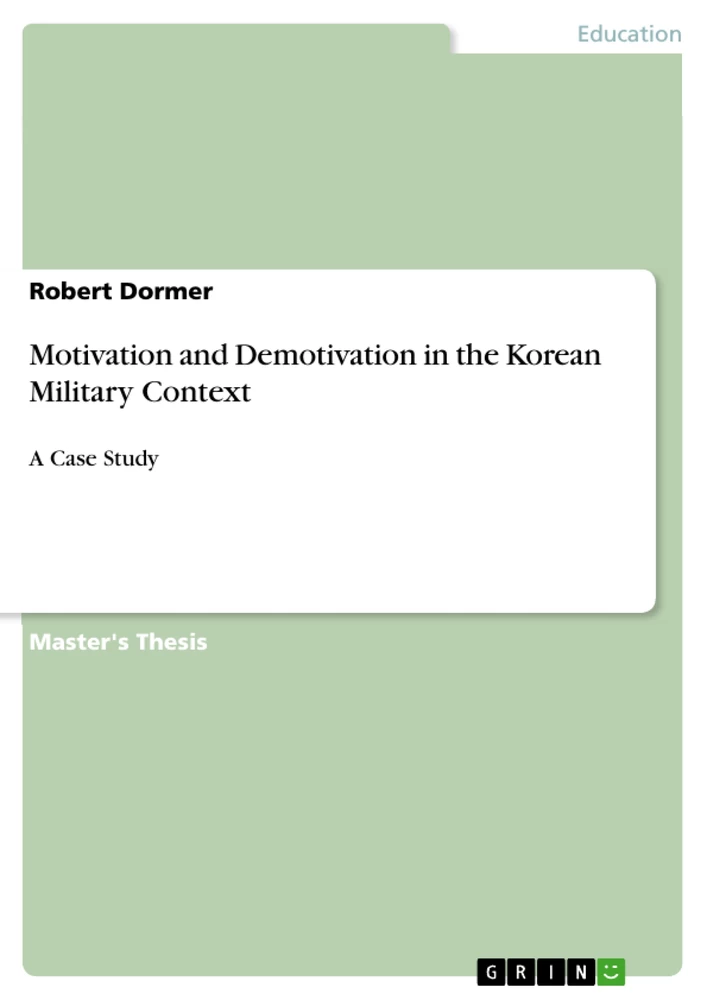
Table of Contents
1. Introduction
2. Literature Review
2.1. The Socio-Educational Model
2.2 The Quantitative Methodology of the Socio-Educational Approach
2.3 Criticism of the AMTB/Socio-Education Model
2.4 The Agenda for Change
2.5 The Need for Qualitative Enquiry
2.6 Attributional Processes
2.7 Demotivation
2.8 Ownership of English
2.9 English as a Lingua Franca
2.10 Integrativeness in World Englishes Contexts
2.11 The ‘Ideal L2 Self’
2.12 Future Research
2.13 Research Aims
3. Method
3.1 Semi-Structured Interviews
3.2 Ethical Considerations
3.3 Data Analysis
4. Results
4.1 Current Motivation
4.2 Integrative/Instrumental Orientation
4.3 Changes in Motivation over Time
4.4 The Role of Textbooks, Teachers, & Institutions
4.5 Motivation Strategies
4.6 The Role of Testing
4.7 Previous Learning Experiences & Motivation
4.8 A Duty to Learn English
4.9 ‘Doing Well’ & Success/Failure Attribution
4.10 Target Groups, Pronunciation/Style, and Ownership
4.11 Demotivation
4.12 Personal Factors & Workload
5. Discussion
5.1 Research Aim 1
5.2 Research Aim 2
5.3 Research Aim 3
5.4 Research Aim 4
5.5 Research Aim 5
5.6 Research Aim 6
5.7 Research Aim 7
5.8 Research Aim 8
5.9 Research Aim 9
5.10 Limitations of the Study
5.11 Future Research Implications
5.12 Conclusion
6. Bibliography
7. Appendices
Research Objectives and Core Themes
This study investigates L2 motivation among highly proficient Korean naval military officers. The primary objective is to explore their motivational orientations, the influence of educational factors, and how these unique professional contexts shape their learning experiences, thereby contributing qualitative insights to the existing body of predominantly quantitative motivation research.
- Instrumental motivation and career-focused goals in professional contexts.
- The impact of institutional environments and testing regimes on learner motivation.
- Exploratory qualitative analysis of L2 motivational self-systems.
- Context-specific factors influencing L2 learning, including military duty and cultural expectations.
Excerpt from the Book
2.1 The Socio-Educational Model
The model sought to understand second language-learning in terms of the wider social-psychological tradition, which holds that attitudes towards targets influence overall target-orientated behaviour. Motivation was characterised in terms of four categories:
• Antecedent Factors: Including both biological (e.g. gender/age) and experiential (learning history) factors.
• Individual Differences: Learner variables.
• Language Acquisition Contexts.
• Learning Outcomes (Dornyei, 2001, p.52).
Recent application and revision of the model (especially AMTB implementation- see below), a view where “the socio-cultural milieu... [overrides] all aspects of the model” (Gardner & MacIntyre, 2003a, p.7) has emerged, such that “when considering the process of second language acquisition, it is recommended that close attention be directed to the social context in which the learning is taking place” (2003a, p.7-8). Gardner’s socio education model, and the AMTB it inspires, has been widely applied. There has however been both criticism of the model, and a major concession from Gardner concerning the purpose and limitations of the model. In the former case, Au (1988) has challenged both the claim to generality of the Integrative Motive Hypothesis (that integrative motivation is positively related to achievement), and the claim that the Integrative Motive itself is unitary (Au, 1988, p.90-1).
Summary of Chapters
1. Introduction: Outlines the shift in L2 research away from traditional Gardnerian methodology and introduces the study of four Korean naval officers.
2. Literature Review: Provides a comprehensive overview of L2 motivation theories, from the socio-educational model to contemporary concepts like the 'Ideal L2 Self'.
3. Method: Describes the use of semi-structured interviews, ethical considerations in a military context, and the categorical data analysis approach.
4. Results: Details the findings regarding current motivation, the impact of testing, and the influence of professional military duties on language learning.
5. Discussion: Synthesizes the results, interpreting them through the lens of existing motivation theory and identifying the specific influence of the Korean professional context.
Keywords
L2 motivation, Socio-educational model, World Englishes, Korean military, Qualitative research, Instrumental orientation, Ideal L2 Self, Demotivation, Attribution theory, Language learning, Professional English, Testing, Hakbul, Professional military capacity, Exploratory study.
Frequently Asked Questions
What is the core focus of this research?
The study examines the L2 motivation of Korean naval officers, specifically focusing on their orientation towards learning English within a unique professional and cultural context.
What are the central thematic fields addressed in this work?
The work covers motivational orientation, the influence of educational environments, the role of testing, and the specific impact of professional duties on language acquisition.
What is the primary research objective?
The main goal is to explore how these specific learners perceive their motivation and to contribute qualitative, context-specific data to the broader field of L2 motivation research.
Which scientific methods were employed?
The researcher used semi-structured interviews to gather detailed qualitative data, followed by content analysis and categorization to identify patterns and themes.
What is covered in the main body of the work?
The main body examines established motivational theories, presents the collected data through thematic tables, and discusses the findings in relation to professional and cultural influences.
What characterizes this study’s unique perspective?
It uniquely applies L2 motivation theory to a specialized military professional group, highlighting the dominance of instrumental goals over traditional affective variables.
How does the "hakbul" culture specifically influence the learners?
The "hakbul" culture in Korea emphasizes the importance of test results and credentials, which the learners in this study perceive as a significant indicator of success and a major driver of their motivation.
How is the "Ideal L2 Self" concept applied to these learners?
The study explores whether the learners’ career ambitions and professional goals can be interpreted as the formation of an "Ideal L2 Self" that is inherently instrumental rather than integrative.
Ende der Leseprobe aus 86 Seiten
- nach oben
- Arbeit zitieren
- Robert Dormer (Autor:in), 2012, Motivation and Demotivation in the Korean Military Context, München, Page::Imprint:: GRINVerlagOHG, https://www.diplomarbeiten24.de/document/342581

neugierig - aktuell - relevant
Entdecken Sie hilfreiche Tipps und Tricks rund ums Studium!

Entdecken Sie hilfreiche Tipps und Tricks rund ums Studium!
Ihre Hausarbeit / Abschlussarbeit:

- - Publikation als E-Book und Buch
- - Hohes Honorar auf die Verkäufe
- - Für Sie komplett kostenlos - mit ISBN
- - Es dauert nur 5 Minuten
- - Jede Arbeit findet Leser

- © GRIN Publishing GmbH.
- Alle Inhalte urheberrechtlich geschützt. Kopieren und verbreiten untersagt.
- info@grin.com
- AGB
- Open Publishing
Der GRIN Verlag hat sich seit 1998 auf die Veröffentlichung akademischer eBooks und Bücher spezialisiert. Der GRIN Verlag steht damit als erstes Unternehmen für User Generated Quality Content. Die Verlagsseiten GRIN.com, Hausarbeiten.de und Diplomarbeiten24 bieten für Hochschullehrer, Absolventen und Studenten die ideale Plattform, wissenschaftliche Texte wie Hausarbeiten, Referate, Bachelorarbeiten, Masterarbeiten, Diplomarbeiten, Dissertationen und wissenschaftliche Aufsätze einem breiten Publikum zu präsentieren.
Kostenfreie Veröffentlichung: Hausarbeit, Bachelorarbeit, Diplomarbeit, Dissertation, Masterarbeit, Interpretation oder Referat jetzt veröffentlichen!
Folgen Sie GRIN auf


- GRIN Verlag GmbH
-
- Nymphenburger Str. 86
- 80636
- Munich, Deutschland
- +49 89-550559-0
- +49 89-550559-10
- info@grin.com
-
