
präsentiert von

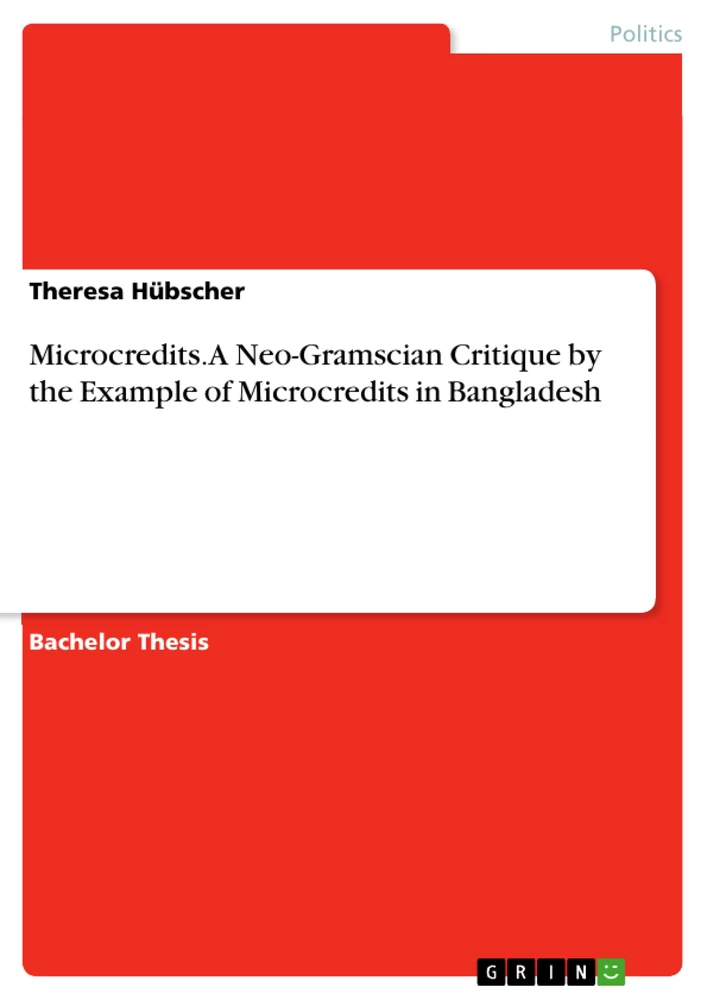
Table of Contents
1. Introduction
2. Microcredits – A Definition
3. Bangladesh, the Centre of Microcredits
3.1 Bangladesh’s Economic Environment
3.2 The Role of NGOs and Microfinance in Bangladesh
4. The Fundamentals of Neo-Gramscianism by Robert W. Cox
4.1 The Basic Ideas of Antonio Gramsci
4.2 Further Development by Robert W. Cox
4.3 The Process of Trasformiso
4.4 NGOs as Transnational Communities
4.5 Assimilation of Third World Protagonists
5. Microcredits’ Goal of Women Empowerment
5.1 Empowering Women Through Entrepreneurship
5.2 Household Control
5.3 Focus on Income-Generating Activities
5.3.1 Microcredits’ High Interest Rates
5.3.2 Subsidization of Microcredits as Possible Solution
5.4 The Group Lending Factor
6. Microcredits – Suitable to Reach the Poorest?
6.1 Replication of Findings
6.2 Waterfall Strategies to Overcome Micro Debt
7. Microcredits’ Neoliberal Environment
7.1 In Pursuit of the Hegemonic Policy
7.1.1 Multinationals’ Advantage of Investing in Microcredit Programmes
7.1.2 NGOs' Dependence on the International Capital Market
7.1.3 Third World Countries’ Lack of Participation
7.2 Microcredits’ Failure to Engage in Social Mobilization
7.2.1 NGOs’ Counter-Hegemonic Potential
7.2.2 Better Performance of Social Mobilization NGOs
7.2.3 The Gender and Food Caravan
8. Conclusion
8.1 The Neo-Gramscian Verdict
8.2 Strengths and Weaknesses of Neo-Gramscianism
Research Objectives and Themes
This thesis aims to provide a Neo-Gramscian critique of microcredits as a development tool, using Bangladesh as a case study to demonstrate how these financial instruments often reinforce asymmetrical power relations and neoliberal agendas rather than truly empowering the poor.
- Application of Neo-Gramscian theory to microfinance practices.
- Critique of the commercialization of NGOs and their dependence on international capital.
- Analysis of women's empowerment claims vs. actual household control and debt cycles.
- Comparison of microfinance with social mobilization movements in Bangladesh.
- Evaluation of the influence of Western donors and multinationals in shaping local development policies.
Excerpt from the Book
3.1 Bangladesh’s Economic Environment
Albeit the country’s economy is developing dynamically with a current growth rate of 6,25%, more than 40% still live below the UN-defined poverty line of 1,25 $US a day. (BMZ July 2016) Considering that MFIs have been operating in the country since more than four decades, this is a fact that may raise doubts of microcredits’ ability to “reach the poorest of the poor”. (Zaman 2004: 11) Equally alarming is the paradoxical combination of development outcomes and poor quality of governance, reflected by high levels of corruption and democratic deficits and a civil society that does not make use of its formal rights. (Castro / Kabeer / Mahmud 2012: 2044) What is more, Bangladesh has an illiterate rate of 40% and a child mortality rate of 38% which is ten times as high as in Germany. (BMZ July 2016) In consideration of such observations it remains questionable if borrowing from an MFI really empowers people to “control their own destiny”. (Kota 2007) This, in turn, makes Bangladesh an interesting case to investigate on, especially with regard to the Neo-Gramscian critique of microcredits this paper aims to provide.
Summary of Chapters
1. Introduction: Outlines the critical stance toward the microcredit success narrative and introduces the Neo-Gramscian framework for the analysis.
2. Microcredits – A Definition: Provides a basic definition of microcredits and their focus on supporting microenterprises.
3. Bangladesh, the Centre of Microcredits: Examines Bangladesh's economic environment and the dominant role of major NGOs in the local microfinance market.
4. The Fundamentals of Neo-Gramscianism by Robert W. Cox: Explains key concepts like hegemony, passive revolution, and trasfomismo within the context of international relations.
5. Microcredits’ Goal of Women Empowerment: Critically evaluates the empowerment narrative, highlighting issues like household control and high interest rates.
6. Microcredits – Suitable to Reach the Poorest?: Challenges the effectiveness of microcredits through replication studies and analysis of debt-cycle strategies.
7. Microcredits’ Neoliberal Environment: Investigates the structural influence of Western donors and multinationals on NGO operations and the suppression of social mobilization.
8. Conclusion: Synthesizes the Neo-Gramscian verdict, noting the theory's strengths in connecting local and international power structures while acknowledging its limitations.
Keywords
Microcredits, Neo-Gramscianism, Bangladesh, NGOs, Women Empowerment, Neoliberalism, Robert W. Cox, Hegemony, Social Mobilization, Debt Cycle, International Development, Capitalist System, Trasformismo, Grameen Bank, BRAC.
Frequently Asked Questions
What is the core focus of this research paper?
The paper provides a Neo-Gramscian critique of microcredits, arguing that they act as an instrument of the neoliberal system rather than a genuine tool for empowering the poor.
What are the primary thematic areas covered?
The study covers the role of NGOs in Bangladesh, Neo-Gramscian theory, the economics of microfinance, gender-specific empowerment, and the influence of international donors.
What is the research goal of this work?
The goal is to analyze whether microcredits fulfill their promise of empowerment or if they instead perpetuate asymmetrical power relations in favor of Western-dominated capitalism.
Which scientific method is applied here?
The paper applies the Neo-Gramscian theory of Robert W. Cox to perform a structural analysis of development policy, focusing on the interplay between national and international political-economic levels.
What is addressed in the main body of the paper?
The main body examines empirical case studies, the institutional transformation of NGOs, the impact of group lending, and the comparative performance of social mobilization vs. microfinance NGOs.
Which keywords best characterize this work?
Key terms include Microcredits, Neo-Gramscianism, Neoliberalism, Bangladesh, NGO dependency, and Hegemony.
How does the author define the "waterfall strategy"?
The author describes this as a desperate survival tactic where clients take out new loans from different NGOs to pay off the weekly installments of existing microcredits, trapping them in a cycle of debt.
What is the role of "trasformismo" in this analysis?
The paper uses "trasformismo" to explain how potentially revolutionary actors (like NGOs) are co-opted into the dominant neoliberal historical bloc, thereby neutralizing their ability to challenge the system.
Ende der Leseprobe aus 35 Seiten
- nach oben
- Arbeit zitieren
- Theresa Hübscher (Autor:in), 2016, Microcredits. A Neo-Gramscian Critique by the Example of Microcredits in Bangladesh, München, Page::Imprint:: GRINVerlagOHG, https://www.diplomarbeiten24.de/document/344414

neugierig - aktuell - relevant
Entdecken Sie hilfreiche Tipps und Tricks rund ums Studium!

Entdecken Sie hilfreiche Tipps und Tricks rund ums Studium!
Ihre Hausarbeit / Abschlussarbeit:

- - Publikation als E-Book und Buch
- - Hohes Honorar auf die Verkäufe
- - Für Sie komplett kostenlos - mit ISBN
- - Es dauert nur 5 Minuten
- - Jede Arbeit findet Leser

- © GRIN Publishing GmbH.
- Alle Inhalte urheberrechtlich geschützt. Kopieren und verbreiten untersagt.
- info@grin.com
- AGB
- Open Publishing
Der GRIN Verlag hat sich seit 1998 auf die Veröffentlichung akademischer eBooks und Bücher spezialisiert. Der GRIN Verlag steht damit als erstes Unternehmen für User Generated Quality Content. Die Verlagsseiten GRIN.com, Hausarbeiten.de und Diplomarbeiten24 bieten für Hochschullehrer, Absolventen und Studenten die ideale Plattform, wissenschaftliche Texte wie Hausarbeiten, Referate, Bachelorarbeiten, Masterarbeiten, Diplomarbeiten, Dissertationen und wissenschaftliche Aufsätze einem breiten Publikum zu präsentieren.
Kostenfreie Veröffentlichung: Hausarbeit, Bachelorarbeit, Diplomarbeit, Dissertation, Masterarbeit, Interpretation oder Referat jetzt veröffentlichen!
Folgen Sie GRIN auf


- GRIN Verlag GmbH
-
- Nymphenburger Str. 86
- 80636
- Munich, Deutschland
- +49 89-550559-0
- +49 89-550559-10
- info@grin.com
-
