
präsentiert von

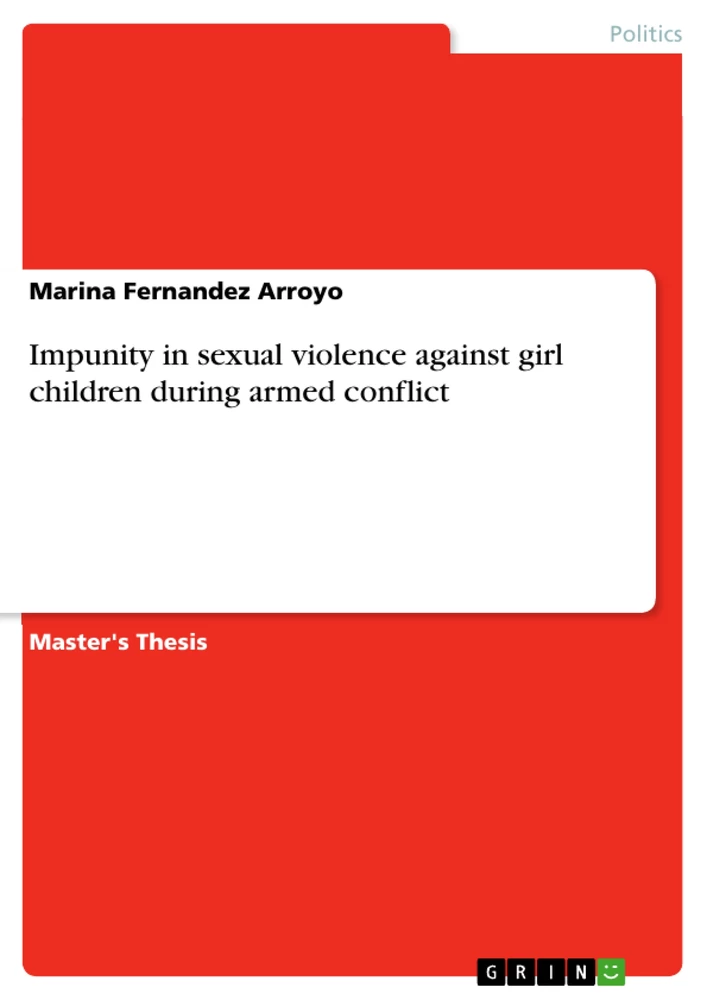
Table of Contents
Introduction
Chapter 1: The Context of Sexual Violence in Armed Conflict
Chapter 2: Legal Protection Afforded in Sexual Violence in Armed Conflict
Chapter 3: Reasons Leading to Impunity for SGBV Crimes
Conclusion
Research Objectives and Themes
This paper examines the persistent issue of sexual violence against girl children during armed conflicts, analyzing the recurring patterns of perpetration, the legal frameworks intended to provide protection, and the structural factors that perpetuate widespread impunity.
- The vulnerability of girl children as primary targets in armed conflict.
- The role of sexual violence as a systematic tactic of war and terror.
- Evaluation of International Humanitarian Law and International Criminal Law frameworks.
- Analysis of institutional and societal barriers to justice in conflict-affected states.
- The impact of state-level law enforcement failures and corruption on victim protection.
Excerpt from the Book
PERPETRATORS
The perpetrators are non-state armed groups, state armed groups, UN peacekeepers and civilians. In Colombia for example, the Constitutional Court acknowledged that all the actors in the armed conflict participate in this practice. In DRC, half of the perpetrators are armed groups and half state armed forces. In eastern DRC, there is a huge number of armed groups committing sexual violence, abducting women making them their sex slaves. In CAR armed groups practice forced recruitment, sexual slavery and forced marriage against girls and women.
One of the problems in DRC is that the government integrated many armed groups that had committed many violations into the state armed forces. As a result, the majority of the convictions by military courts since 2011 go against state armed forces. Indeed, according to HRW, the DRC state forces are responsible for “some of the worst abuses over the past two decades”, so it is not surprising that 73% of those convicted by military courts for sexual violence were FARDC members. In Colombia, according to the Ombudsman, the State security forces commit sexual violence taking advantage of the situation of outbreak, and not as a war tactic. It is also of concern for the CRC for Colombia (2015) that many times, the perpetrators of crimes of sexual violence against children are their own family members. Lastly, the reported behaviour of UN peacekeepers in MONUSCO in DRC and MINUSCA in CAR of sexual abuse of children is also worrying.
Summary of Chapters
Introduction: Provides an overview of the dangerous reality for women and girls in modern conflicts and establishes the paper's focus on the disproportionate impact on girl children.
Chapter 1: The Context of Sexual Violence in Armed Conflict: Describes the global prevalence of sexual violence, highlighting it as a systematic war tactic and documenting the alarming statistics regarding child victims.
Chapter 2: Legal Protection Afforded in Sexual Violence in Armed Conflict: Outlines the international and domestic legal frameworks, including humanitarian and human rights law, designed to prevent sexual violence and punish perpetrators.
Chapter 3: Reasons Leading to Impunity for SGBV Crimes: Analyzes the structural and circumstantial factors, such as corruption and social stigma, that prevent effective prosecution and justice for survivors.
Conclusion: Summarizes the findings, arguing that the primary issue is not a lack of legislation but a profound failure in enforcement and political will, and offers recommendations for reform.
Keywords
Sexual violence, armed conflict, girl children, impunity, human rights, international humanitarian law, war crimes, DRC, Colombia, sexual slavery, accountability, gender-based violence, transitional justice, state forces, victim protection.
Frequently Asked Questions
What is the primary focus of this research?
The work primarily addresses the widespread and systematic nature of sexual violence against girls during armed conflicts and the prevailing lack of accountability for these crimes.
What are the central themes discussed in the book?
The book covers the tactical use of sexual violence in war, the legal mechanisms for protection under international and domestic law, and the complex socioeconomic and political reasons behind the high levels of impunity.
What is the core research question?
The research explores why, despite existing legal protections, sexual violence against girl children remains an endemic feature of armed conflict with near-total impunity for perpetrators.
Which scientific methods or approaches are utilized?
The author employs a comparative legal analysis and policy review, utilizing reports from international organizations, judicial tribunals, and human rights NGOs to evaluate the enforcement of laws in specific conflict zones like the DRC and Colombia.
What does the main body of the work cover?
It details the patterns of sexual violence, the status of legal protections in different jurisdictions, and an analysis of structural barriers—such as corruption and social stigma—that hinder the prosecution of these crimes.
Which keywords best characterize the work?
The study is characterized by terms such as impunity, SGBV, armed conflict, girl children, international humanitarian law, and judicial reform.
How does the author define the role of military jurisdiction in impunity?
The author identifies military jurisdiction as a frequent loophole for impunity, noting that military courts often shield high-ranking officers and fail to prosecute crimes effectively due to political pressures and institutional self-interest.
What role does social stigma play in the lack of victim reporting?
Social stigma creates a "permissive context" where victims are often blamed, rejected by their families, or pressured to marry their perpetrators to avoid "dishonor," which effectively silences them and prevents legal action.
Why are domestic laws in conflict-affected regions often ineffective?
Laws are often ineffective due to a lack of resources, endemic corruption, political unwillingness to prosecute state actors, and the absence of victim-friendly reporting mechanisms that account for the specific needs of children.
Ende der Leseprobe aus 31 Seiten
- nach oben
- Arbeit zitieren
- Marina Fernandez Arroyo (Autor:in), 2016, Impunity in sexual violence against girl children during armed conflict, München, Page::Imprint:: GRINVerlagOHG, https://www.diplomarbeiten24.de/document/354406

neugierig - aktuell - relevant
Entdecken Sie hilfreiche Tipps und Tricks rund ums Studium!

Entdecken Sie hilfreiche Tipps und Tricks rund ums Studium!
Ihre Hausarbeit / Abschlussarbeit:

- - Publikation als E-Book und Buch
- - Hohes Honorar auf die Verkäufe
- - Für Sie komplett kostenlos - mit ISBN
- - Es dauert nur 5 Minuten
- - Jede Arbeit findet Leser

- © GRIN Publishing GmbH.
- Alle Inhalte urheberrechtlich geschützt. Kopieren und verbreiten untersagt.
- info@grin.com
- AGB
- Open Publishing
Der GRIN Verlag hat sich seit 1998 auf die Veröffentlichung akademischer eBooks und Bücher spezialisiert. Der GRIN Verlag steht damit als erstes Unternehmen für User Generated Quality Content. Die Verlagsseiten GRIN.com, Hausarbeiten.de und Diplomarbeiten24 bieten für Hochschullehrer, Absolventen und Studenten die ideale Plattform, wissenschaftliche Texte wie Hausarbeiten, Referate, Bachelorarbeiten, Masterarbeiten, Diplomarbeiten, Dissertationen und wissenschaftliche Aufsätze einem breiten Publikum zu präsentieren.
Kostenfreie Veröffentlichung: Hausarbeit, Bachelorarbeit, Diplomarbeit, Dissertation, Masterarbeit, Interpretation oder Referat jetzt veröffentlichen!
Folgen Sie GRIN auf


- GRIN Verlag GmbH
-
- Nymphenburger Str. 86
- 80636
- Munich, Deutschland
- +49 89-550559-0
- +49 89-550559-10
- info@grin.com
-
