
präsentiert von

Contents
1 Introduction
2 Review of the Regulation Development of Financial Markets
3 Liquid Market and Market-Making
3.1 Market Liquidity
3.1.1 Swiss Franc Revaluation
3.1.2 The Taper Tantrum
3.1.3 Treasury Market Rally and Volatility of European Sovereign Bonds
3.2 Principles and Importance of Market-Making
3.3 Market-Making Versus Proprietary Trading
3.4 Modelling Market-Making
3.4.1 A Simple Model of Market-Making
3.4.2 The Case of Fixed Income
3.4.3 The Case of Lower Risk-Adjusted Return
3.4.4 The Case of Non-Falling Interest Rates
3.5 Change of Market-Making
3.5.1 Trends in Market-Making and the Behaviour of Market-Makers
3.5.2 Drivers of the Trend
3.6 Danger of a Dry-Up
3.6.1 A Model of Herd Behaviour
3.6.1.1 Herding Measure
3.6.1.2 Herding over Time and Price Impacts
3.6.2 A Model of Self-Fulfilling Liquidity Dry-Ups
3.6.2.1 Structure of the Model
3.6.2.2 Equilibrium
3.6.2.3 Externality and the Result of the Model
3.7 The Link between Liquid Markets and the Real Economy
3.7.1 The Households
3.7.2 A Household’s Decisions
3.7.3 The Equilibrium
3.7.4 Result of a Liquidity Shock
4 Data
5 Estimating Illiquidity
5.1 Related Literature
5.2 Bid-Ask Spreads
5.3 The Conventional Liquidity Ratio
5.4 Amihud Illiqudity Ratio
5.5 The Index of Martin
5.6 Marsh and Rock’s Liquidity Ratio
5.7 Change of Prices
5.8 Bao-Pan-Wang Model
5.8.1 Measuring Illiquidity
5.8.2 A Dynamic Approach
6 Conclusion
Research Objectives & Topics
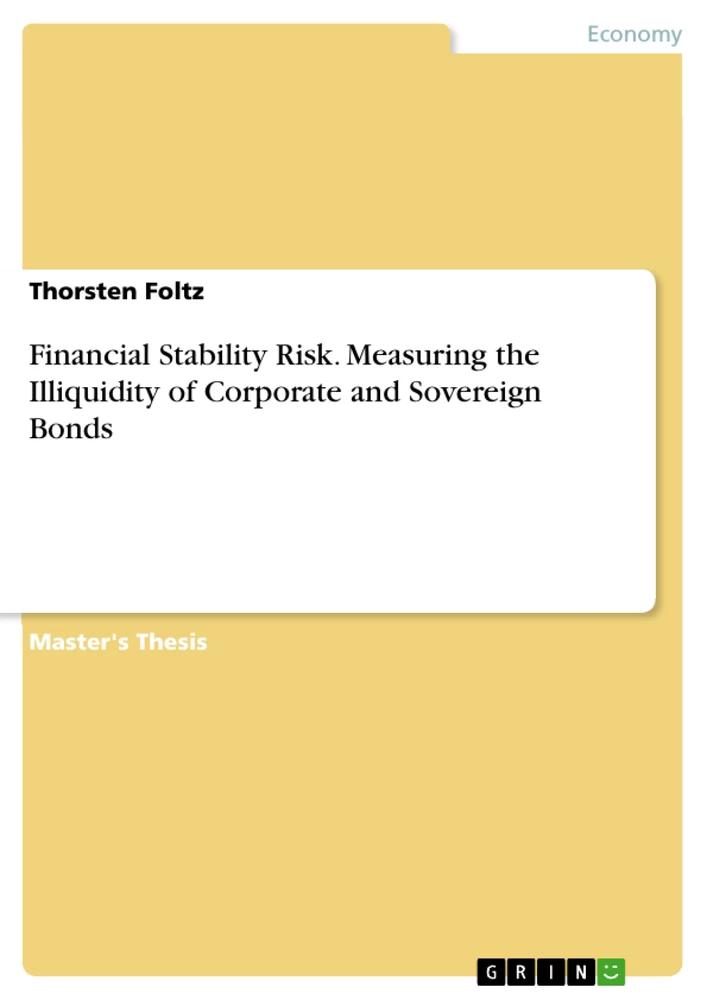
This thesis examines the increasing level of market illiquidity in global corporate and sovereign bond markets following the financial crisis and subsequent regulatory changes. The central research question investigates whether bond markets have become less liquid, the underlying behavioural shifts of market-makers, and how these illiquidity trends impact the broader real economy.
- Regulatory impact of Basel III and the Volcker Rule on market-making capacity.
- Theoretical modelling of market-making, herd behaviour, and liquidity dry-ups.
- Empirical analysis of liquidity trends across 34 countries using a dataset of 60,000 bonds.
- Assessment of the transmission mechanism between financial market liquidity shocks and real economic output.
Excerpt from the Book
3.1 Market Liquidity
The term liquidity refers to at least three different things. It has a tendency to be slippery in meaning (Hicks, 1962). When people speak about liquidity mostly they mean monetary supply, which can be named “global liquidity”, when referring to the world (Bank of England, 2007). Another notion is “monetary liquidity” which is associated with monetary aggregates (IMF, 2015). The second term is known as “funding liquidity”, which is defined as the ability of a bank or another financial institution to settle obligations with immediacy (Drehmann and Nikolaou, 2009). In other words, a bank has different assets in its balance sheet and sells them to customers, who hold them to maturity (de Haan, Oosterloss and Schoenmaker, p. 58, 2015). Of course, it is problematic, when a large part of assets remains in the financial sector, due to the remaining risk. Acharya and Schnabl (2009) state that this happened during the financial crisis in the US, when 30% of all AAA asset-backed securities remained within the banking system. This fraction rises to 50%, if one includes ABCP conduits (asset-backed commercial papers) and SIVs (structured investment vehicles) with recourse.
The third term is known as “market liquidity” — the ability to rapidly execute large financial transactions at a low cost level and with limited price impacts — and it is very important for financial stability and the real economic activity (IMF, 2015 and CGFS, 2014). Nevertheless, these three different liquidity concepts are related. When companies and households hold more money on their balance sheets because the supply of money has grown sharply, they will probably buy more financial assets. As a result, it is possible that market activity is stimulated and market liquidity increases (Bank of England, 2007).
Summary of Chapters
1 Introduction: Outlines the rise of market illiquidity post-financial crisis and sets the scope for examining regulatory impacts and their real economic consequences.
2 Review of the Regulation Development of Financial Markets: Provides a historical overview of financial deregulation and the subsequent implementation of reforms like Basel III and the Volcker Rule.
3 Liquid Market and Market-Making: Defines market liquidity, explains the role of market-makers, and presents theoretical models for market-making and liquidity dry-ups.
4 Data: Describes the microeconomic dataset comprising 60,434 bonds across 34 countries used for the empirical analysis.
5 Estimating Illiquidity: Empirically tests seven different liquidity measures to quantify bond market illiquidity trends and volatility over time.
6 Conclusion: Summarizes the findings, confirming that market liquidity has declined in the latest period, and calls for structural reforms to address these issues.
Keywords
Market Liquidity, Market-Maker, Financial Markets, Measuring Illiquidity, Corporate Bonds, Sovereign Bonds, Basel III, Herd Behaviour, Liquidity Dry-Up, Asset Pricing, Real Economy, Financial Stability, Regulatory Impact, Bid-Ask Spread, Trading Volume.
Frequently Asked Questions
What is the core focus of this Master Thesis?
This work explores the reasons behind the decreasing liquidity in bond markets globally, analyzing the interaction between recent financial regulations and the risk-averse behaviour of market-makers.
Which thematic fields are central to this research?
The thesis connects financial regulation, the mechanics of market-making, and macroeconomic modelling to understand how financial distress transmits to the real economy.
What is the primary research goal?
The goal is to determine if bond markets have become objectively less liquid since the financial crisis and to identify whether current regulatory frameworks require adjustment.
Which scientific methodology is applied?
The author combines theoretical modeling (e.g., CIR-model, herd behaviour models) with a rigorous empirical analysis of a microeconomic dataset covering over 60,000 bonds across 34 countries.
What topics are discussed in the main part?
The main part covers the historical context of financial regulation, detailed definitions of market liquidity, models of market-maker profitability and herd behaviour, and the estimation of liquidity using various financial ratios.
How would you characterize this thesis using keywords?
Key terms include Market Liquidity, Market-Maker, Corporate and Sovereign Bonds, Regulatory Impact, and Financial Stability.
How does the "Bao-Pan-Wang Model" contribute to the findings?
The Bao-Pan-Wang model is used to statistically validate that bond illiquidity increases with age and maturity, providing further empirical weight to the conclusion that liquidity has declined.
What is the significance of the "liquidity dry-up" models?
These models explain how self-fulfilling expectations and cash hoarding by financial institutions can lead to market breakdowns, offering a theoretical basis for observed market fragility.
Ende der Leseprobe aus 95 Seiten
- nach oben
- Arbeit zitieren
- Thorsten Foltz (Autor:in), 2016, Financial Stability Risk. Measuring the Illiquidity of Corporate and Sovereign Bonds, München, Page::Imprint:: GRINVerlagOHG, https://www.diplomarbeiten24.de/document/354737

neugierig - aktuell - relevant
Entdecken Sie hilfreiche Tipps und Tricks rund ums Studium!

Entdecken Sie hilfreiche Tipps und Tricks rund ums Studium!
Ihre Hausarbeit / Abschlussarbeit:

- - Publikation als E-Book und Buch
- - Hohes Honorar auf die Verkäufe
- - Für Sie komplett kostenlos - mit ISBN
- - Es dauert nur 5 Minuten
- - Jede Arbeit findet Leser

- © GRIN Publishing GmbH.
- Alle Inhalte urheberrechtlich geschützt. Kopieren und verbreiten untersagt.
- info@grin.com
- AGB
- Open Publishing
Der GRIN Verlag hat sich seit 1998 auf die Veröffentlichung akademischer eBooks und Bücher spezialisiert. Der GRIN Verlag steht damit als erstes Unternehmen für User Generated Quality Content. Die Verlagsseiten GRIN.com, Hausarbeiten.de und Diplomarbeiten24 bieten für Hochschullehrer, Absolventen und Studenten die ideale Plattform, wissenschaftliche Texte wie Hausarbeiten, Referate, Bachelorarbeiten, Masterarbeiten, Diplomarbeiten, Dissertationen und wissenschaftliche Aufsätze einem breiten Publikum zu präsentieren.
Kostenfreie Veröffentlichung: Hausarbeit, Bachelorarbeit, Diplomarbeit, Dissertation, Masterarbeit, Interpretation oder Referat jetzt veröffentlichen!
Folgen Sie GRIN auf


- GRIN Verlag GmbH
-
- Nymphenburger Str. 86
- 80636
- Munich, Deutschland
- +49 89-550559-0
- +49 89-550559-10
- info@grin.com
-
