
präsentiert von

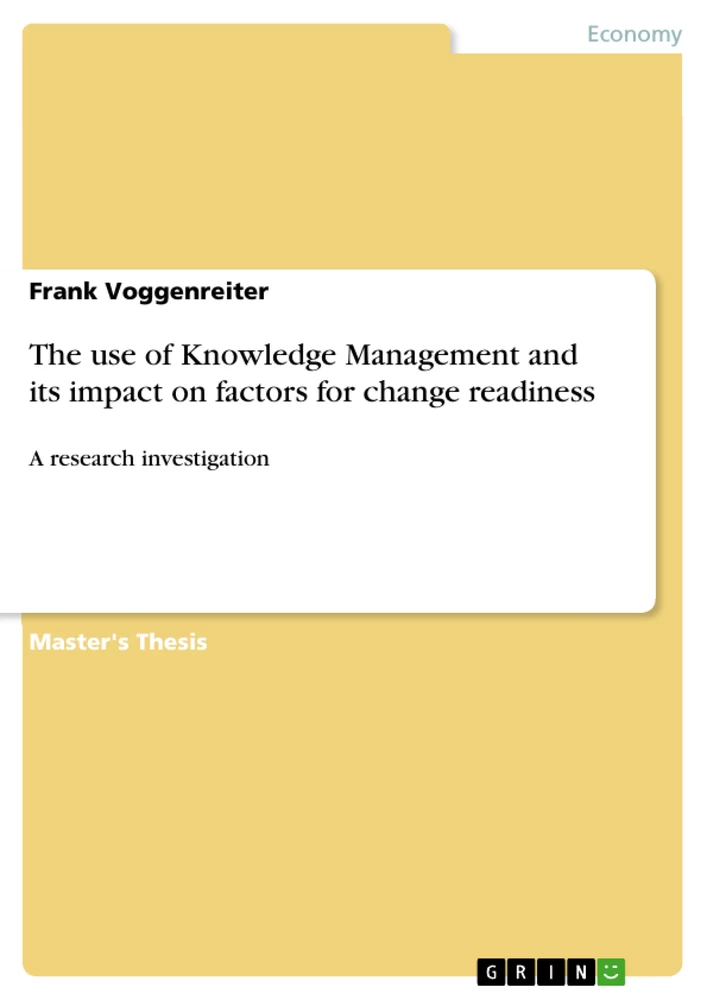
Table of Contents
Chapter 1: Aims of the Dissertation
1.1. Goals of the Research
1.2. Introduction to Problem
1.3. Definitions
1.4. Research Objective
Chapter 2: Review of the Literature
2.1. Introduction
2.2. Readiness for Change
2.3. Behaviour and Knowledge
2.4. Knowledge Management
2.5. Conclusions from literature review
Chapter 3: Research Methodology
3.1. Research approach
3.2. Survey testing
3.3. Interview testing
Chapter 4: Presentation of the Results
4.1. Survey Results
4.1.1. MB (MB)
4.1.2. Borderless Lifescience Group (XYZ)
4.1.3. Open survey to Pharmaceutical Specialists
4.2. Summary of survey findings
4.3. In-depth Interviews
4.3.1. Overview Participants
4.3.2. Interview Analysis
4.3.3. Interview Coding
4.3.4. Interview analysis support for Hypotheses
Chapter 5: Meaning of findings for Knowledge Management
5.1.1. Creating Knowledge
5.1.2. Creating Willingness
5.1.3. Creating Skill
Chapter 6: Limitation and Recommendations for Future Research
Research Objectives and Focus Areas
This research aims to identify change readiness factors within a German cultural and knowledge worker environment and to analyze how these factors can be influenced by Knowledge Management practices. The study investigates whether clear communication, understanding of change objectives, and personal skill development are significant drivers for employees to shift from resistance to active support during organizational change processes.
- The relationship between Knowledge Management and individual change readiness.
- Identification of barriers to behavioural change in professional environments.
- Evaluation of bi-directional information flows as a success factor for change initiatives.
- The role of individual needs and subjective perception in the adoption of new work routines.
- Categorization of employees based on their capability and willingness to embrace change.
Excerpt from the Dissertation
1.2. Introduction to Problem
Continuous change in organizations require continuous change of individuals working in these companies. Studies have provided evidence that personal change readiness is positively related to successful organizational change (Wittenstein, 2008, p.146). Individual change requires energy and energy is not an endless resource people can rely on (Madsen, John and Miller, 2006, p.108). To ensure that the available energy is not used to overcome change barriers, but is effectively used to fulfil the daily tasks at work, it is important to achieve a high readiness for change through individual and environmental factors (Madsen, John and Miller, 2006, p.108).
The continuous confrontation of companies with environmental factors forcing them to change (Balogan and Jenkins, 2003) (Child, 2005) (Roberts, 2004) require that organizations approach change not as a necessary exception of normal, but define change as the standard and amend their organization in a way that ensures a high level of individual change readiness is created (Armenakis, Harris and Mossholder, 1993) (Backer, 1998) (Cummings and Worley, 2009) (Cunningham et al., 2002).
Despite this known necessity the majority of change projects are not successful (Decker et al., 2012). The mismatch between a high required level of change readiness and the low success rate of change projects is a problem that will increase with an increasing change frequency in our world of globalized markets. This work will analyse the possibilities Knowledge Management can have on increasing the success of change projects by increasing the general change readiness.
Summary of Chapters
Chapter 1: Aims of the Dissertation: Outlines the research topic regarding the impact of Knowledge Management on employees' ability to adapt to organizational changes and defines the study's core hypotheses.
Chapter 2: Review of the Literature: Examines existing academic discourse on readiness for change, behavioural change, and organizational learning frameworks like I4 and SECI.
Chapter 3: Research Methodology: Details the mixed-methods approach, utilizing both quantitative online surveys and qualitative in-depth interviews to capture subjective employee experiences.
Chapter 4: Presentation of the Results: Reports the empirical data gathered from organizational surveys and individual interviews, highlighting recurring themes like the need for transparent communication.
Chapter 5: Meaning of findings for Knowledge Management: Synthesizes the results into a proposed framework for Knowledge Management to enhance change readiness by creating knowledge, willingness, and skill.
Chapter 6: Limitation and Recommendations for Future Research: Discusses the constraints of the study, specifically its focus on German culture, and suggests avenues for further exploration.
Keywords
Knowledge Management, Change Readiness, Behavioural Change, Organizational Change, Knowledge Worker, Individual Need, Employee Empowerment, Communication Flow, Change Management, Learning Organization, Subjective Perception, Trust, Skill Acquisition, Organizational Culture, German Business Environment
Frequently Asked Questions
What is the core focus of this dissertation?
The research examines the relationship between Knowledge Management practices and an individual employee's readiness to support organizational change, particularly focusing on the psychological and communicative factors involved.
Which thematic fields are addressed in this work?
Key topics include organizational change management, individual change readiness, knowledge flows within firms, employee motivation, and the impact of organizational culture on learning and adaptation.
What is the primary goal of the research?
The study aims to determine whether providing specific types of knowledge (information, understanding, and skill) significantly impacts an individual's perceived readiness to embrace change at work.
Which scientific methods were employed?
The researcher used a mixed-methods approach: a quantitative online survey conducted across three different organizational groups, followed by qualitative, semi-structured in-depth interviews with selected participants.
What topics are discussed in the main part of the thesis?
The main part covers a comprehensive literature review, the methodological framework, the presentation of survey and interview findings, and a discussion on how these findings can be integrated into a new Change Readiness Framework for Knowledge Management.
Which keywords best characterize the study?
The study is characterized by concepts such as Change Readiness, Knowledge Management, Employee Behaviour, Organizational Trust, and Professional Empowerment.
How does cultural background influence the results?
The study is limited to the German work environment, which is described as having low power distance and high individualism, leading to a greater expectation for direct, honest, and dialog-oriented communication from management.
Why are "empathy" and "dialogue" highlighted as critical?
The interview results indicate that even when formal information is provided, employees experience strain and resistance if they feel excluded from the process; thus, empathy and dialogue are essential to foster the trust required for change commitment.
What is the "Change Readiness Framework" proposed by the author?
It is a structured model that maps specific types of individual needs (Meaning, Willingness, Capability) to corresponding Knowledge Management tools, facilitating a more effective and supportive approach to organizational transitions.
Ende der Leseprobe aus 141 Seiten
- nach oben
- Arbeit zitieren
- Frank Voggenreiter (Autor:in), 2015, The use of Knowledge Management and its impact on factors for change readiness, München, Page::Imprint:: GRINVerlagOHG, https://www.diplomarbeiten24.de/document/355601

neugierig - aktuell - relevant
Entdecken Sie hilfreiche Tipps und Tricks rund ums Studium!

Entdecken Sie hilfreiche Tipps und Tricks rund ums Studium!
Ihre Hausarbeit / Abschlussarbeit:

- - Publikation als E-Book und Buch
- - Hohes Honorar auf die Verkäufe
- - Für Sie komplett kostenlos - mit ISBN
- - Es dauert nur 5 Minuten
- - Jede Arbeit findet Leser

- © GRIN Publishing GmbH.
- Alle Inhalte urheberrechtlich geschützt. Kopieren und verbreiten untersagt.
- info@grin.com
- AGB
- Open Publishing
Der GRIN Verlag hat sich seit 1998 auf die Veröffentlichung akademischer eBooks und Bücher spezialisiert. Der GRIN Verlag steht damit als erstes Unternehmen für User Generated Quality Content. Die Verlagsseiten GRIN.com, Hausarbeiten.de und Diplomarbeiten24 bieten für Hochschullehrer, Absolventen und Studenten die ideale Plattform, wissenschaftliche Texte wie Hausarbeiten, Referate, Bachelorarbeiten, Masterarbeiten, Diplomarbeiten, Dissertationen und wissenschaftliche Aufsätze einem breiten Publikum zu präsentieren.
Kostenfreie Veröffentlichung: Hausarbeit, Bachelorarbeit, Diplomarbeit, Dissertation, Masterarbeit, Interpretation oder Referat jetzt veröffentlichen!
Folgen Sie GRIN auf


- GRIN Verlag GmbH
-
- Nymphenburger Str. 86
- 80636
- Munich, Deutschland
- +49 89-550559-0
- +49 89-550559-10
- info@grin.com
-
