
präsentiert von

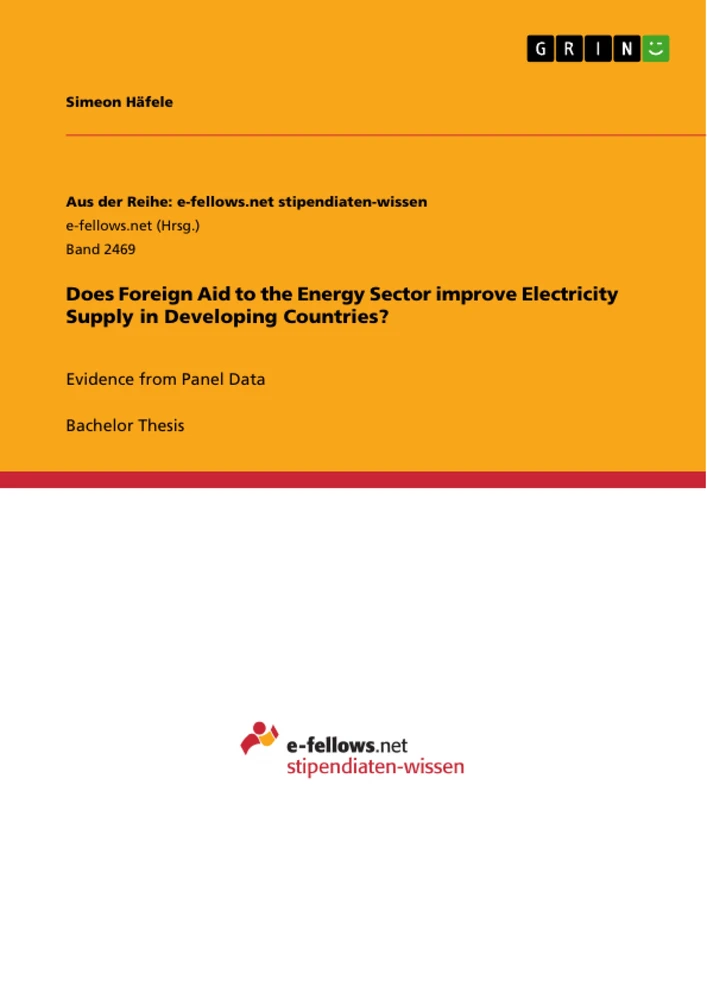
Table of Contents
I. INTRODUCTION
II. LITERATURE OVERVIEW
A. THE AID-GROWTH RELATIONSHIP
B. THE DISAGGREGATION OF AID FLOWS
C. THE ELECTRICITY SECTOR WORLDWIDE: AN OVERVIEW
D. THE NEXUSES OF ELECTRICITY SUPPLY
III. EMPIRICAL ANALYSIS
A. DATA SOURCES AND UNITS
B. DESCRIPTIVE STATISTICS
C. ESTIMATION STRATEGY
D. RESULTS
E. ROBUSTNESS TESTS
IV. CONCLUSION
Research Objectives & Core Themes
This bachelor thesis investigates whether foreign aid specifically allocated to the energy sector effectively promotes development within that sector, moving beyond the traditional macro-level aid-growth literature to examine sector-specific outcomes in electricity supply. The study aims to determine the impact of energy-sector aid disbursements on generation capacity, total output, and per capita consumption, while accounting for the heterogeneity of recipient countries across various income levels using a fixed effects model.
- Disaggregation of foreign aid flows by specific sectors
- Empirical analysis of electricity supply indicators in developing countries
- Assessment of aid effectiveness across different income groups
- Evaluation of the relationship between electricity infrastructure aid and output
- Identification of critical bottlenecks in electricity transmission and generation
Excerpt from the Book
The Aid-Growth Relationship
The impact and effectiveness of foreign aid on the development of countries has been an issue for researchers for over 40 years. However, there is still no clear answer to the question whether foreign aid does or does not foster economic growth or under which circumstances it could do so.
In line with the recent literature, e.g. Arndt, Jones, and Tarp (2010), Doucouliagos and Paldam (2009) or Mekasha and Tarp (2013), I categorise the existing studies on the aid-growth nexus into four generations:
The first generation, which represents literature in the 1970s and early 1980s was based on the idea that foreign aid should accumulate capital in receiving countries and that growth would be achieved by investing this capital. Being based on neoclassical growth theory, a linear relationship between growth on the one hand and investment in physical capital on the other hand was assumed (Arndt, Jones, and Tarp 2010, 2), but the actual impact on growth was hardly investigated in these studies, as they focus on the impact of aid on investment. Papanek (1973, 129) for example comes to the result that “Savings and the components of foreign inflows ... explain over a third of the growth rate. Foreign aid ... has a more significant effect on growth than savings or the other forms of foreign resource inflows.“ Altogether, most of these studies find a positive effect of aid on investment but also show that most aid is consumed (often by the government) and not invested (Arndt, Jones, and Tarp 2010, 2).
Summary of Chapters
I. INTRODUCTION: The chapter establishes the crucial role of electricity for modern development and identifies the research gap regarding the impact of sector-specific foreign aid on the electricity supply of developing countries.
II. LITERATURE OVERVIEW: This section reviews existing aid-effectiveness studies, provides a global overview of the electrification sector, and explores the multifaceted relationships between electricity supply and human development goals.
III. EMPIRICAL ANALYSIS: This chapter details the data sources, describes the statistical characteristics of the panel, outlines the fixed-effects estimation strategy, presents the regression results, and validates these findings through various robustness tests.
IV. CONCLUSION: The final chapter summarizes the findings, which suggest that energy-sector aid positively impacts total output, and offers policy implications regarding the importance of focusing on transmission infrastructure and targeting aid based on recipient country income levels.
Keywords
Foreign Aid, Energy Sector, Electricity Supply, Developing Countries, Aid Effectiveness, Panel Data, Fixed Effects Model, Total Output, Generation Capacity, Sustainable Development Goals, Infrastructure, Aid Disaggregation, Economic Development, Energy Policy, Transmission Losses
Frequently Asked Questions
What is the core focus of this thesis?
The thesis focuses on the effectiveness of foreign aid specifically granted to the energy sector and its impact on the development of the electricity sector in developing countries.
What are the primary themes addressed?
Central themes include the disaggregation of aid flows, the relationship between electricity supply and economic development, the effectiveness of aid in infrastructure construction, and the influence of institutional and economic factors on aid outcomes.
What is the main objective or research question?
The study seeks to answer whether foreign aid to the energy sector fosters development in that same sector, specifically by testing the hypothesis that such aid improves electricity supply metrics.
Which scientific methodology is applied?
The author uses a fixed effects (FE) regression model on panel data spanning from 1991 to 2010 to analyze the impact of energy-sector foreign aid on three distinct outcome indicators.
What does the main part of the thesis cover?
The main part covers a comprehensive literature review of the aid-growth relationship, an overview of global electrification challenges, a detailed description of data sources and the empirical model, and a series of regression results followed by rigorous robustness tests.
Which keywords characterize this work?
Key terms include Foreign Aid, Energy Sector, Electricity Supply, Aid Effectiveness, Fixed Effects Model, and Infrastructure, among others.
Why did the author choose to disaggregate aid flows?
The author argues that using aggregate aid data is misleading because different sectors have distinct goals and impacts; disaggregating allows for a clearer understanding of how specific interventions contribute to sector-level progress.
What conclusion does the author draw regarding transmission versus generation?
The analysis suggests that energy aid is more effectively utilized for the rehabilitation of power plants and the construction of transmission infrastructure, as transmission and distribution are often the primary bottlenecks in electricity supply.
How do income levels affect the effectiveness of energy aid?
The results indicate that energy aid tends to be more effective in upper-middle-income countries, potentially due to better organized utilities, stronger institutional frameworks, and increased capacity to manage and implement energy projects.
Ende der Leseprobe aus 56 Seiten
- nach oben
- Arbeit zitieren
- Simeon Häfele (Autor:in), 2016, Does Foreign Aid to the Energy Sector improve Electricity Supply in Developing Countries?, München, Page::Imprint:: GRINVerlagOHG, https://www.diplomarbeiten24.de/document/356775

neugierig - aktuell - relevant
Entdecken Sie hilfreiche Tipps und Tricks rund ums Studium!

Entdecken Sie hilfreiche Tipps und Tricks rund ums Studium!
Ihre Hausarbeit / Abschlussarbeit:

- - Publikation als E-Book und Buch
- - Hohes Honorar auf die Verkäufe
- - Für Sie komplett kostenlos - mit ISBN
- - Es dauert nur 5 Minuten
- - Jede Arbeit findet Leser

- © GRIN Publishing GmbH.
- Alle Inhalte urheberrechtlich geschützt. Kopieren und verbreiten untersagt.
- info@grin.com
- AGB
- Open Publishing
Der GRIN Verlag hat sich seit 1998 auf die Veröffentlichung akademischer eBooks und Bücher spezialisiert. Der GRIN Verlag steht damit als erstes Unternehmen für User Generated Quality Content. Die Verlagsseiten GRIN.com, Hausarbeiten.de und Diplomarbeiten24 bieten für Hochschullehrer, Absolventen und Studenten die ideale Plattform, wissenschaftliche Texte wie Hausarbeiten, Referate, Bachelorarbeiten, Masterarbeiten, Diplomarbeiten, Dissertationen und wissenschaftliche Aufsätze einem breiten Publikum zu präsentieren.
Kostenfreie Veröffentlichung: Hausarbeit, Bachelorarbeit, Diplomarbeit, Dissertation, Masterarbeit, Interpretation oder Referat jetzt veröffentlichen!
Folgen Sie GRIN auf


- GRIN Verlag GmbH
-
- Nymphenburger Str. 86
- 80636
- Munich, Deutschland
- +49 89-550559-0
- +49 89-550559-10
- info@grin.com
-
