
präsentiert von

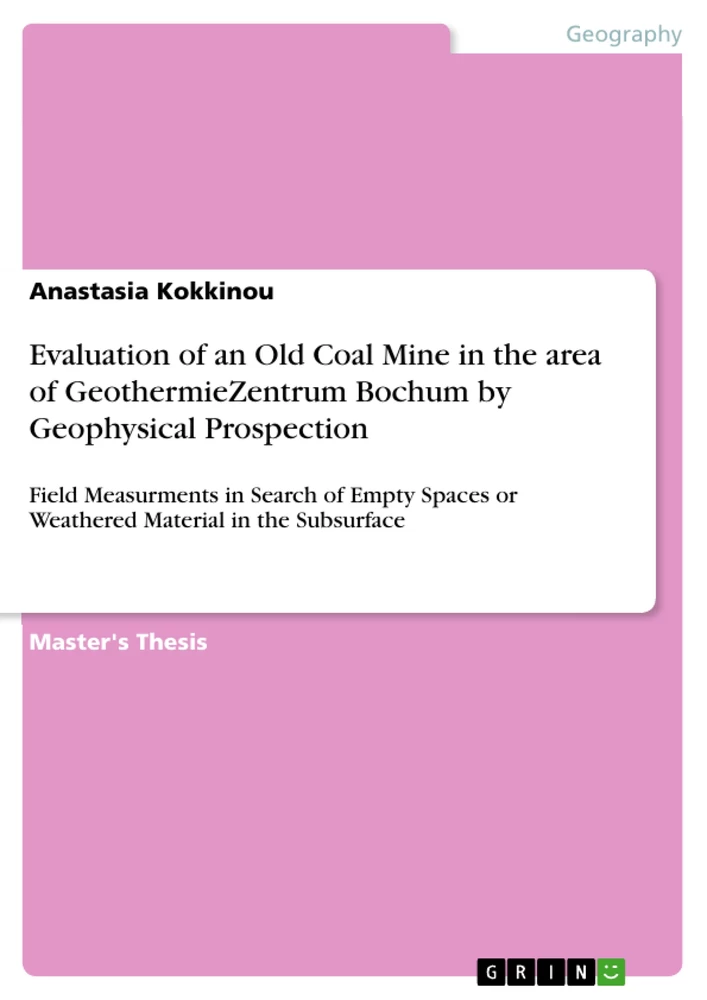
Table of Contents
1. Introduction
1.1 Motivation
1.2 Research Area
1.2.1 Geology
1.2.2 Former Studies
2. Surveys and Theoretical Background
2.1 Ground Penetrating Radar Survey
2.2 Geoelectric Survey
2.3 Seismic Survey
3. Field measurements
3.1 Measurements at the western side of GZB
3.2 Measurements at the eastern side of GZB
4. Data Processing and Results
4.1 Analyses of radargrams with ReflexW
4.2 Inversion of pseudo-sections with BERT and DC2DInvRes
4.2.1 Geoelectric data analysis of the western side of GZB
4.2.2 Geoelectric data analysis of the eastern side of GZB
4.3 Seismogram processing with FMTOMO
4.3.1 Analysis of the pre-existing seismic data near GZB building
4.3.2 Analysis of the seismic data from the survey at the eastern side of GZB
5. Interpretation
5.1 West of GZB
5.2 East of GZB
6. Summary and Conclusions
Research Objectives and Core Topics
This master thesis aims to evaluate the subsurface stability of an old coal mine ("Markgraf 2") located beneath the GeothermieZentrum Bochum (GZB). By employing non-destructive geophysical methods, the research seeks to develop an efficient, cost-effective, and safe exploration workflow that can identify structural weaknesses, such as loose material or cavities, to prevent ground collapse and subsidence in former mining areas.
- Geophysical investigation of subsurface stability using non-destructive techniques.
- Application and comparison of Ground Penetrating Radar (GPR), Geoelectric Tomography, and Seismic Refraction.
- Data processing and inversion workflows for subsurface modeling in urban, post-mining environments.
- Evaluation of restoration project effectiveness (1980 and 2010) through geophysical data interpretation.
- Development of a precautionary exploration methodology for historical mining sites.
Excerpt from the Thesis
1.1 Motivation
The Ruhr-area used to be the leading producer of coal among all European countries, during the 18th, 19th and 20th centuries. In the late 1990s the coal production was no more as profitable as it used to be and along with other factors, like health hazards that coal mining was accused for, they lead to dramatical decline of the mining activity and most of the mines have been closed. After the end of the exportation of the coal, the empty space that stays behind into the subsurface has to be filled up with the mining waste, and sometimes with pressed cement, so that ground stability is attained. For reasons that have not yet been clarified, in some areas, where a mine restoration by cement injection took place, the ground, nevertheless, underwent severe subsidence and depression. The crater of Wattensheid (an area which belongs to Bochum) is the nearest incident to the studied area. On the January of 2000, a crater of 500 m2 surface and 15 m depth along with a smaller crater near it, opened up in the urban area of Wattenscheid with no previous warning (DW, 2000). The incident is more likely connected to the activity of the old Mine “Marie Anne”, which was operating until 1905. Although the regular restoration project, that follows the closing of every mine, took place, the incident could not be avoided.
The reason that caused the subsidence and ground collapse at that specific time, is not yet determined but the reason why the incident happened at that specific area and what it was related to was specified as connected to the previous mining activity. It is consequently important to inspect such areas which were restored after previously mining activity in urban areas and non. Firstly, in the sense of safety reasons and secondary, because of financial reasons. Until now, the most accurate method that is used for the inspection of the subsurface and the estimation of the weaknesses of the subsurface, is the exploration drilling. Nevertheless, it is a very destructive and expensive method which rules out the probability of using this method for the underground exploration just for precaution. The idea of using geophysical methods, such as electromagnetic and seismic tomography for the evaluation of the subsurface could provide a partial or complete solution to that problem.
Summary of Chapters
1. Introduction: Presents the motivation behind the study, highlighting the history of mining in the Ruhr-area, the associated risks of subsidence, and describes the research area and geological context of the GZB site.
2. Surveys and Theoretical Background: Outlines the fundamental geophysical principles of GPR, Geoelectric, and Seismic surveys, establishing the theoretical framework for the study's chosen methods.
3. Field measurements: Details the site-specific setups for geophysical measurements conducted at the western and eastern sides of the GZB, including equipment and survey parameters.
4. Data Processing and Results: Describes the processing workflows for radar, geoelectric, and seismic data, including inversion strategies using software like ReflexW, BERT, and FMTOMO.
5. Interpretation: Synthesizes the results of the geophysical surveys to assess the stability and geological features of the subsurface, specifically looking for indicators of old mining activities.
6. Summary and Conclusions: Evaluates the efficacy of the applied geophysical workflow, offering suggestions for future improvements and summarizing the study's findings regarding the safety of the investigated area.
Keywords
Geophysics, Coal Mine, Subsurface Stability, Ground Penetrating Radar, Geoelectric Tomography, Seismic Refraction, Ruhr-area, Restoration, Subsidence, Data Inversion, ReflexW, BERT, FMTOMO, Mining Hazard, Near-surface exploration.
Frequently Asked Questions
What is the primary purpose of this study?
The study evaluates the subsurface stability of an old coal mine ("Markgraf 2") using non-destructive geophysical techniques to identify potential structural weaknesses and prevent subsidence.
Which geophysical methods were employed in this research?
The author utilized Ground Penetrating Radar (GPR), Geoelectric Tomography, and Seismic Refraction to characterize the subsurface properties.
What is the core research question or goal?
The goal is to determine if geophysical measurements provide a reliable, cost-effective, and non-destructive alternative to traditional exploration drilling for evaluating safety in restored post-mining areas.
Which specific areas were investigated?
The study focused on the western and eastern sides of the GeothermieZentrum Bochum (GZB) in Germany, which is situated over historical mining infrastructure.
How were the geophysical data processed?
The author used specialized software packages, including ReflexW for GPR analysis, BERT and DC2DInvRes for geoelectric inversion, and FMTOMO for seismic processing.
What are the key technical challenges mentioned?
Challenges include distinguishing between geological features and artifacts caused by near-surface obstacles (e.g., metallic tubes, gravel), signal attenuation, and the influence of meteorological conditions like rain on resistivity measurements.
How does the author evaluate the effectiveness of the 1980 and 2010 restoration projects?
The author compares current geophysical results with historical reports and borehole data to check for remaining subsurface anomalies, such as loose material or cavities, which indicate that the restoration might not have guaranteed full stability.
What role does the "safety pillar" play in this study?
The safety pillar is a section of the mine left unexcavated to ensure structural integrity; the study investigates whether the integrity of this pillar at the GZB site could be verified using non-destructive methods.
Ende der Leseprobe aus 60 Seiten
- nach oben
- Arbeit zitieren
- Anastasia Kokkinou (Autor:in), 2016, Evaluation of an Old Coal Mine in the area of GeothermieZentrum Bochum by Geophysical Prospection, München, Page::Imprint:: GRINVerlagOHG, https://www.diplomarbeiten24.de/document/365484

neugierig - aktuell - relevant
Entdecken Sie hilfreiche Tipps und Tricks rund ums Studium!

Entdecken Sie hilfreiche Tipps und Tricks rund ums Studium!
Ihre Hausarbeit / Abschlussarbeit:

- - Publikation als E-Book und Buch
- - Hohes Honorar auf die Verkäufe
- - Für Sie komplett kostenlos - mit ISBN
- - Es dauert nur 5 Minuten
- - Jede Arbeit findet Leser

- © GRIN Publishing GmbH.
- Alle Inhalte urheberrechtlich geschützt. Kopieren und verbreiten untersagt.
- info@grin.com
- AGB
- Open Publishing
Der GRIN Verlag hat sich seit 1998 auf die Veröffentlichung akademischer eBooks und Bücher spezialisiert. Der GRIN Verlag steht damit als erstes Unternehmen für User Generated Quality Content. Die Verlagsseiten GRIN.com, Hausarbeiten.de und Diplomarbeiten24 bieten für Hochschullehrer, Absolventen und Studenten die ideale Plattform, wissenschaftliche Texte wie Hausarbeiten, Referate, Bachelorarbeiten, Masterarbeiten, Diplomarbeiten, Dissertationen und wissenschaftliche Aufsätze einem breiten Publikum zu präsentieren.
Kostenfreie Veröffentlichung: Hausarbeit, Bachelorarbeit, Diplomarbeit, Dissertation, Masterarbeit, Interpretation oder Referat jetzt veröffentlichen!
Folgen Sie GRIN auf


- GRIN Verlag GmbH
-
- Nymphenburger Str. 86
- 80636
- Munich, Deutschland
- +49 89-550559-0
- +49 89-550559-10
- info@grin.com
-
