
präsentiert von

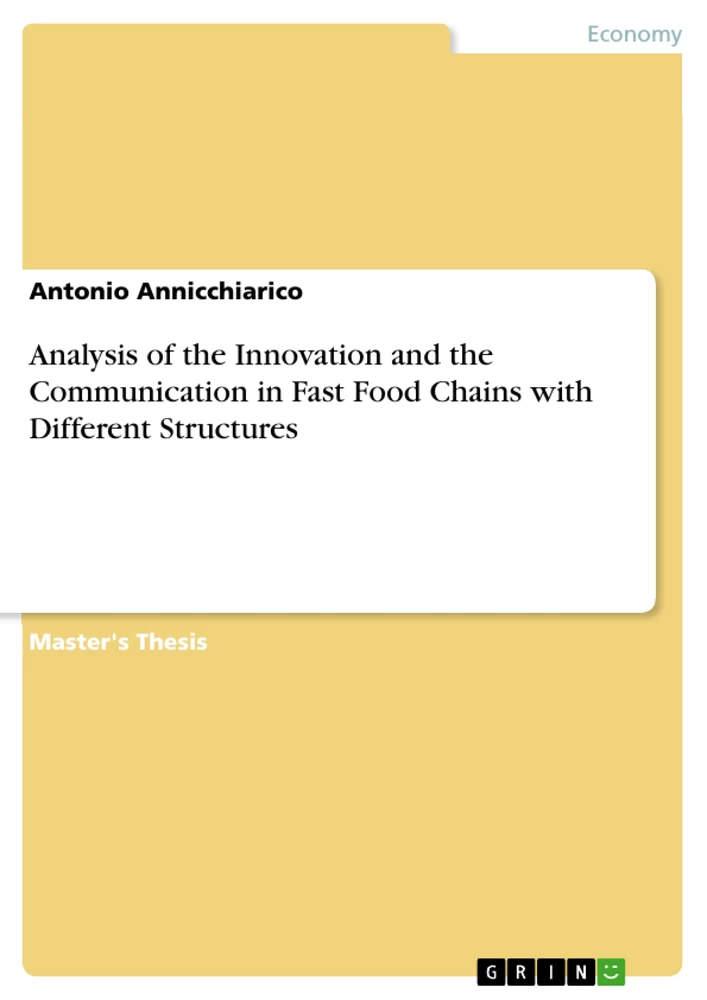
Table of Contents
1. INTRODUCTION
1.1. Problem Statement Franchisees and Company-Owned Stores
1.2. Purpose
1.3. Research Questions
1.4. Delimitations
2. LITERATURE REVIEW
2.1. Self Service Technology
2.2. Innovation
2.3. Franchising
2.4. Motivations to Franchise a Company
2.5. Advantages of the Different Structures
2.6. Innovation in the Different Structures
2.7. Communication
2.8. Literature Conclusions
2.9. Rogers Diffusion of Innovation Model
3. RESEARCH METODOLOGY
3.1. Motivations to Select a Case Study
3.2. Case Selection
3.2.1. Location of Research
3.2.2. Selection of Chains to Analyze
3.2.2.1. Subway
3.2.2.2. Pret a Manger
3.3. Data Collection
3.3.1. Interview Techniques and Guide to Maximize Data
3.4. Data Analysis
3.4.1. Inductive and Deductive Method
3.4.2. Survey (Research Design)
3.4.3. Analysis Data and Results
4. EMPIRICAL FINDINGS
4.1. Company Relationship SST’s
4.1.1. Subway
4.1.2. Pret a Manger
4.2. Communication
4.2.1. Subway
4.2.2. Pret a Manger
4.3. Innovation and Power Distribution
4.3.1. Subway
4.3.2. Pret a Manger
5. DATA ANALYSIS
5.1. Subway
5.1.1. Communication
5.1.2. Processes of Innovation within Subway
5.1.3. Rogers Diffusion of Innovation within Subway
5.1.4. Comparison with Previous Research
5.1.5. Individual Entrepreneur
5.1.6. Power
5.2. Pret a Manger
5.2.1. Communication
5.2.2. Power
5.2.3. Rogers Diffusion of Innovation within Pret a Manger
5.2.4. Comparison with Previous Research
6. CONCLUSIONS
7. DISCUSSIONS
8. GLOSSARY
9. REFERENCES
Research Objectives and Key Topics
The primary objective of this dissertation is to investigate the relationship and degree of power between local management and the innovation process within fast food restaurant chains, while evaluating the efficiency of internal communication across different organizational structures.
- Analysis of innovation management in franchised versus company-owned structures.
- Investigation of power distribution and its impact on the local manager's role in the innovation process.
- Evaluation of internal communication effectiveness, specifically horizontal and vertical information flow.
- Comparative analysis using two case studies: Subway (franchised) and Pret a Manger (wholly owned).
- Application of the Rogers Diffusion of Innovation model to understand innovation adoption stages.
Excerpt from the Book
3.1. Motivations to Select a Case Study
Generally one of the purposes which leads the study of innovation in the hospitality system is to enable to develop knowledge and understanding of examples of innovation and emerging technologies (or sometimes technological revolutions). This research will help to develop background knowledge for possible comparisons of industrial and commercial applications in the fast food chain businesses.
Choosing an innovation case study should consider the following issues:
1. Will the information you find on the innovation be of enough depth to fulfill the requirements of your case study?
2. Is the innovation truly innovative? The clearer cut the innovation, the easier it is to understand and analyze the factors that led to its development.
Choose an innovation that will allow identifying the components of innovation and talking about the relationship between them, that is, an analysis of innovation and emerging technologies.
To learn more about the nature of the innovation and the factors impacting innovation it need to be understood the nature and meaning of the innovation itself: this is the new use or application of existing technology for a completely different purpose from which it was originally used or intended. This is not a dictionary definition, it is a re-worded dictionary definition to make it more understandable.
Chapter Summaries
1. INTRODUCTION: Outlines the research background, the problem statement regarding franchisee versus company-owned store management, and the research purpose and questions.
2. LITERATURE REVIEW: Reviews existing theories on self-service technologies, innovation, franchising structures, and communication, concluding with a synthesis of key factors influencing innovation.
3. RESEARCH METODOLOGY: Details the rationale for using a qualitative case study approach, explaining the selection process for the chains Subway and Pret a Manger, and the methods used for data collection and analysis.
4. EMPIRICAL FINDINGS: Presents the primary data obtained from interviews with store managers, categorized by their relationship with technology, communication styles, and the distribution of power regarding innovation.
5. DATA ANALYSIS: Analyzes the empirical findings by comparing them against the established theoretical framework and the Rogers Diffusion of Innovation model for both companies.
6. CONCLUSIONS: Summarizes the findings, confirming the positive relationship between local management power and innovation, and highlights the communication challenges present in different organizational structures.
7. DISCUSSIONS: Reflects on the limitations of the current research and provides suggestions for expanding the study in future academic endeavors.
Keywords
Innovation, Fast Food Chains, Franchising, Company-Owned Stores, Local Management, Communication, Self Service Technologies (SST), Rogers Diffusion of Innovation, Power Distribution, Organizational Structure, Case Study, Qualitative Research, Business Strategy, Knowledge Diffusion, Operational Efficiency.
Frequently Asked Questions
What is the primary focus of this research?
The thesis focuses on how innovation is generated and managed within fast food restaurant chains, specifically examining the role of local management and the effectiveness of communication across different organizational structures.
What are the central thematic areas?
The core themes include the innovation process, the power dynamics between headquarters and local managers, the impact of company structure (franchised vs. company-owned) on innovation, and the role of communication in organizational success.
What is the main research question?
The research aims to determine how power distribution affects local management’s role in innovation, how effective internal communication is within these chains, and which organizational structure most efficiently promotes innovation.
Which scientific methods are employed?
The author uses a qualitative cross-case study approach, conducting semi-structured interviews with store managers from two distinct chains, Subway and Pret a Manger, and applying the Rogers Diffusion of Innovation model.
What does the main body cover?
The main body covers a comprehensive literature review, the research methodology, empirical findings from store manager interviews, and a detailed data analysis comparing the findings to existing management theories.
Which keywords characterize this work?
Key terms include Innovation, Franchising, Fast Food Chains, Local Management, Self Service Technologies (SST), Communication, and Organizational Structure.
Why were Subway and Pret a Manger selected as case studies?
They were chosen because they represent opposite poles of the organizational structure spectrum—Subway being almost entirely franchised and Pret a Manger being wholly company-owned—allowing for a robust comparative analysis.
How does the author define the role of local management in innovation?
The author identifies a positive relationship between the amount of formal power distributed to local managers and their influence in the innovation process, though this power is often limited by the requirement for brand uniformity.
What is the "plural structure" mentioned in the thesis?
It refers to a mix of franchised and company-owned stores within a single chain, which the author (supported by literature) discusses as a potentially superior organizational option for balancing innovation and efficiency.
What are the final conclusions regarding communication?
The thesis concludes that while vertical communication is generally seen as satisfactory, there is a distinct lack of efficient horizontal communication among franchisees, which creates unnecessary dependencies on higher-level management for routine issues.
Ende der Leseprobe aus 84 Seiten
- nach oben
- Arbeit zitieren
- Antonio Annicchiarico (Autor:in), 2012, Analysis of the Innovation and the Communication in Fast Food Chains with Different Structures, München, Page::Imprint:: GRINVerlagOHG, https://www.diplomarbeiten24.de/document/367942

neugierig - aktuell - relevant
Entdecken Sie hilfreiche Tipps und Tricks rund ums Studium!

Entdecken Sie hilfreiche Tipps und Tricks rund ums Studium!
Ihre Hausarbeit / Abschlussarbeit:

- - Publikation als E-Book und Buch
- - Hohes Honorar auf die Verkäufe
- - Für Sie komplett kostenlos - mit ISBN
- - Es dauert nur 5 Minuten
- - Jede Arbeit findet Leser

- © GRIN Publishing GmbH.
- Alle Inhalte urheberrechtlich geschützt. Kopieren und verbreiten untersagt.
- info@grin.com
- AGB
- Open Publishing
Der GRIN Verlag hat sich seit 1998 auf die Veröffentlichung akademischer eBooks und Bücher spezialisiert. Der GRIN Verlag steht damit als erstes Unternehmen für User Generated Quality Content. Die Verlagsseiten GRIN.com, Hausarbeiten.de und Diplomarbeiten24 bieten für Hochschullehrer, Absolventen und Studenten die ideale Plattform, wissenschaftliche Texte wie Hausarbeiten, Referate, Bachelorarbeiten, Masterarbeiten, Diplomarbeiten, Dissertationen und wissenschaftliche Aufsätze einem breiten Publikum zu präsentieren.
Kostenfreie Veröffentlichung: Hausarbeit, Bachelorarbeit, Diplomarbeit, Dissertation, Masterarbeit, Interpretation oder Referat jetzt veröffentlichen!
Folgen Sie GRIN auf


- GRIN Verlag GmbH
-
- Nymphenburger Str. 86
- 80636
- Munich, Deutschland
- +49 89-550559-0
- +49 89-550559-10
- info@grin.com
-
