
präsentiert von

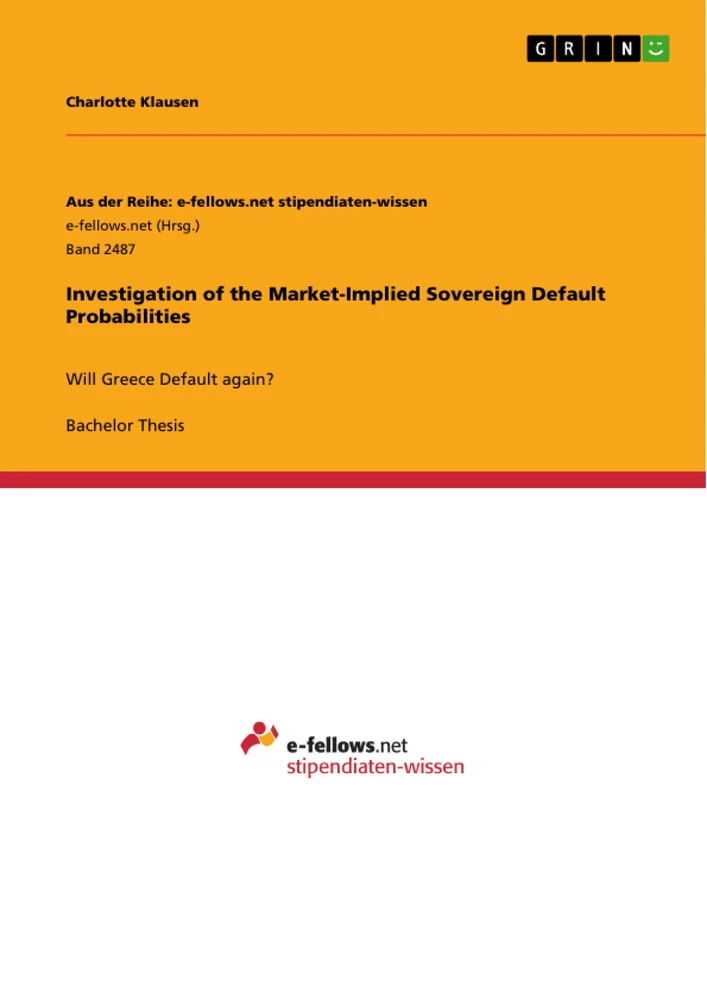
Table of Contents
1 Introduction
1.1 Problem formulation
1.2 Delimitations
1.3 Methodology
2 Theory: Credit Default Swaps
2.1 The contract and its terms
2.2 Corporate vs. sovereign CDS
2.3 Inferring default probabilities from CDS spreads
2.3.1 Default probabilities and the hazard rate λ
2.3.2 The Arbitrage-free model
3 Application of market-implied default probabilities
3.1 Default probabilities in five years for European sovereigns
3.2 Historical defaults and market-implied default probabilities
4 Analysis of CDS spreads
4.1 Greece’s, Germany’s, France’s and Italy’s spread evolution
4.2 Determinants of sovereign CDS spreads
4.3 Global risk factors
4.3.1 Stock market volatility index: VIX
4.3.2 The risk-free rate
4.3.3 Foreign Exchange rate, EUR/USD
4.4 Country specific factors
4.4.1 Local stock market
4.4.2 Domestic inflation rate
4.4.3 Unemployment Rate
4.5 Expected effects of explanatory variables on the spreads
5 Regression results
5.1 Greece’s CDS spread determinants
5.2 Germany’s CDS spread determinants
5.3 Italy’s CDS spread determinants
5.4 France’s CDS spread determinants
5.5 Predicted vs. actual spreads
6 Conclusion
7 Appendix
Research Objectives and Key Themes
This thesis aims to investigate market-implied sovereign default probabilities for selected European countries by utilizing Credit Default Swap (CDS) spreads. The research centers on the validity of these probabilities in predicting sovereign credit events and analyzes the macroeconomic determinants that drive CDS spread fluctuations through multiple linear regression.
- Computation of CDS-implied default probabilities for European sovereigns.
- Empirical comparison of market-implied probabilities with historical credit events (specifically the 2012 Greek default).
- Identification of global financial risk factors influencing CDS spreads (e.g., VIX, risk-free rate, FX rates).
- Analysis of country-specific determinants of spread volatility (e.g., local stock markets, inflation, unemployment).
- Validation of regression models by comparing predicted spreads with actual market data.
Excerpt from the Book
2.1 The contract and its terms
A CDS is a type of credit derivative, whose payoff depends on the whether a third party, i.e. either a company (for corporate CDS) or a country (for sovereign CDS), defaults or not. It is a contract between a default protection buyer and a default protection seller to provide insurance against the risk of default by a third party, the so-called reference entity. The reference entity however, is not part of the contract. The contract gives protection until some specified maturity date T or until default, whichever occurs first. It also specifies the time for the periodic payments of the buyer, which usually are made in arrears quarterly. The buyer of the contract takes a long position in the contract, whereas the protection seller takes the corresponding short position. The buyer owns one or more assets of the reference entity, so the buyer has an exposure to these assets of the reference entity. In return to the insurance against the credit risk, which the protection buyer receives, the protection buyer makes the periodic payments, which is known as the premium leg, until the end of the contract or until a default occurs – whichever event occurs first, will stop the payments and the contract will cease (Hull, 2012, pp. 547-548).
The payment of the protection seller to the protection buyer to compensate for the loss in case of default is called the protection leg. The protection leg is equal to the difference between par and the price of the cheapest to deliver asset of the reference entity on the face value of the protection (O’Kane and Turnbull, 2003, p. 3).
Summary of Chapters
1 Introduction: Provides an overview of the financial landscape post-Lehman Brothers, defines the purpose of using CDS for sovereign risk, and outlines the thesis methodology.
2 Theory: Credit Default Swaps: Explains the foundational mechanics of CDS contracts, differentiates between corporate and sovereign instruments, and develops the no-arbitrage model to infer hazard rates and default probabilities.
3 Application of market-implied default probabilities: Applies the theoretical model to compute default probabilities for European sovereigns and evaluates their accuracy by comparing them to historical defaults.
4 Analysis of CDS spreads: Examines the evolution of CDS spreads for Greece, Germany, France, and Italy, and identifies global and local macroeconomic factors that serve as potential determinants.
5 Regression results: Presents the findings of multiple linear regressions for each country and evaluates the model's performance in predicting current spreads.
6 Conclusion: Summarizes the thesis findings, confirming that while CDS spreads reflect default risk, they are subject to limitations regarding recovery rate assumptions and macroeconomic influences.
7 Appendix: Contains supporting statistical tables, supplementary probability calculations, and historical data proofs for the regression analysis.
Keywords
Credit Default Swap, Sovereign Default, Default Probability, Hazard Rate, No-Arbitrage Pricing, CDS Spreads, Macroeconomic Determinants, Regression Analysis, Eurozone Crisis, Credit Risk, Recovery Rate, Financial Markets, Sovereign Debt, Risk-Neutral Measure, Market-Implied Probability.
Frequently Asked Questions
What is the core focus of this thesis?
The thesis investigates how sovereign default probabilities can be derived from Credit Default Swap (CDS) spreads and what macroeconomic factors determine the fluctuations of these spreads.
What are the primary themes examined?
The work covers theoretical CDS pricing, the application of these models to European sovereign data, the influence of global risk factors like market volatility, and country-specific economic indicators.
What is the main objective or research question?
The primary objective is to compute market-implied default probabilities and determine if current regression models accurately predict sovereign defaults based on observed market spreads.
Which scientific methods are employed?
The research uses the no-arbitrage pricing model for CDS valuation and applies multiple linear regression analysis to identify significant determinants of spread changes.
What does the main body cover?
It details the contractual nature of CDS, derives hazard rates, performs empirical tests comparing market spreads to actual credit events, and presents regression results for Greece, Germany, Italy, and France.
Which keywords best characterize this research?
Key terms include Credit Default Swaps, sovereign risk, market-implied default probabilities, hazard rates, and macroeconomic determinants.
Why is the 2012 Greek default significant in this study?
The 2012 default serves as a critical real-world test case to evaluate how effectively CDS spreads predicted a sovereign credit event prior to its occurrence.
How does the assumption of the recovery rate impact the results?
The study finds that the recovery rate is a decisive variable; adjusting it significantly changes the output of default probabilities, highlighting its crucial role in the accuracy of the no-arbitrage model.
What does the comparison between predicted and actual spreads reveal?
The analysis indicates that the regression models consistently overestimate spreads across the sampled countries, suggesting potential limitations in the model's assumptions or the impact of market volatility.
Ende der Leseprobe aus 49 Seiten
- nach oben
- Arbeit zitieren
- Charlotte Klausen (Autor:in), 2015, Investigation of the Market-Implied Sovereign Default Probabilities, München, Page::Imprint:: GRINVerlagOHG, https://www.diplomarbeiten24.de/document/369427

neugierig - aktuell - relevant
Entdecken Sie hilfreiche Tipps und Tricks rund ums Studium!

Entdecken Sie hilfreiche Tipps und Tricks rund ums Studium!
Ihre Hausarbeit / Abschlussarbeit:

- - Publikation als E-Book und Buch
- - Hohes Honorar auf die Verkäufe
- - Für Sie komplett kostenlos - mit ISBN
- - Es dauert nur 5 Minuten
- - Jede Arbeit findet Leser

- © GRIN Publishing GmbH.
- Alle Inhalte urheberrechtlich geschützt. Kopieren und verbreiten untersagt.
- info@grin.com
- AGB
- Open Publishing
Der GRIN Verlag hat sich seit 1998 auf die Veröffentlichung akademischer eBooks und Bücher spezialisiert. Der GRIN Verlag steht damit als erstes Unternehmen für User Generated Quality Content. Die Verlagsseiten GRIN.com, Hausarbeiten.de und Diplomarbeiten24 bieten für Hochschullehrer, Absolventen und Studenten die ideale Plattform, wissenschaftliche Texte wie Hausarbeiten, Referate, Bachelorarbeiten, Masterarbeiten, Diplomarbeiten, Dissertationen und wissenschaftliche Aufsätze einem breiten Publikum zu präsentieren.
Kostenfreie Veröffentlichung: Hausarbeit, Bachelorarbeit, Diplomarbeit, Dissertation, Masterarbeit, Interpretation oder Referat jetzt veröffentlichen!
Folgen Sie GRIN auf


- GRIN Verlag GmbH
-
- Nymphenburger Str. 86
- 80636
- Munich, Deutschland
- +49 89-550559-0
- +49 89-550559-10
- info@grin.com
-
